We may earn a commission if you buy through links on this page. It never changes a score or a ranking. How we make money
For a general-purpose relational database, PostgreSQL is our best overall pick: it is open source, free and self-hostable, with your team responsible for hosting and operations. SQLite is a better fit when storage belongs inside an application; DuckDB and ClickHouse target analytical SQL. MongoDB suits document-shaped data, while Neon offers managed Postgres with branching. The right choice depends on your workload and who will run the system. Check pricing, deployment options and the operational work before you build around a database.
Quick picksThe shortlist
 PostgreSQLPostgreSQLBest overall · Free
 SQLiteSQLiteBest embedded database · $125/mo
 DuckDBDuckDBBest local analytics · Free
 ClickHouseClickHouseBest analytical SQL · Custom
 MongoDBMongoDBBest document database · $8/mo
 NeonNeonBest managed Postgres · $15/mo
 MySQLMySQLBest for MySQL apps · $178.33/mo
 RedisRedisBest shared fast data · $5/mo
 CockroachDBCockroachDBBest multi-region SQL · $203/mo
 ElasticsearchElasticsearchBest search database · $99/mo
 Neo4jNeo4jBest graph database · Free
01Compared at a glance
| Tool | Score | From | Free plan | Trial |
|---|---|---|---|---|
| PostgreSQLPostgreSQL | 8.4 | Free | Yes | — |
| SQLiteSQLite | 8.4 | $125/mo | Yes | — |
| DuckDBDuckDB | 8.5 | Free | Yes | — |
| ClickHouseClickHouse | 8.3 | Custom | No | 30 days |
| MongoDBMongoDB | 7.2 | $8/mo | Yes | — |
| NeonNeon | 7.6 | $15/mo | Yes | — |
| MySQLMySQL | 7.3 | $178.33/mo | Yes | 30 days |
| RedisRedis | 7.5 | $5/mo | Yes | — |
| CockroachDBCockroachDB | 7.6 | $203/mo | No | 30 days |
| ElasticsearchElasticsearch | 7.5 | $99/mo | No | — |
| Neo4jNeo4j | 7.4 | Free | Yes | — |
02The picks, in detail
- Best overallPostgreSQLPostgreSQL
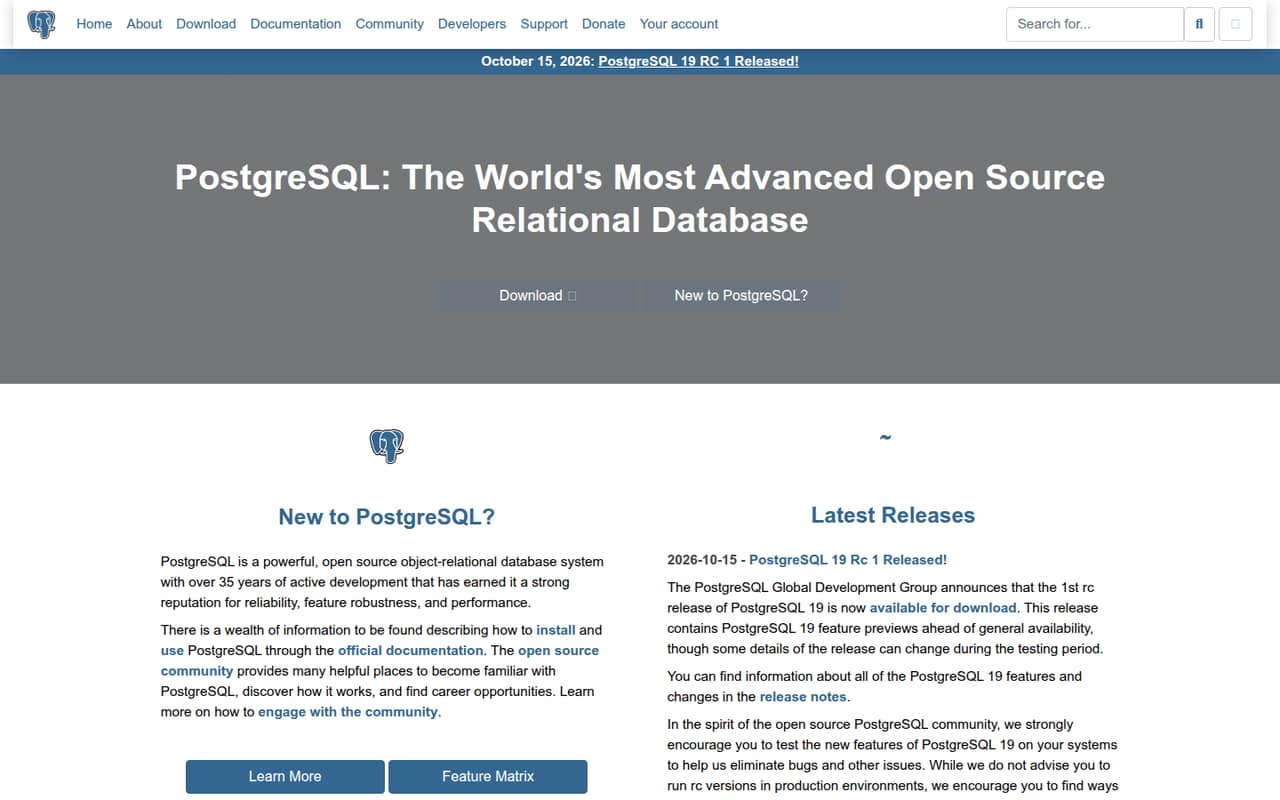
PostgreSQL is a free, open-source database server for teams that want a relational data layer and can operate it themselves. That makes it a flexible starting point for application data without a managed-service bill. The tradeoff is operational ownership: your team supplies hosting and ongoing database work. The listed starting price is n/a, with a free plan.
What works
- Open-source object-relational database system
- Free of charge under the PostgreSQL License
- More than 35 years of active development
What doesn't
- Hosting and operating costs are separate from the software
- No hosted API or managed service is established here
- Language-specific SDK details need confirmation in the docs
- Best embedded databaseSQLiteSQLite
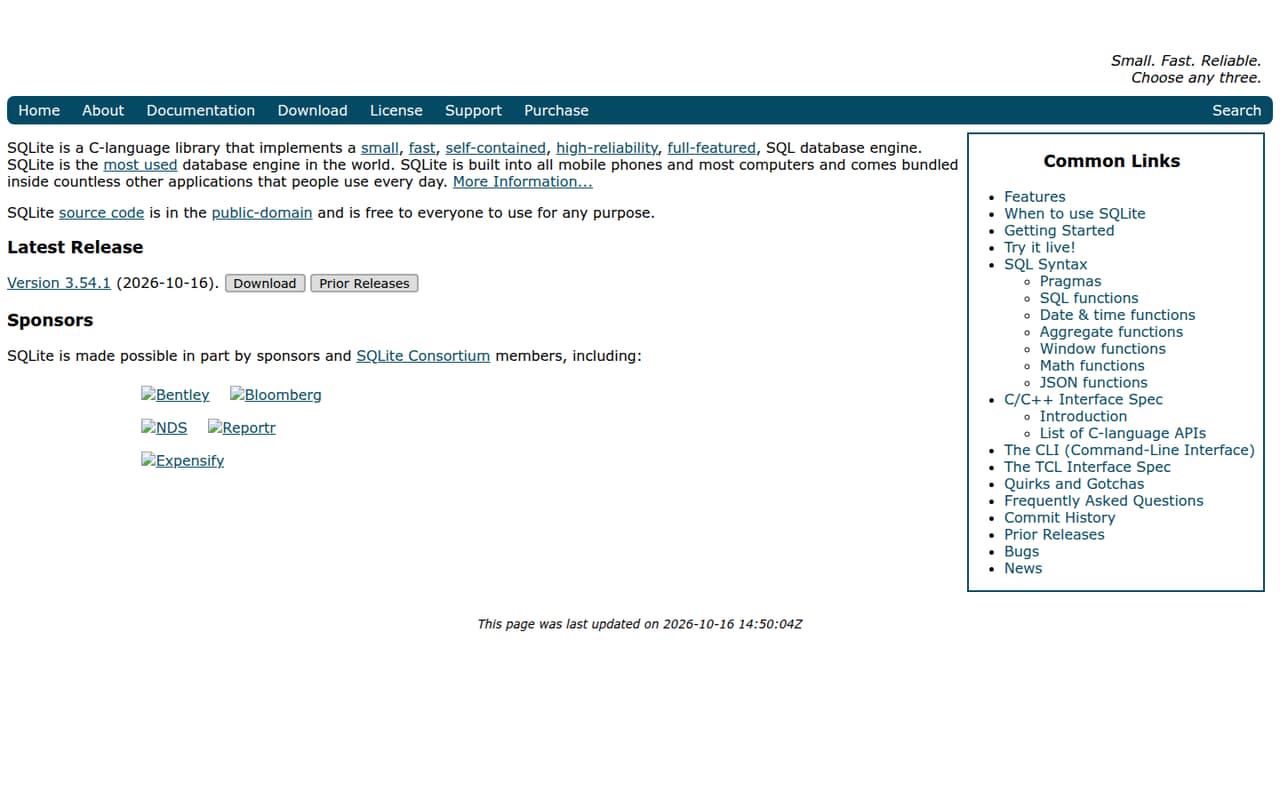
SQLite is a free C library that puts SQL storage inside an application, with no database server to deploy. It fits embedded storage, offline-first mobile apps and local datasets. That architecture avoids a separate server, but it is not the same operating model as a shared database service. The listing shows a free plan and a starting price of $125.
What works
- Public-domain source is free for any purpose
- SQL engine ships as a C-language library
- CLI and C/C++ interface documentation are available
What doesn't
- Not designed as a general networked database server
- Reddit users warn about concurrent-access constraints
- Paid direct support starts at $1,500 per year
- Best local analyticsDuckDBDuckDB
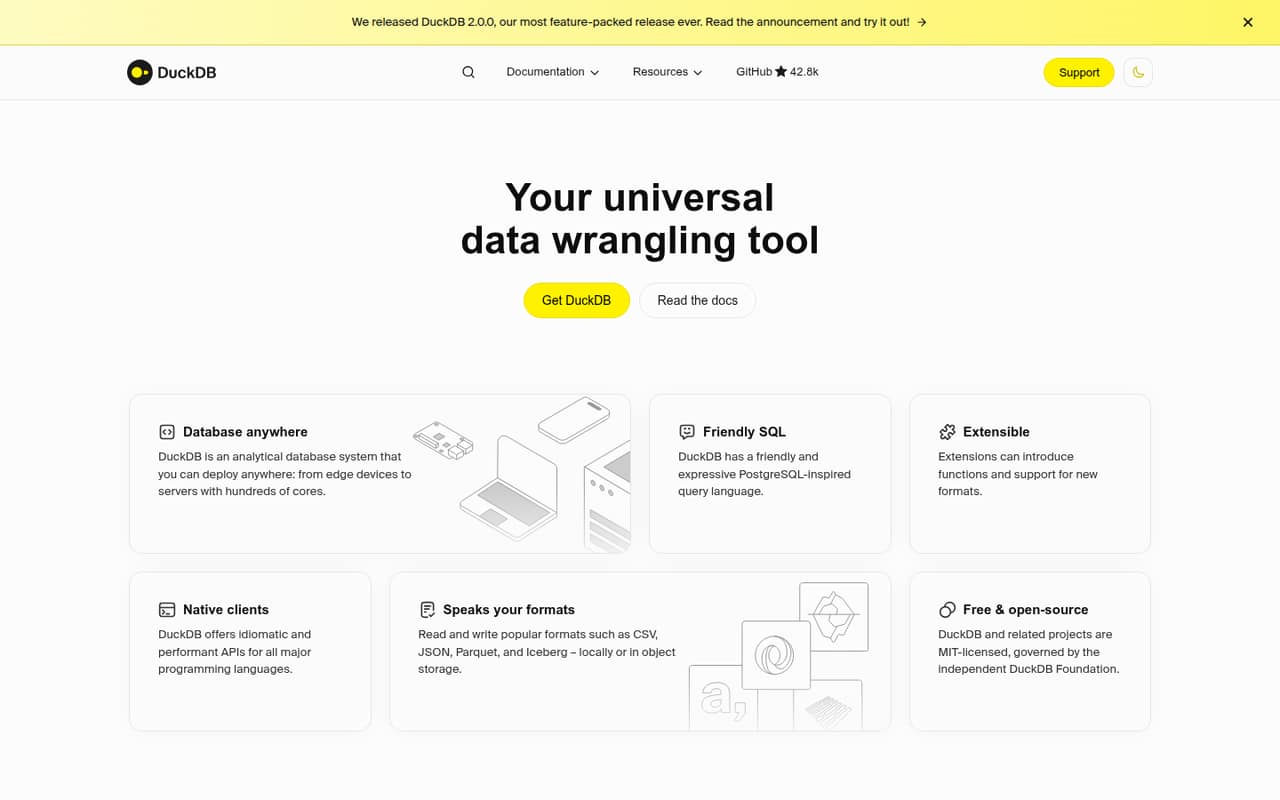
DuckDB is an in-process SQL analytics database for local data work, embedded queries and working with Parquet and CSV. It is a practical fit when analytics belong close to an application or a data file rather than in a separately operated server. It is open source, self-hostable and has a free plan; no starting price is listed.
What works
- Runs in-process without a separate database server
- MIT-licensed for personal and commercial use
- Reads and writes CSV, JSON, Parquet and Iceberg
What doesn't
- No paid plans or managed-service pricing are published
- Concurrency needs require workload-specific evaluation
- Support options and service commitments are not clear
- Best analytical SQLClickHouseClickHouse
ClickHouse is built for fast analytical SQL on large datasets. It suits teams that understand the columnar database model and are comfortable operating databases. The project is open source and self-hostable, so teams can run it themselves rather than depend on a managed deployment. The listed starting price is n/a, and the product has no listed free-plan detail.
What works
- Columnar storage suits analytical queries
- SQL supports sophisticated data analysis
- ClickHouse Local queries files without a server
What doesn't
- Schema and ingestion design need care
- Join-heavy workloads need evaluation
- Cloud compute and storage are billed separately
- Best document databaseMongoDBMongoDB
MongoDB fits applications built around document-shaped data and offers one query API for document-centric apps. It can also suit teams combining database operations and search. Flexible schemas still need deliberate design, and the team should choose between Atlas and self-hosting based on deployment needs. The listed starting price is $8, with a free plan; self-hosting is available.
What works
- Document model maps to application access patterns
- One query API supports varied workloads
- Atlas offers a free tier
What doesn't
- Flexible schemas still require planning and discipline
- Atlas costs rise with cluster size and usage
- Atlas Infinite is in public preview

- Best managed PostgresNeonNeon
Neon pairs managed Postgres with branching and backend services. It is worth considering for teams that want Postgres without supplying all the hosting themselves, or need isolated preview databases. Branching does not make usage costs fixed: paid bills depend on usage. The listed starting price is $15, with a free plan. Check the usage model against expected production activity.
What works
- Free plan includes 100 projects
- Database branches are copy-on-write
- Compute scales with application load
What doesn't
- Paid monthly spends are estimates, not fixed fees
- Compute and storage charges grow with usage
- Additional branches incur hourly charges
- Best for MySQL appsMySQLMySQL
MySQL is the sensible choice when an application and its team already depend on MySQL, or when a GPL database is required. It is open source and self-hostable, and it also has embedded OEM use cases. Production costs and licensing depend on the edition and server size. The listed starting price is $178.33, with a free plan.
What works
- Community Edition is free under GPL
- Community governance promotes open collaboration
- Enterprise Edition includes management tools and support
What doesn't
- Paid editions are licensed per server
- Socket-based pricing raises costs on larger servers
- Community Edition socket and seat limits are unpublished
- Best shared fast dataRedisRedis
Redis suits applications that need shared, fast data, including AI agents that retrieve context and teams that need multi-region reads. It is open source and self-hostable, so deployment choice is part of the decision. Production fit depends on cost and deployment requirements. The listed starting price is $5, with a free plan.
What works
- Combines caching, streaming and search
- Offers vector search for AI context
- Supports cloud, on-premises and hybrid deployment
What doesn't
- Free cloud tier is limited to 30 MB
- Pro has a $200 monthly minimum
- Request and rate limits are not published
- Best multi-region SQLCockroachDBCockroachDB
CockroachDB is a PostgreSQL-compatible distributed SQL database for teams building multi-region production applications or global services. Its distributed design targets resilience across regions, but a team should confirm the compatibility it needs before choosing it as a PostgreSQL replacement. The product is self-hostable. The listed starting price is $203, with no free plan listed.
What works
- PostgreSQL wire protocol and broad driver compatibility
- Every node can accept reads and writes
- Adds capacity without manual sharding
What doesn't
- No free plan; trial has a credit limit
- Storage, backups and data transfer cost extra
- Published Standard vCPU-hour rates differ by pricing table
- Best search databaseElasticsearchElasticsearch
Elasticsearch is a fit for search across large datasets and AI applications that need hybrid retrieval. It is open source and self-hostable, but teams should be prepared for cluster operations and scaling work. That makes it a more specialized choice than a general relational database. The listed starting price is $99; no free plan is listed.
What works
- One API supports vector and hybrid search
- Indexes structured and unstructured data
- Supports full-text search and real-time analytics
What doesn't
- Cloud costs scale with RAM-hours, storage and zones
- Hosted Standard starts at $99 per month
- Reddit users report painful upgrades
- Best graph databaseNeo4jNeo4j
Neo4j is designed for connected-data workloads, including applications centered on relationships and knowledge graphs for AI context. It offers managed and self-managed deployment options, so teams can evaluate how much infrastructure they want to own. The listed starting price is n/a, with a free plan. Choose it for graph-shaped problems, not as a general replacement for SQL.
What works
- Managed and self-managed graph products
- Graph analytics and Graph Data Science offerings
- GraphRAG connects graph data to AI context
What doesn't
- AuraDB production pricing is billed per GB per hour
- Free-tier capacity limits are not published
- License terms need confirmation before self-hosting
03How we chose
We ranked systems for developers and technical teams by workload fit, deployment model and the amount of operational work they imply. We weighed API and SDK coverage, documentation, free tiers and usage-based pricing, open-source licensing, self-hosting and portability. We also treat Reddit sentiment as a secondary signal when evaluating developer fit, not as a substitute for product documentation or pricing terms. We did not claim hands-on testing or benchmarks. Prices are starting points, not estimates for a production workload; check the vendor’s current terms and model expected usage before committing.
04Match the database to the workload
Start with the shape and access pattern of the data. PostgreSQL is a general relational choice; MySQL is a natural fit for existing MySQL applications. MongoDB targets document-shaped data, while Neo4j focuses on connected data. For analytics, DuckDB is an in-process option for local queries and data files; ClickHouse targets fast analytical SQL on large datasets. SQLite embeds storage in an application rather than requiring a database server. These are different architectures, not interchangeable feature sets. Decide whether the application needs a shared operational database, embedded storage, search, graph traversal or analytics. Then check whether the database’s query model and deployment options fit that role. Adding a second database can solve a specific workload, but it also adds another system to operate, integrate and account for.
05Price the operating model, not just the plan
A free plan or low starting price does not establish what production will cost. Compare the pricing model with expected usage, and check how the bill changes as data and activity grow. Neon lists a $15 starting price and says paid bills depend on usage; MongoDB lists $8 and a free plan. For self-hosted options such as PostgreSQL, SQLite and ClickHouse, the software may be free or open source, but your team supplies the hosting and operational work. Also confirm licensing for your deployment and product: MySQL’s production cost and licensing depend on edition and server size. Before committing, review backups, scaling, monitoring, migration paths and data export. Ask the vendor which limits apply to your plan and what happens when you exceed them; do not assume a free tier has production capacity.
Questions people ask
Can you give me some examples of database software?
Examples include PostgreSQL and MySQL for relational data, MongoDB for document-shaped applications, SQLite for embedded storage, DuckDB and ClickHouse for analytics, Redis for shared fast data, Elasticsearch for search and Neo4j for connected data. They solve different workloads, so choose by data shape and access pattern.
Is Neo4j better than SQL?
They serve different data models. Neo4j is a graph database for connected-data workloads; SQL databases such as PostgreSQL and MySQL are relational systems. If relationships and graph queries are central to the application, evaluate Neo4j. For relational application data, start with a SQL database. Neither is universally better.
Which is harder, SQL or Excel?
It depends on the task and the user. Excel provides a spreadsheet interface for working with tables; SQL is a language for querying and managing data in databases. SQL has syntax and database concepts to learn, while spreadsheet work can become difficult to manage as data and workflows grow. They solve different jobs.
What are the top 5 data management tools?
For developer teams, five useful starting points are PostgreSQL for relational storage, SQLite for embedded data, MongoDB for document-shaped data, Redis for shared fast data and ClickHouse for analytical SQL. This is a shortlist by workload, not a universal ranking. A SQL client or migration tool may also be part of a team’s stack.