
We may earn a commission if you buy through links on this page. It never changes a score or a ranking. How we make money
The bottom line
A free C library that puts SQL storage inside your application, without a database server.
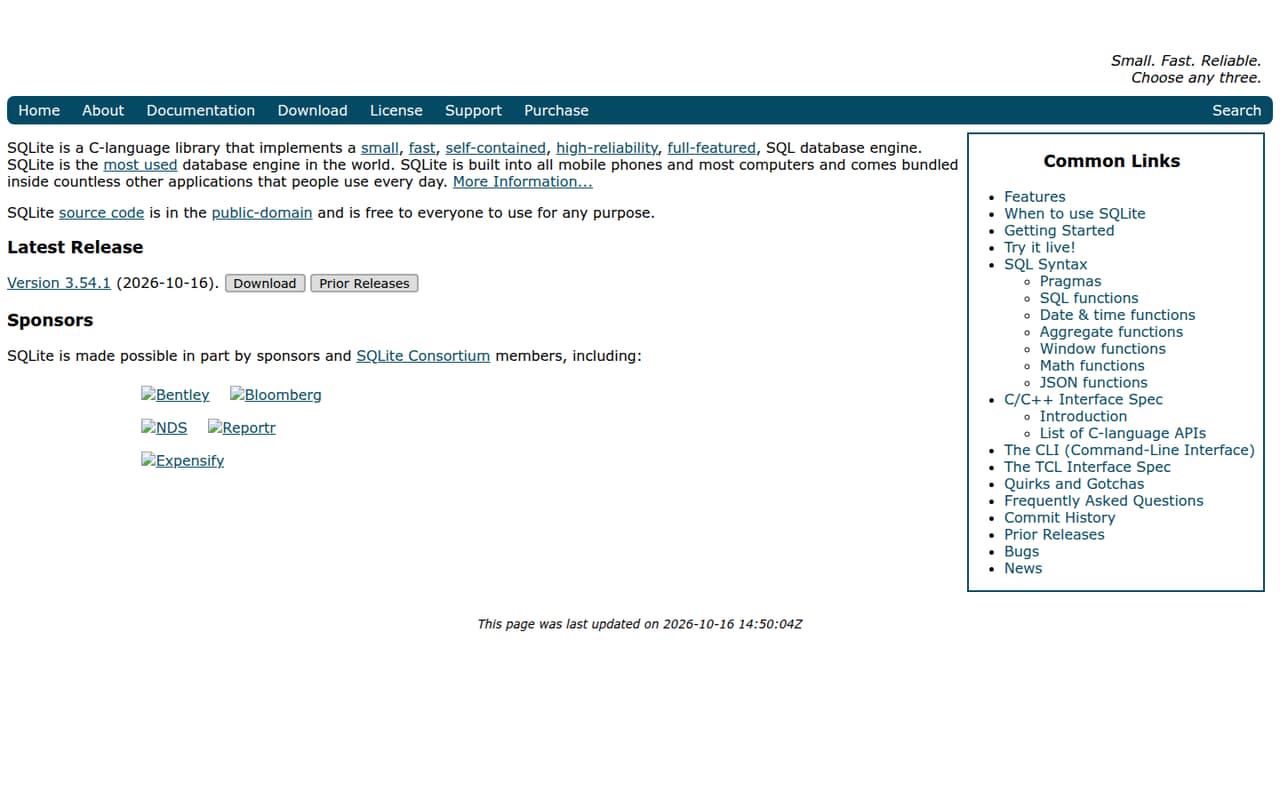
SQLite is a C-language library that embeds a full-featured SQL database engine in an application. Its public-domain source is free for any use, and the CLI and documentation provide direct ways to work with the engine.
It fits local and embedded data well, but it is not a general substitute for a networked database server. Reddit users praise its simplicity and reliability in deployed systems, while warning that multi-client architectures and plans for ongoing scale need careful evaluation.
Good fit if
- Embedded application storage
- Offline-first mobile apps
- Local datasets and configuration
Skip it if
- Networked multi-client database services
- Teams needing paid support at no cost
- Portable data exchange formats
ScoresHow it rates
What works
- Public-domain source is free for any purpose
- SQL engine ships as a C-language library
- CLI and C/C++ interface documentation are available
- No hosted service or usage bill is required
- SQL features include JSON and window functions
What doesn't
- Not designed as a general networked database server
- Reddit users warn about concurrent-access constraints
- Paid direct support starts at $1,500 per year
- SQLite database files are not ideal exchange formats
- Scaling plans may require a different architecture
01What SQLite is, technically
SQLite is an embedded database engine delivered as a C-language library, not a hosted API or a standalone database server. It puts SQL storage inside an application, with the engine working on a database file rather than requiring a separate server process. That makes it a way to manage structured local data where an application might otherwise read and write files directly.
The homepage describes SQLite as small, fast, self-contained, high-reliability and full-featured. It also says the engine is built into all mobile phones and most computers, and is bundled in many applications. SQL is the interface for querying and changing data; the project documents SQL syntax, functions and pragmas. The CLI offers a separate command-line interface for working with databases. This architecture is a good match for app-local storage, configuration and datasets, but it is not the same deployment model as a database service designed to serve many clients over a network.
02SQLite API, SDKs and docs
The primary integration surface is the C-language library. SQLite publishes a C/C++ Interface Specification and a list of C-language APIs; it also has a TCL Interface Specification. The homepage names the CLI (Command-Line Interface) as another way to work with SQLite. For application code in other languages, confirm binding and SDK support in the project documentation rather than assuming a particular package is maintained by SQLite.
The docs cover SQL syntax, pragmas, SQL functions, date and time functions, aggregate and window functions, math functions and JSON functions. They also link to Getting Started, Features, When to use SQLite, FAQs, quirks and gotchas, and prior releases. This gives developers reference material for both the SQL layer and the C interface. SQLite is a library rather than a hosted API, so integration centers on embedding the engine and choosing a compatible language binding; there is no hosted endpoint to call.
03SQLite pricing for developers
SQLite's source code is in the public domain and free for anyone to use for any purpose. There is no usage-based engine fee listed, so the bill does not grow with queries, seats or compute as it would for a metered hosted database. The free public forum is the community-support option; the pricing information does not list seat or usage limits for it.
Paid support is sold annually. The Annual Maintenance Subscription costs $1,500 per year for one development team and one contact person, with up to 20 contact hours per year. Standard Technical Support is listed at $8,000 for one year; custom packages generally range from $8,000 to $35,000 per year. Consortium membership is listed at $150,000 per year, while the consortium page also says $120,000. The one-time SQLite License for a warranty of title is $6,000. SEE, for encryption, is $2,000 one time for one team's perpetual source-code license. CEROD is $2,000 and ZIPVFS is $4,000, each one time. Monthly prices are not published.
04SQLite: open source, self-hosting and lock-in
SQLite's source code is public domain, and the project says it is free for everyone to use for any purpose. That is different from a conventional open-source license: the project calls the code public domain. The engine is a library that runs as part of an application, so there is no SQLite-hosted service to self-host or migrate away from.
The database is a file, and Reddit commenters describe SQLite as useful for local application state. One commenter cautions that SQLite is not designed as a good exchange format. Plan exports as an application-level requirement: decide how to convert or present the data if another system needs to consume it. Moving to another database also involves migrating the schema and data and adapting application code that uses SQLite's C API or a language binding. The source is available, but SQL compatibility and application integration still affect migration effort.
05SQLite in production
SQLite's homepage calls it high-reliability, and Reddit users report deploying it on thousands of terminals and in long-running products. Those are user reports, not a guarantee for a particular workload. The main production question is architectural: your application embeds the engine and owns access to its data, rather than sending requests to a database server built for many networked clients.
Several Reddit commenters caution that concurrent access and multi-client backend workloads can make SQLite a poor fit; others say online services can work when the workload suits the engine. Test the actual access pattern, backup procedure and recovery plan before committing. One Reddit commenter warns against simply copying a database file while it is open. If you need encryption, the SQLite Encryption Extension is a separately priced option at $2,000 one time. Check security and compliance requirements against your deployment and the extension terms; the project pricing also lists separate support for SEE, with price not published.
From the threadsWhat users say
Reddit sentiment is broadly positive when SQLite is used for embedded or local data, with strong praise for its simplicity and real deployments. The main reservations concern multi-client workloads, concurrent access and choosing it for systems expected to scale into a different architecture.
SQLite is very, very good at its intended job. However, if you do not know what its intended job is, then it will be a poor fit
If the database is embedded, go for it. If the database is part of a networked architecture, use Postgres or another DB designed for many clients
We have been using Sqlite on thousands of terminals for a decade without issue
SQLite's main benefit is simplicity, and its main target isn't replacing Postgres, it's replacing fopen
Questions people ask
Is SQLite suitable for production?
It can be, when the workload suits an embedded database. Reddit users report long-running deployments, including use on thousands of terminals. Evaluate how your application accesses the database, how it backs up and recovers data, and whether your architecture needs a server designed for many networked clients.
What are SQLite's main limitations?
SQLite is a library embedded in an application, not a database server for every networked workload. Reddit commenters warn about concurrent access and multi-client architectures. Its database file is also not designed as a general exchange format, so plan a separate export path if other systems need the data.
Can I use SQLite for free in a commercial application?
The SQLite homepage says its source code is public domain and free for everyone to use for any purpose. A separate SQLite License is available for buyers seeking a warranty of title and is listed at $6,000 one time. That purchase is distinct from the right to use the core public-domain code.
How much does SQLite support cost?
The Annual Maintenance Subscription is listed at $1,500 per year for one development team, one contact person and up to 20 contact hours. Standard Technical Support is $8,000 for one year, with custom packages generally listed at $8,000–$35,000 per year. A free public forum is also available.
How do I move data out of SQLite?
Treat export as an application requirement. SQLite stores data in a database file, but a Reddit commenter notes that it is not designed as a good exchange format. Choose a target format or database, define how to transform the schema and data, and verify that the destination can represent the types and queries your application uses.
Sources
- SQLite homepage
- SQLite pricing, compiled via web search from sqlite.org
- Reddit: Why isn't SQLite more commonly used for save files or for other user-facing application file formats?
- Reddit: Why does SQLite (in production) have such a bad rep?
- Reddit: SQLite is not a toy database
- Reddit: Why you should probably be using SQLite