
We may earn a commission if you buy through links on this page. It never changes a score or a ranking. How we make money
The bottom line
A free, open-source database server; teams supply the hosting and operational work.
PostgreSQL is an open-source object-relational database system for the data layer of an application. Its long development history, official documentation and active community make it a strong option for teams choosing a database they can run themselves.
The software is free, but production is not cost-free: your team must account for hosting and operations. PostgreSQL is a good fit when you want control over deployment and can manage upgrades, availability and capacity.
Good fit if
- Teams that want open-source database software
- Applications needing a relational data layer
- Organizations able to operate their database
Skip it if
- Teams seeking a turnkey hosted database
- Projects requiring a named SDK guarantee
- Teams unable to own database operations
ScoresHow it rates
What works
- Open-source object-relational database system
- Free of charge under the PostgreSQL License
- More than 35 years of active development
- Official documentation and community learning resources
- No published seat or usage limits
What doesn't
- Hosting and operating costs are separate from the software
- No hosted API or managed service is established here
- Language-specific SDK details need confirmation in the docs
- Production capacity and rate limits need deployment-specific planning
- PostgreSQL 14 fixes end November 12, 2026
01What PostgreSQL is, technically
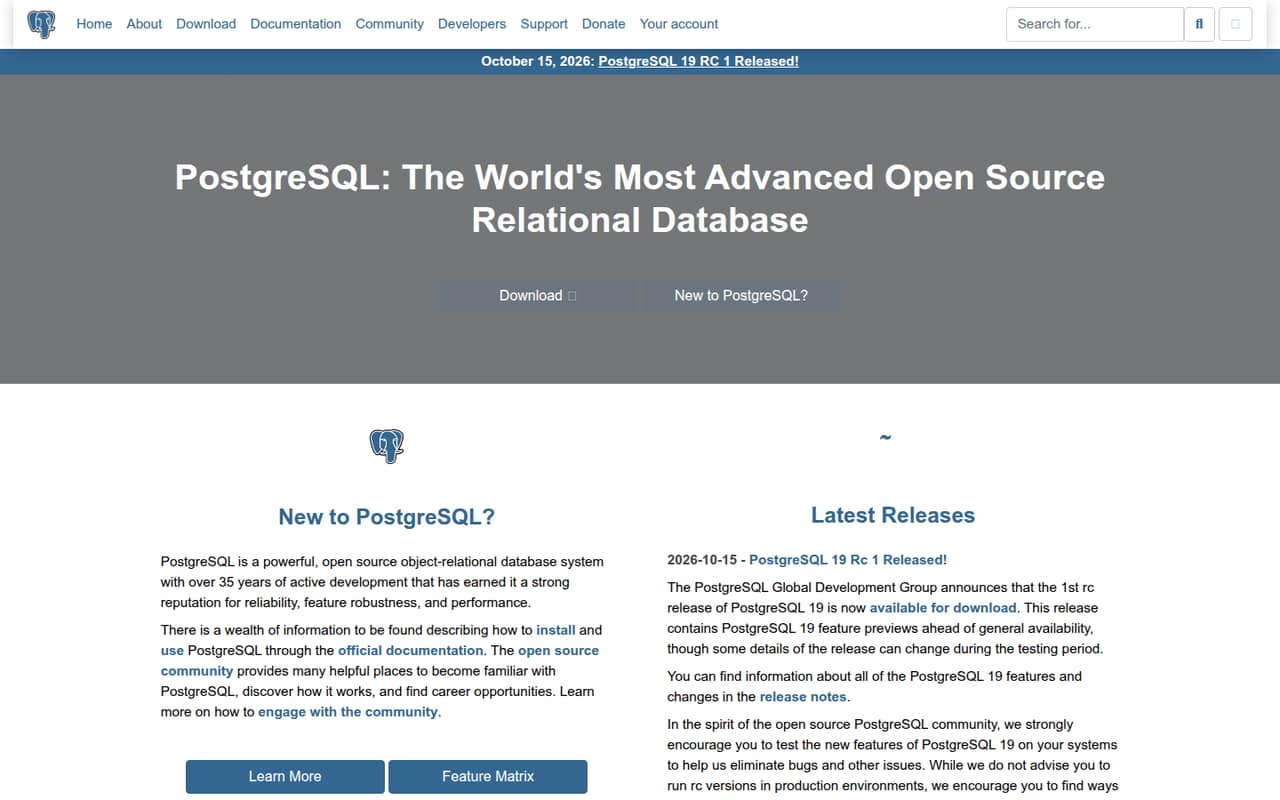
PostgreSQL is an open-source object-relational database system: a database server for the data layer of an application, rather than a SaaS app, library or hosted API. Your application uses it to store and work with structured data; the server is a separate component in the stack. The project offers downloads and official documentation for installing and using it.
That architecture gives teams the option to run PostgreSQL in their own environment and choose how it fits alongside application services. It also means the team operating it is responsible for the database deployment and its production lifecycle. PostgreSQL’s homepage points to more than 35 years of active development and says the project has earned a reputation for reliability and performance. Those are project claims, not a substitute for testing the database with your workload or planning operations. The project also provides community resources for learning and support.
02PostgreSQL API, SDKs and docs
PostgreSQL is a database integration point in an application stack, not an HTTP API or standalone client library. The project homepage directs developers to downloads and official documentation for installing and using the database. It also links to a feature matrix, release notes, versioning policy and community resources, including mailing lists and events.
The homepage does not name programming languages, SDKs, database drivers, a CLI or an API protocol. Treat the server as the integration surface and confirm language-driver support and connection details in the official documentation before choosing an application stack. The PostgreSQL community mailing lists cover development, using the database, events and releases. That gives teams public learning and discussion channels, but the homepage does not describe a paid support plan or response-time commitment. For a production integration, check the docs for the supported client options and the upgrade guidance relevant to your chosen PostgreSQL version.
03PostgreSQL pricing for developers
The open-source PostgreSQL option is free of charge and uses the OSI-approved PostgreSQL License. The pricing information lists no paid plans, monthly or annual billing, or published seat and usage limits. The software’s starting price is therefore $0; there is no listed free-trial period because the software itself is free.
That does not make a production database free to operate. Teams running PostgreSQL need to budget for the infrastructure and operational work their deployment requires. The pricing information does not list per-request, per-seat or compute charges, overage fees, or add-ons, so there is no published PostgreSQL software bill that grows with those measures. Instead, costs depend on how and where you run it and what operational support your organization needs. Ask any hosting provider about its own compute, storage, backup and network charges: those are separate from PostgreSQL’s license and are not set by the PostgreSQL project. There is no vendor-published usage cap to plan around in the listed open-source option.
04PostgreSQL: open source, self-hosting and lock-in
PostgreSQL is open-source software under the OSI-approved PostgreSQL License. Its homepage offers downloads and instructions for installing the database, so teams can run it themselves instead of depending on a PostgreSQL-hosted service. The open-source community also provides documentation and discussion resources.
Running the database yourself avoids tying its operation to one hosted vendor, but it makes your team responsible for deployment and maintenance. The published pricing details do not describe an export product or migration service. Before adopting PostgreSQL, define how your application will extract its data and how you would move it to another database; test that process against your schema and application dependencies. The open-source license and downloadable software give teams access to the database itself, but they do not make every application-level migration automatic.
05PostgreSQL in production
The project describes PostgreSQL as reliable and performant, but its homepage does not give capacity or rate-limit figures. Production planning should therefore start with your workload, deployment design and operational requirements rather than assuming a universal limit. Confirm the version you intend to run and its support window: PostgreSQL says version 14 will stop receiving fixes on November 12, 2026, and recommends planning an upgrade to a newer supported version.
The project labels PostgreSQL 19 RC 1 a feature preview and advises against running release candidates in production. Reddit discussions include users praising PostgreSQL’s handling of constraints and data, while another commenter says the right database depends on the use case. Those are individual reports, not service guarantees. Establish your own checks for availability, backups, security, compliance and recovery in the environment where you deploy it; the project homepage does not publish capacity targets or compliance commitments.
From the threadsWhat users say
The Reddit comments lean positive, with several users recommending PostgreSQL and praising its data handling. Some comments also stress that database choice depends on workload and requirements.
Postgres all the way
Usually there's no reason to use mongo unless there's a specific requirement
PostgreSQL treats data much more seriously
Hard to say without knowing your use case, but PostGIS - geospatial storage and operations
Questions people ask
Is PostgreSQL free?
Yes. PostgreSQL is free-of-charge open-source software under the OSI-approved PostgreSQL License. The listed software option has no paid plans or published seat and usage limits. Running a production deployment can still incur infrastructure and operations costs, which are separate from the PostgreSQL software license.
Can I self-host PostgreSQL?
Yes. PostgreSQL is downloadable software, and its official documentation covers installation and use. A self-hosted deployment gives your team responsibility for operating the database, including planning upgrades and production requirements. The project homepage also points to community resources for learning and support.
Is PostgreSQL a hosted API?
No. PostgreSQL is an open-source object-relational database system, not a hosted API or SaaS application. It sits in the data layer of a software stack. The PostgreSQL project provides downloads and documentation; teams choose how to deploy it and how their applications connect.
What should I budget for PostgreSQL in production?
The PostgreSQL software is free, with no listed usage-based fee or paid plan. Budget separately for the infrastructure and operational work required by your deployment. If you use a hosting provider, check its prices for compute, storage, backups and network use; those charges are separate from the PostgreSQL license.
How should I plan PostgreSQL upgrades?
Check the project’s versioning policy and plan to move from versions that are nearing the end of fixes. PostgreSQL says version 14 will stop receiving fixes on November 12, 2026, and recommends planning an upgrade to a newer supported version. The project advises against running PostgreSQL 19 release candidates in production.
Sources
- PostgreSQL homepage
- PostgreSQL pricing, compiled via web search from capterra.com, postgresql.org
- Reddit: As of nowadays, is there any reason to use MongoDB over PostgreSQL?
- Reddit: PostgreSQL user here—what database is everyone else using?
- Reddit: What are the reasons *not* to migrate from MySQL to PostgreSQL?
- Reddit: Convince me to choose PostgreSQL over MySQL