
We may earn a commission if you buy through links on this page. It never changes a score or a ranking. How we make money
The bottom line
A flexible database platform, but production costs and licensing depend on the edition and server size.
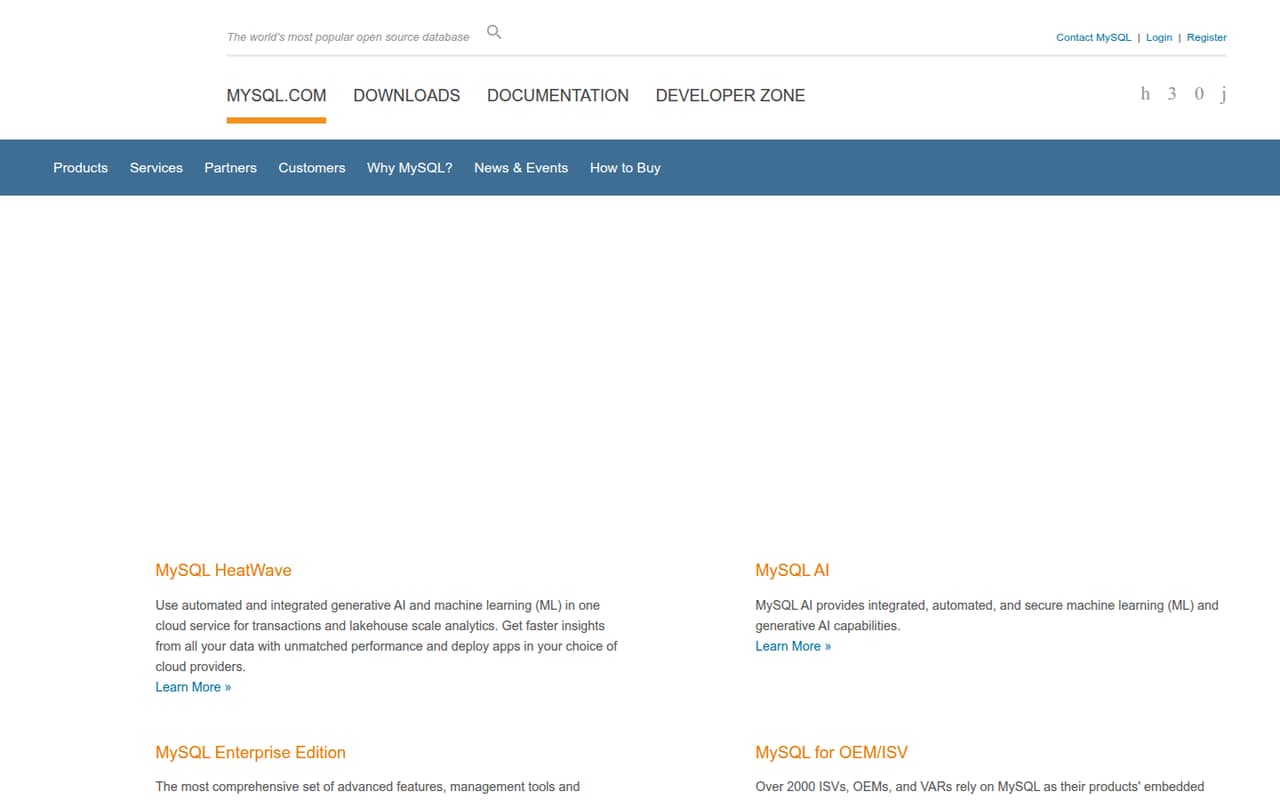
MySQL is a database platform spanning a GPL Community Edition, paid Enterprise and Cluster editions, and the HeatWave cloud service. Its core role is application data storage; HeatWave adds transactions, lakehouse-scale analytics, machine learning and generative AI capabilities.
The free Community Edition is a practical starting point, while paid editions add enterprise features, management tools and support. Reddit sentiment is divided: developers cite its ecosystem and long-running deployments, while others prefer PostgreSQL or MariaDB. Compare the licensing and operational fit with your workload before committing.
Good fit if
- Applications already built on MySQL
- Teams needing a GPL database
- Embedded products from OEMs
Skip it if
- Teams requiring published usage limits
- Projects seeking one fixed cloud price
- Teams unwilling to assess Oracle licensing
ScoresHow it rates
What works
- Community Edition is free under GPL
- Community governance promotes open collaboration
- Enterprise Edition includes management tools and support
- HeatWave combines transactions and analytics
- Used for embedded products by ISVs and OEMs
What doesn't
- Paid editions are licensed per server
- Socket-based pricing raises costs on larger servers
- Community Edition socket and seat limits are unpublished
- SDK and language integration details need checking
- Reddit sentiment is divided over MySQL versus PostgreSQL
01What MySQL is, technically
MySQL is a relational database platform, not an application framework or a standalone hosted API. The Community Edition is the free, GPL option; paid offerings include Standard, Enterprise and Cluster editions. HeatWave is a cloud service that combines transactions with lakehouse-scale analytics, while MySQL AI provides machine learning and generative AI capabilities.
In an application stack, MySQL stores and serves structured data for application code and other database clients. Teams can choose a Community deployment or paid server licences, and organizations building products can use MySQL as an embedded database through OEM/ISV licensing. HeatWave is the cloud offering for teams that want analytics and transaction processing in one service. The homepage also describes MySQL Cluster for web, cloud and communications services. These offerings are not one interchangeable deployment: decide whether you need a self-managed database, an enterprise licence, a cluster deployment or HeatWave before comparing costs and operating requirements.
02MySQL API, SDKs and docs
MySQL is a SQL database, rather than a REST API or a library that you call directly from application code. Your application needs a MySQL-compatible client connection to issue queries; check the vendor's documentation for the supported connection protocols, language drivers, SDKs and command-line tools for your stack. The homepage promotes Community Early Access downloads for previewing and evaluating upcoming Community Edition builds, and links to MySQL Reference Architectures for security and high availability.
The product pages describe HeatWave as a cloud service, MySQL AI as integrated machine learning and generative AI, and Enterprise Edition as including management tools and technical support. They do not establish a specific SDK or language integration surface in the homepage text. Confirm client-library support and version compatibility in the vendor's docs before selecting a language runtime or deployment. The homepage also lists a webinar introducing MySQL 9.7 LTS, but teams should check the release and download documentation for current version details.
03MySQL pricing for developers
MySQL Community Edition is free under GPL. Its socket and seat limits are not published, so confirm applicable terms before using it in production. Paid list prices are annual per server, not published monthly subscriptions: Standard Edition costs $2,140 per year for 1–4 sockets or $4,280 for 5+ sockets. Enterprise Edition costs $5,350 or $10,700 per year for those server sizes, respectively, and includes a 30-day trial.
MySQL Cluster Carrier Grade Edition costs $10,700 per year for a 1–4-socket server; the 5+ socket price is not published. Classic Edition is available only through OEM/embedded licensing, with price not published. The pricing page lists no add-ons. The bill scales by licensed server and socket tier, rather than a published request, seat or compute meter. Budget for annual licence costs as servers move into a higher socket band, and ask Oracle about terms for your deployment. HeatWave pricing is not included in these server licence figures.
04MySQL: open source, self-hosting and lock-in
MySQL Community Edition is free under the GPL, and the product's Community pages describe open collaboration, transparent processes and community participation. That makes it a different proposition from a hosted-only database: teams can choose the Community Edition rather than buying an Enterprise server licence. The paid editions and OEM/embedded licensing have separate commercial terms, so confirm the licence that applies to your intended use with Oracle.
The product pages position HeatWave as a cloud service, but MySQL's other editions give teams database deployment options beyond that service. Treat migration as an application and data project: assess SQL compatibility, schema behavior, client dependencies and the destination database before planning an exit. Confirm your data export and migration options against the relevant MySQL documentation and contract. The sources do not establish a vendor-provided export guarantee or a particular lock-in mechanism.
05MySQL in production
Before production, choose the edition and check socket counts: paid Standard, Enterprise and Cluster prices differ by server tier, and Community Edition's socket and seat limits are not published. Enterprise Edition includes technical support and management tools; verify which features, service commitments and security controls match your requirements. The homepage describes scalability, security, reliability and uptime as Enterprise goals, but does not name compliance certifications or service-level targets. Ask Oracle for those details before relying on them.
Reddit discussions reflect mixed operational experience rather than a settled performance verdict. Some commenters point to replication, tooling and connection handling as practical benefits; others prefer PostgreSQL or MariaDB, and one commenter raises transaction-error concerns. A performance comparison in another thread drew questions about methodology, workload and topology. That is a useful reminder to validate your own query patterns, failure handling, backups and recovery process. For Cluster or HeatWave, confirm the deployment limits and operating responsibilities that apply to your configuration.
From the threadsWhat users say
Reddit sentiment is sharply divided, with some developers valuing MySQL's ecosystem and long-term reliability while others favor PostgreSQL or MariaDB. Comments also caution against treating benchmarks or broad claims as a substitute for workload-specific evaluation.
Mostly because at this point, there's no reason not to use Postgres
Been using mysql for 25 years (and now mariadb), never had a single problem
MySQL still has its place - replication is way simpler to set up and manage, plus there's a massive ecosystem of tooling that just works out of the box
real-world perf can be pretty different from synthetic benchmarks depending on your specific workload and config tuning
Questions people ask
Is MySQL free to use?
MySQL Community Edition is free under the GPL. Paid options include Standard, Enterprise and Cluster Carrier Grade editions, with annual per-server list prices based on socket tier. Community Edition socket and seat limits are not published in the pricing information, so check the applicable licence terms before choosing it for production.
What is the difference between Community and Enterprise Edition?
Community Edition is the free GPL option. Enterprise Edition is a paid per-server licence that includes advanced features, management tools and technical support. The listed annual prices are $5,350 for 1–4 sockets and $10,700 for 5+ sockets; the pricing page also lists a 30-day trial.
Can I host a MySQL database myself?
The GPL Community Edition offers an option outside the HeatWave cloud service, and the pricing page lists it as free. Check MySQL's documentation for deployment requirements and the licence terms that apply to your use. If you choose HeatWave, confirm its cloud deployment details and pricing separately.
Which MySQL editions are available?
The product offers Community, Standard, Enterprise, Cluster Carrier Grade and Classic editions, along with HeatWave as a cloud service. Classic Edition is available only through OEM/embedded licensing. Choose based on deployment model, support needs, socket count and whether you are embedding MySQL in a product.
What is MySQL HeatWave?
HeatWave is MySQL's cloud service for transactions and lakehouse-scale analytics. The vendor describes it as combining automated, integrated generative AI and machine learning in one service. The product homepage says applications can be deployed in a choice of cloud providers; confirm supported providers and pricing for your intended configuration.
Sources
- MySQL homepage
- MySQL pricing, compiled via web search from mysql.com, improvado.io, scribd.com, siriusopensource.com, bytebase.com, oracle.com, saasworthy.com
- Reddit: MySQL’s popularity as ranked by DB-Engines started to tank hard, a trend that will likely accelerate in 2026.
- Reddit: One more reason to choose Postgres over MySQL
- Reddit: Why do you choose MySQL over Postgres?
- Reddit: Given Postgres performance, what are the use-cases for MySQL?