
We may earn a commission if you buy through links on this page. It never changes a score or a ranking. How we make money
The bottom line
A free, in-process SQL analytics database for local data work and embedded analytics.
DuckDB is an analytical SQL database that runs in-process, rather than requiring a separate database server. It works with CSV, JSON, Parquet and Iceberg, and offers language APIs for Python, Go, Java, Node.js and Rust. Its MIT licence permits commercial use.
We recommend it for local analytics, data wrangling and applications that benefit from SQL without operating a separate database service. Production teams should assess their concurrency, operational and security requirements; DuckDB's architecture is not a default replacement for every shared database.
Good fit if
- Local SQL analytics and data wrangling
- Applications embedding analytical queries
- Working directly with Parquet and CSV
Skip it if
- Teams needing a managed database service
- Workloads requiring shared concurrent updates
- Teams needing published support commitments
ScoresHow it rates
What works
- Runs in-process without a separate database server
- MIT-licensed for personal and commercial use
- Reads and writes CSV, JSON, Parquet and Iceberg
- Language APIs include Python, Go, Java, Node.js and Rust
- Extensions can add functions and format support
What doesn't
- No paid plans or managed-service pricing are published
- Concurrency needs require workload-specific evaluation
- Support options and service commitments are not clear
- Production teams must plan their own deployment
- The PostgreSQL-inspired SQL dialect is not PostgreSQL itself
01What DuckDB is, technically
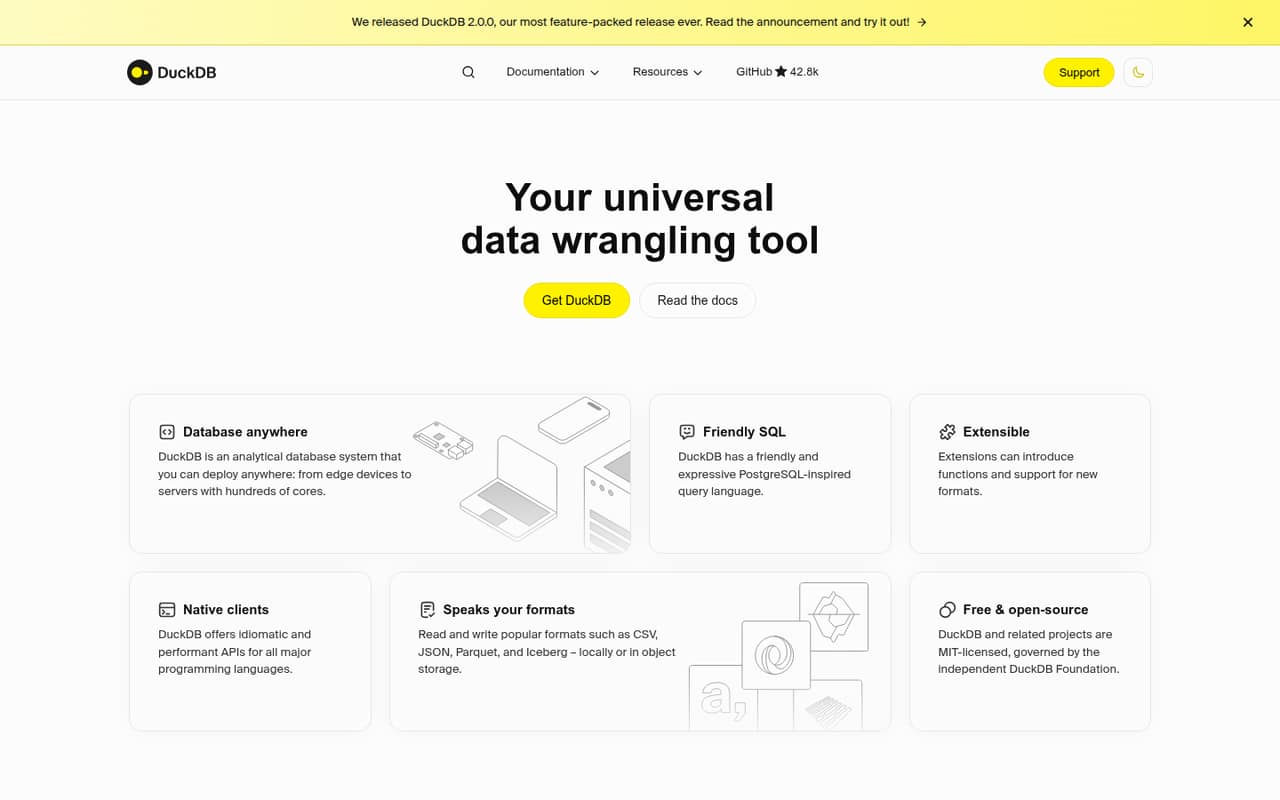
DuckDB is an analytical SQL database that runs in-process: an application can embed the database instead of connecting to a separate database server. It can also run on devices and servers, according to the homepage. That makes it a fit for local data wrangling, embedded analytics and SQL queries over files, rather than only as a centrally hosted database.
The engine reads and writes CSV, JSON, Parquet and Iceberg, locally or in object storage. Its SQL is PostgreSQL-inspired. DuckDB also describes a broader Duck Stack that includes Quack, a client-server protocol; DuckLake, a lakehouse format; and Iceberg support. These are distinct pieces of the ecosystem, not evidence that the core database is a hosted SaaS service. The homepage says extensions can add functions and support for new formats. DuckDB and related projects are MIT-licensed, and the DuckDB Foundation is described as independent. The project can therefore sit inside an application or data workflow without requiring a proprietary database licence.
02DuckDB API, SDKs and docs
DuckDB offers idiomatic APIs for major programming languages, with named clients for Python, Go, Java, Node.js and Rust. The install options include pip install duckdb, go get github.com/duckdb/duckdb-go/v2, npm install @duckdb/node-api, a Java JDBC JAR and the Rust duckdb crate. The homepage also provides a command-line client and ODBC packages. It directs developers to the docs, but does not describe an HTTP REST API for the core database.
The in-process model keeps the database close to application code; the SQL interface is PostgreSQL-inspired. DuckDB says it reads and writes CSV, JSON, Parquet and Iceberg, locally or in object storage, and extensions can add formats and functions. Its integration list also names AWS, Azure, Google Cloud, Hugging Face, SQLite, MySQL, PostgreSQL, ODBC, Arrow, Delta Lake and other formats and tools. Check the docs for the specific client version, extension and integration behavior your deployment needs; language support alone does not guarantee identical capabilities across clients.
03DuckDB pricing for developers
The project is free and open source under the MIT License, with personal and commercial use permitted. The pricing information lists no usage limits for the open-source option and no monthly or annual charge. The vendor does not publish paid plans for the core DuckDB project. That makes the direct software bill $0 at the listed price, whether a developer is evaluating it or building a commercial application.
There is no published per-query, per-request, seat or compute price for the open-source database, so its project price does not rise with those measures. Instead, production costs depend on the environment and surrounding systems a team chooses to operate: application infrastructure, storage, data transfer and engineering time are separate from the DuckDB licence. The homepage describes DuckDB as deployable on devices and servers, but does not publish hosted-service pricing or an add-on catalogue. Teams considering a managed or commercial offering should confirm its pricing, limits and support terms with that provider rather than assume they are part of the free project.
04DuckDB: open source, self-hosting and lock-in
DuckDB and related projects are MIT-licensed, and the licence permits commercial use. The database is deployable on devices and servers, and its in-process design lets teams run it within their own application environment rather than depend on a hosted DuckDB service. The homepage says the DuckDB Foundation is independent.
DuckDB reads and writes CSV, JSON, Parquet and Iceberg, which gives teams options for working with data outside a DuckDB-specific database file. That can make it easier to move data between tools, though SQL behavior, extensions and application code may still need adaptation during a migration. The homepage also describes Quack for client-server access and DuckLake for lakehouse workloads. Teams should verify their own export paths and test dependent extensions before switching engines. The core project's open licence reduces vendor lock-in, but it does not eliminate the cost of rewriting queries or changing data workflows.
05DuckDB in production
DuckDB can run inside production applications, but teams should validate the workload against its in-process architecture. Check how the application handles concurrent access and updates, memory use, disk spill, backups, recovery and deployment across instances. The homepage says DuckDB can run on servers with hundreds of cores; that is not a service-level or workload guarantee. Security controls, compliance attestations, rate limits and support commitments should be confirmed for the deployment model you choose.
Reddit reports are mixed but include production use. One commenter says their team had used DuckDB in production for a year with Python and had no major problems. Another commenter flags poor handling of concurrent updates as a limitation to consider. These are individual reports, not reliability guarantees. Other commenters describe using DuckDB for local transformations or analytics alongside existing data systems. Before making it a shared production dependency, test concurrency patterns, failure recovery and data-access controls with your own application and deployment setup.
From the threadsWhat users say
Reddit comments are generally positive about DuckDB for embedded analytics, local transformations and production pipelines. The discussion also cautions that workload fit matters, particularly for concurrent updates.
We've been using DuckDB in production for a year now, running and generating the queries we need with Python code. So far it's gone great. No major problems
Duckdb is an “in process” database. It has its own scheme for storing data in memory and disk
A lot of the oft-noted limitations of DuckDB (eg, its poor handling of concurrent updates) are more a feature than a bug with that in mind
Before rewriting anything (especially larger projects), try to use a profiler to find the slow and/or memory inefficient operations
Questions people ask
What is DuckDB useful for?
DuckDB is useful for analytical SQL and data wrangling inside an application or on a device or server. It can read and write CSV, JSON, Parquet and Iceberg, making it suitable for local file-based analytics and embedded queries without a separate database server.
Is DuckDB free for commercial use?
Yes. DuckDB is MIT-licensed, and commercial use is permitted. The project lists no monthly or annual charge and no usage limits for its free open-source option. Infrastructure and other services you choose to use with it can still cost money.
Is DuckDB faster than PostgreSQL?
There is no universal winner: performance depends on the query, data, configuration and workload. DuckDB is an analytical database designed for in-process use, while the homepage describes its SQL as PostgreSQL-inspired. Benchmark the actual workload before choosing between them.
Can DuckDB handle production workloads?
Developers on Reddit report using DuckDB in production, including with Python pipelines. Other commenters caution about concurrent updates. Evaluate concurrency, recovery, security and operational requirements against your workload; individual reports are not a reliability guarantee.
Which languages have DuckDB clients?
The homepage names Python, Go, Java, Node.js and Rust clients, along with a command-line client and ODBC. It provides install options for several of these. Check the docs for the client version and feature support that match your application.