
We may earn a commission if you buy through links on this page. It never changes a score or a ranking. How we make money
The bottom line
Redis covers caching through AI context, but production fit depends on cost and deployment choices.
Redis is a real-time data platform for caching, streaming, search and AI agent context. It offers hosted cloud plans alongside on-premises, hybrid and open-source deployment options, so it can sit in different parts of an application stack.
The Free cloud plan is limited to 30 MB and one shared database. Paid plans start at $5/month for Essentials, while Pro has a $200 monthly minimum. Reddit comments reflect broad agreement that Redis suits particular use cases, alongside concerns about licensing changes.
Good fit if
- Apps needing shared, fast data
- AI agents requiring retrieved context
- Teams needing multi-region reads
Skip it if
- Projects needing a large free tier
- Teams requiring published rate limits
- Buyers needing settled license terms
ScoresHow it rates
What works
- Combines caching, streaming and search
- Offers vector search for AI context
- Supports cloud, on-premises and hybrid deployment
- Active-active replication supports multi-region workloads
- Free cloud plan available for small projects
What doesn't
- Free cloud tier is limited to 30 MB
- Pro has a $200 monthly minimum
- Request and rate limits are not published
- SDK and language support needs confirmation
- Reddit users report concerns about licensing changes
01What Redis is, technically
Redis is a real-time data service and platform, not just a cache library. It combines caching, streaming, search and other data capabilities, with vector search and memory and context features aimed at AI agents. In a typical stack, it sits behind application services as a shared data layer: services can use it for cached data, streamed events or retrieval of relevant context.
Redis is available as a hosted cloud service, as well as for on-premises and hybrid deployments that teams manage themselves. The homepage also offers Redis 8 as open-source software. That gives teams a choice between a vendor-hosted database and running Redis within their own infrastructure. Its multi-region active-active replication is aimed at applications that need local-speed reads and failover across regions; tiered RAM and flash storage targets larger datasets. Choose Redis for these data-service roles, not as a blanket replacement for every system of record.
02Redis API, SDKs and docs
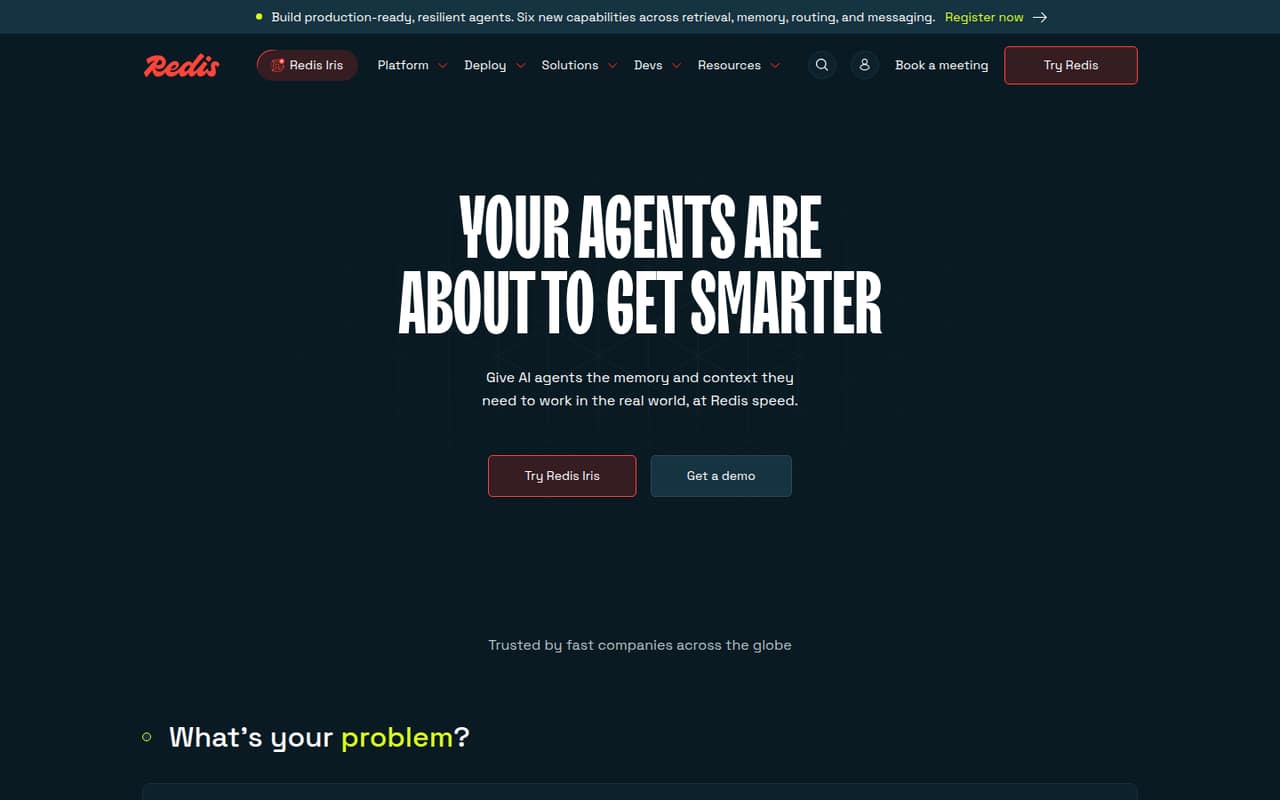
Redis promotes a unified platform for agents and apps, with Redis Iris as a context engine for memory, context and messaging. Its Context Gateway uses Redis-powered vector search to retrieve information from structured and unstructured data. The homepage invites developers to start in their preferred LLM’s coding tools and says Redis works with any LLM, agent framework or cloud.
The homepage does not name a programming language, SDK, API protocol or CLI. The integration surfaces it does identify are Redis itself, Redis Iris and the Context Gateway, alongside the option to bring existing tools. Before adopting it, confirm SDK and protocol support for your languages and frameworks in the vendor’s docs. The homepage links to documentation but does not describe a particular setup flow, authentication method or client library. Those details matter when estimating integration work, especially if your services need to share data across languages or run in a restricted network environment.
03Redis pricing for developers
The pricing page lists a Free cloud plan at $0/month, with 30 MB, one database, shared cloud deployment, best-effort SLA and community support. Essentials starts at $0.007/hour, with a $5/month total, for one database and 250 MB–100 GB of RAM and SSD. It lists uptime of up to 99.99% and basic support only.
Pro starts at $0.014/hour, with a $200/month minimum and the first $200 free. It includes unlimited RAM, multiple databases and active-active multi-region deployment, with uptime of up to 99.999%. Enterprise offers dedicated RAM and SSD architecture, usage-based data transfer and on-demand or annual pricing; the annual option supports multi-cloud and hybrid cloud/on-prem deployment. Its price is not published. The plan table lists no add-ons. Expect costs to depend on selected plan and provisioned resources; Enterprise also charges for data transfer. Confirm how usage is metered and what happens at plan limits before putting a workload in production.
04Redis: open source, self-hosting and lock-in
Redis offers Redis 8 as free open-source software, and its deployment options include on-premises and hybrid cloud. Teams can therefore manage deployments themselves instead of using Redis-hosted cloud. The homepage does not identify the license attached to each version. Reddit threads report disagreement and concern about licensing changes and hosting implications; check the exact license for the version you plan to deploy and whether it permits your intended use.
The vendor’s homepage does not describe data export formats. Ask how to export data and which data structures, persistence settings and replication behavior you would need to reproduce elsewhere. Applications that depend on Redis-specific data structures or features may need code changes when moving to another store. A self-managed deployment can reduce reliance on a hosted provider, but it shifts infrastructure and operations work to your team.
05Redis in production
Redis promotes active-active replication for local-speed reads and failover across regions, and tiered RAM plus flash storage for terabyte-scale data. The cloud plans list up to 99.99% uptime for Essentials and up to 99.999% for Pro. Treat those as plan-specific claims, and confirm the SLA terms, recovery behavior and capacity limits for your workload. The vendor does not publish request or rate limits on the pricing details; ask about them, along with security controls and compliance coverage, before setting production requirements.
Reddit commenters describe Redis as a database suited to particular use cases, rather than only a cache. Other users raise concerns about licensing changes and their effect on hosting. Those discussions are signals to check deployment and license assumptions, not substitutes for a technical or legal review. For production, model RAM and SSD needs, data transfer charges and multi-region behavior, then verify support coverage: Free has community support, while Essentials lists basic support only.
From the threadsWhat users say
Reddit sentiment is mostly positive about Redis as a useful, specialized data store, while commenters disagree about how to categorize it and raise concerns about licensing changes.
It's one particular kind of database. It's not a relational database. It's good for some use-cases, and it's not so good for other use-cases
An "in memory cache" is a thing you can do *with* redis. It's not what redis IS
Hard fork soon ?
redis is good when you need to share data between multiple instances
Redis in the news
Questions people ask
Is Redis a database or a cache?
Redis is a real-time data platform that includes caching alongside streaming, search and other data capabilities. It can serve as a database for appropriate workloads, but it is not a relational database. Decide based on your data model, persistence needs, consistency requirements and application use case.
Can I self-host Redis?
Yes. Redis offers on-premises and hybrid deployment options for teams managing their own deployments, and its homepage offers Redis 8 as open-source software. Check the license for the specific version and intended use, and account for the infrastructure and operations work of self-hosting.
Does Redis support AI agent memory and vector search?
Redis promotes Redis Iris as a context engine for agent memory, context and messaging. Its Context Gateway uses Redis-powered vector search to retrieve relevant information from structured and unstructured data. Confirm the integration details, supported clients and deployment requirements in the vendor’s docs.
What uptime does Redis offer?
The pricing page lists up to 99.99% uptime for Essentials and up to 99.999% for Pro. Free has a best-effort SLA. Check the plan’s SLA terms and confirm how they apply to your region, configuration and workload before relying on an uptime target.
Can Redis replace my primary database?
That depends on your application’s persistence, consistency and query needs. Redis includes database capabilities, but it is not a relational database, and its fit varies by workload. Reddit commenters describe it as useful for specific cases rather than a universal replacement for other data stores.