
We may earn a commission if you buy through links on this page. It never changes a score or a ranking. How we make money
The bottom line
A graph database platform for connected-data workloads, with managed and self-managed deployment options.
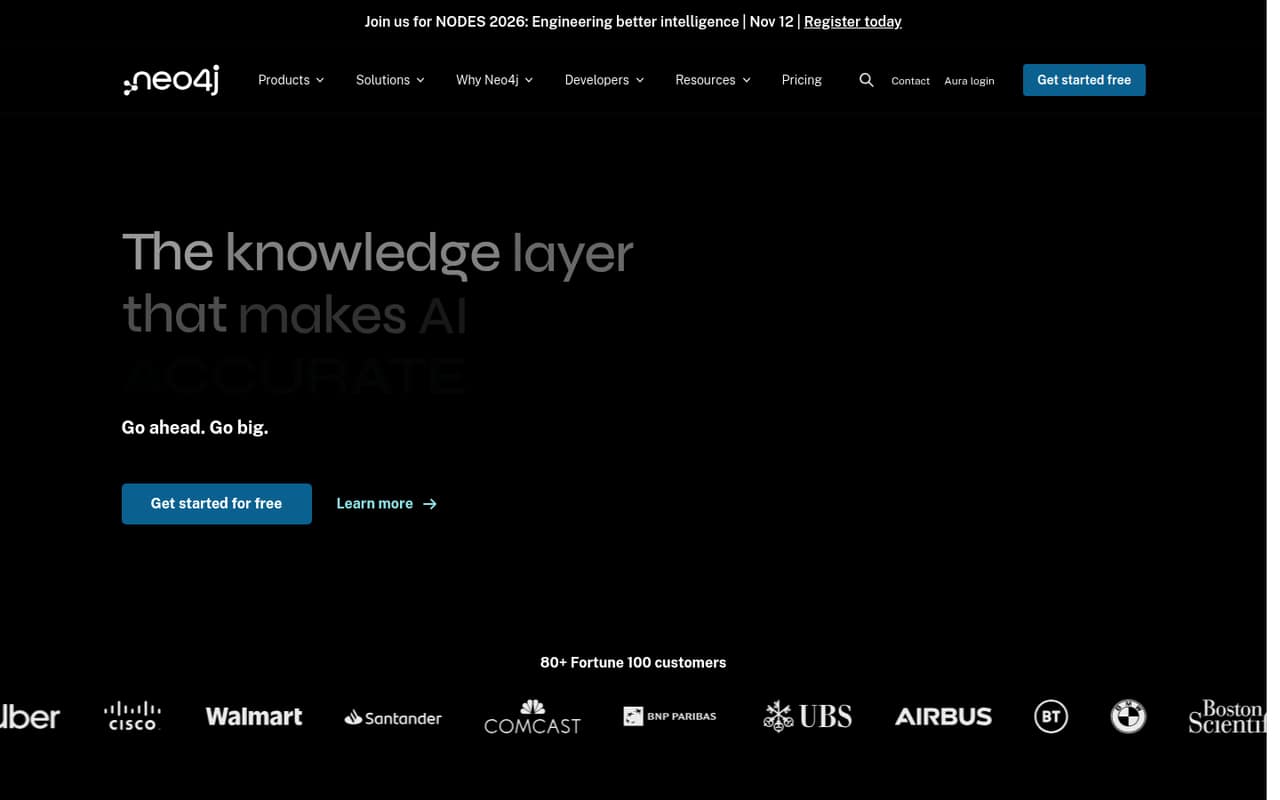
Neo4j is a graph database platform for storing and analyzing connected data. Its product range includes fully managed Aura services and self-managed graph products, with graph analytics and GraphRAG aimed at AI applications.
The fit depends on whether relationships and traversals are central to the workload. AuraDB Free is a useful entry point, but production costs are capacity-based and some deployment details need confirmation with Neo4j before you commit.
Good fit if
- Apps centered on connected data
- Knowledge graphs for AI context
- Teams needing managed or self-managed options
Skip it if
- Simple records without graph relationships
- Teams needing published free-tier capacity limits
- Buyers requiring clear license terms upfront
ScoresHow it rates
What works
- Managed and self-managed graph products
- Graph analytics and Graph Data Science offerings
- GraphRAG connects graph data to AI context
- AuraDB Free requires no payment method
- Business Critical lists a 99.95% uptime SLA
What doesn't
- AuraDB production pricing is billed per GB per hour
- Free-tier capacity limits are not published
- License terms need confirmation before self-hosting
- SDKs and programming languages are not named on the homepage
- Reddit users report workload-dependent performance and stability
01What Neo4j is, technically
Neo4j is a graph database platform: it stores data as connected entities and relationships, then supports querying and analyzing those connections. In a stack, it sits in the data layer, where an application or analytics workflow can use graph data rather than treating every record as an isolated row. The vendor positions this connected-data model as a knowledge layer for AI systems.
The product range includes fully managed services such as AuraDB, Virtual Graph, Aura Graph Analytics, and Aura Agent, alongside self-managed Graph Database, Graph Analytics, and Graph Data Science products. Enterprise Studio and Fleet Manager are also listed for exploring and managing deployments. GraphRAG is presented as a way to retrieve context from connected data for AI systems. This is not just a hosted database: the product menu offers managed and self-managed paths, so deployment and operating responsibility depend on the product you choose.
02Neo4j API, SDKs and docs
Neo4j's homepage points developers to documentation, the Dev Center, GraphAcademy, community resources, Discord, and a Deployment Center. It also names GraphRAG, agent memory, and Model Context Protocol (MCP) as areas for building AI applications. The homepage does not name programming languages or SDKs, so confirm language-driver support and connection details in the vendor's documentation before selecting a stack.
The integration surface named for AI agents includes MCP; GraphRAG is the retrieval pattern for bringing graph context into AI systems. The product menu also lists AuraDB for storing and querying connected data, plus graph analytics products for running algorithms. The homepage does not identify a CLI, REST API, or webhook interface, so do not assume those are the right integration path without checking the docs. For implementation planning, verify authentication, connection behavior, supported drivers, and deployment-specific requirements against the documentation for the exact Neo4j product you intend to use.
03Neo4j pricing for developers
AuraDB Free costs $0 per month, requires no payment method, and includes access to all graph tools. The vendor does not publish its capacity limits in the listed plan details, so confirm whether the free instance is sufficient for a prototype and what happens when it reaches its limits.
AuraDB Professional costs $0.09 per GB per hour, with a 1 GB minimum instance. It lists up to 128 GB of memory, 2 TB of storage, daily backups, and seven-day retention. AuraDB Business Critical costs $0.20 per GB per hour, with a 2 GB minimum; it lists up to 2 TB of memory on AWS and GCP, 512 GB on Azure, up to 5 TB of storage per instance, a 99.95% uptime SLA, and 30-day backup retention. These hourly capacity rates mean the bill grows with provisioned size and time; the pricing page does not list monthly or annual prices. Virtual Dedicated Cloud uses custom pricing. No add-ons are listed, so ask sales about charges and limits relevant to your deployment.
04Neo4j: open source, self-hosting and lock-in
Neo4j offers self-managed products, including Graph Database, Graph Analytics, and Graph Data Science. That gives teams a deployment path they operate themselves; it does not, by itself, establish the applicable license or whether a particular edition can be used without a commercial agreement. The vendor's homepage does not state the license terms, so confirm them with Neo4j before building a commercial product or planning a self-hosted rollout.
The homepage also does not describe data export formats or a migration path to another database. Those details matter because graph models, queries, and analytics workflows can be tied to a particular database's data model and tooling. Reddit discussions include licensing and cost concerns, but comments are not a substitute for current contract terms. Before committing, ask Neo4j about the license for your selected product, data export options, and the effort required to move both graph data and application queries.
05Neo4j in production
Production planning starts with matching the data model and query patterns to the workload. AuraDB Professional and Business Critical list storage and memory ceilings, while Virtual Dedicated Cloud is positioned for dedicated infrastructure. Business Critical lists a 99.95% uptime SLA and 30-day backup retention; Professional lists daily backups with seven-day retention. Check the selected cloud's capacity limits, backup recovery process, security controls, and compliance requirements with Neo4j before relying on the service. The listed plan details do not provide rate limits.
Reddit reports vary by workload. One commenter describes a deployment with six million nodes and 60 million relationships, while another describes performance and stability issues at a startup that improved after changing its data model. A separate commenter says a graph approaching 2 TB is in use with Neo4j Community and a plugin. These are individual reports, not comparable benchmarks. Model representative queries, mutations, and concurrency, and confirm the relevant limits and SLA before sizing a production deployment.
From the threadsWhat users say
Reddit sentiment is mixed: some developers report useful deployments at substantial graph sizes, while others raise performance, stability, licensing, and cost concerns. The comments repeatedly point to workload and data modeling as important to the outcome.
I have at least 6 millions nodes with 60 millions relationship in neo4j, and i have it hosted on azure to both write and read, as per your case, with no latency
We did have some issues with performance and stability, but resolved with nicer data modelling
It does not scale well
I worked on a startup that used it for most of the application, about 200k users and 200M nodes.We did have some issues with performance and stability, but resolved with nicer data modelling
Questions people ask
What is Neo4j used for?
Neo4j stores and analyzes connected data in a graph database. Its product range includes graph analytics, knowledge graph capabilities, and GraphRAG for retrieving context from connected data for AI systems.
Can I self-host Neo4j?
Yes. Neo4j lists self-managed products, including Graph Database, Graph Analytics, and Graph Data Science. Confirm the license terms, operating requirements, and commercial rights for the product and edition you plan to deploy.
Does Neo4j have a free plan?
AuraDB Free costs $0 per month, requires no payment method, and includes access to all graph tools. The listed plan details do not specify capacity limits, so check with Neo4j before relying on it for production.
Does Neo4j support AI applications?
Neo4j presents its graph technology as a knowledge layer for AI. Its listed capabilities include GraphRAG, AI integrations, agent memory, and Model Context Protocol (MCP). Check the documentation for the integration details that fit your application.
What uptime does Neo4j guarantee?
AuraDB Business Critical lists a 99.95% uptime SLA. The other AuraDB plan details do not list an uptime SLA. Review the current service terms with Neo4j for the specific product and deployment you plan to use.
Sources
- Neo4j homepage
- Neo4j pricing page
- Reddit: No one uses Neo4j for actual large scale live applications... right?
- Reddit: Neo4j Alternatives in 2026: A Fair Look at the Open-Source Options (including licensing)
- Reddit: Free/cheaper alternatives to neo4j for a commercial product?
- Reddit: Neo4j alternatives !??