
We may earn a commission if you buy through links on this page. It never changes a score or a ranking. How we make money
The bottom line
A flexible search database for teams prepared to manage its operating and scaling complexity.
Elasticsearch is a distributed search and analytics engine with RESTful HTTP access, full-text search, vector retrieval and hybrid search. It can run as Elastic Cloud Hosted, Elastic Cloud Serverless or a self-managed deployment, putting it in the data and retrieval layer of an application stack.
The trade-off is operational work: Reddit users report painful upgrades and cluster-management challenges at scale, while others say setup is straightforward. Hosted Standard starts at $99 per month, with usage costs tied to RAM-hours, storage and availability zones.
Good fit if
- AI apps needing hybrid retrieval
- Search across large datasets
- Teams with cluster-operations experience
Skip it if
- Projects needing a minimal search stack
- Teams avoiding operational complexity
- Fixed-budget workloads without usage monitoring
ScoresHow it rates
What works
- One API supports vector and hybrid search
- Indexes structured and unstructured data
- Supports full-text search and real-time analytics
- Available hosted, serverless or self-managed
- Can provide retrieval context for LLMs
What doesn't
- Cloud costs scale with RAM-hours, storage and zones
- Hosted Standard starts at $99 per month
- Reddit users report painful upgrades
- Cluster operations can be difficult at scale
- SDK and language support needs confirmation in docs
01What Elasticsearch is, technically
Elasticsearch is a distributed search database and analytics engine that stores, indexes and queries structured and unstructured data through a RESTful HTTP API. It sits between data producers and the applications that need to search or analyze that data: ingest records, index them, then query the resulting store for full-text matches, vector retrieval or analytics.
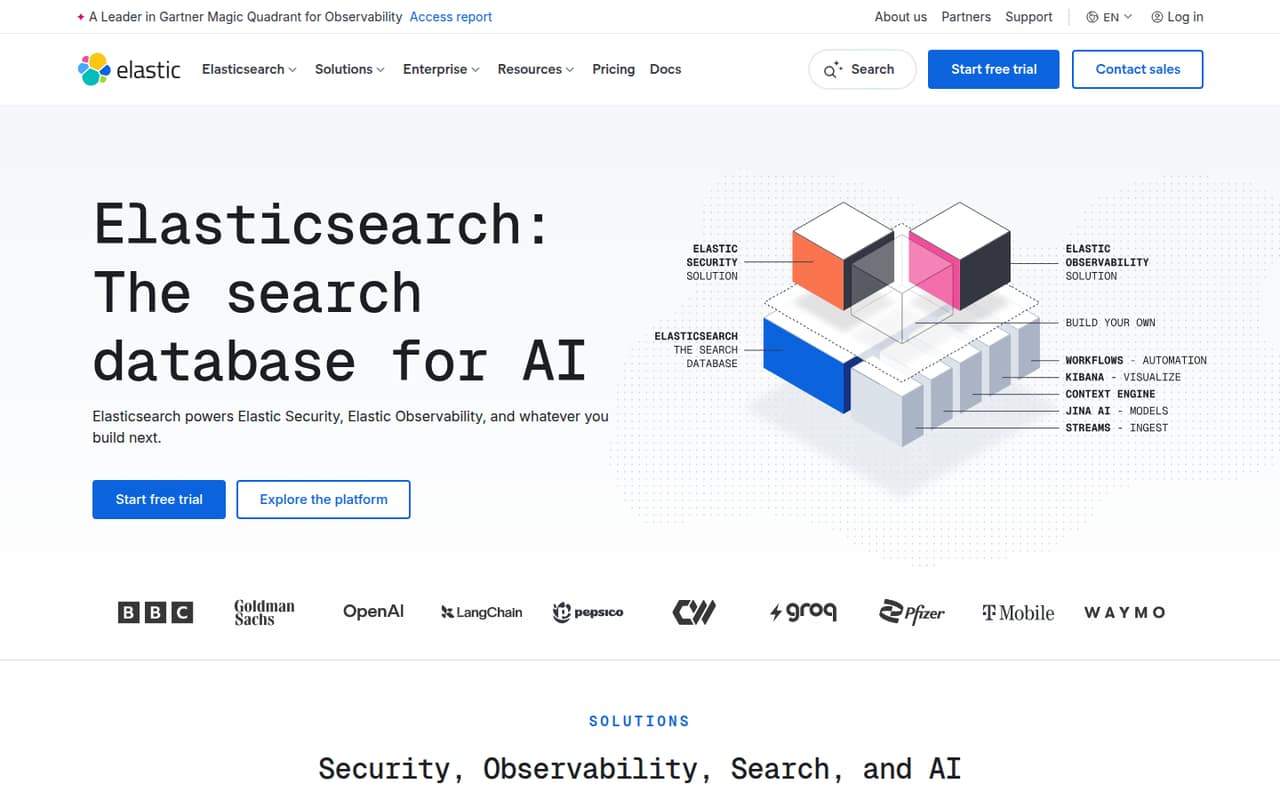
It can serve as the retrieval layer for AI applications and RAG pipelines, where search results supply context to an LLM. Elastic describes the platform as available through Elastic Cloud Hosted, Elastic Cloud Serverless or self-managed deployment, so it can be a hosted service or a server you operate. Elasticsearch is part of the broader Elastic Stack, which also includes Kibana, Logstash, Beats and Elastic Agent. That makes it a database component rather than a standalone search UI: applications call its API, while Kibana provides a visualization and management interface.
02Elasticsearch API, SDKs and docs
The main integration surface is Elasticsearch’s RESTful HTTP API. Applications send indexed data and search or analytics queries to the engine; the homepage highlights full-text, vector and hybrid search, reranking and GPU inference as capabilities available in the search API. The platform also covers ingestion, storage, retrieval, visualization and agentic orchestration.
Elastic’s homepage links to product documentation, but it does not name specific programming languages or SDKs in the published product details. Confirm SDK availability, supported versions and query coverage in the vendor’s docs before choosing a client library. The homepage also does not identify a CLI, webhook interface or plugin system as the core integration path, so plan around the HTTP API unless the docs confirm another option. For adjacent components, Elastic describes Logstash as a server-side data ingestion pipeline, Beats as lightweight data shippers, and Elastic Agent as a unified agent for logs, metrics and security data.
03Elasticsearch pricing for developers
Elastic’s homepage offers a free trial with no credit card required, but the published pricing information lists no free plan. The trial’s duration and resource limits are not published in the pricing details, so confirm them before using it to size a project.
For hosted production, Elastic Cloud Hosted (Standard) starts at $99 per month and includes 120 GB of storage and two availability zones. The price is not a flat ceiling: usage scales with RAM-hours, storage and zones. The pricing information does not give a separate rate for overages, higher usage or add-ons, so model those costs with Elastic before deployment. An annual-billing price is not published; prepaid consumption contracts are available through sales. Self-managed deployment avoids the hosted plan price, but your team must provide and operate the infrastructure.
04Elasticsearch: open source, self-hosting and lock-in
Elastic supports self-managed deployment as well as hosted options. The homepage itself does not give license terms.
Self-hosting gives you control over where the search database runs, but your team takes on infrastructure and operations. With hosted deployments, the service and its usage-based billing become part of the stack. Elasticsearch exposes data and queries through a RESTful HTTP API, which gives applications a clear interface to build against. Moving away still means accounting for indexed data, mappings and query behavior in the destination system; plan and test that migration rather than treating the API as automatic portability. Confirm supported data export paths and formats with Elastic before relying on them.
05Elasticsearch in production
The production questions are less about whether Elasticsearch can search data and more about how you will operate and size it. Hosted Standard includes two availability zones and 120 GB of storage; its bill scales with RAM-hours, storage and zones. The vendor does not publish a rate-limit figure in the published pricing information, so ask Elastic about request limits, capacity planning and the cost of higher usage before setting traffic budgets. Confirm security and compliance requirements against the plan and deployment you select.
Reddit reports are mixed. One user says setup was easy, while other discussions describe painful upgrades and difficulty managing shards, indexes and rolling upgrades at scale. Those reports are not universal, but they point to work worth planning: upgrade procedures, index lifecycle and retention, cluster monitoring, and recovery. A hosted deployment can reduce infrastructure work, but it does not remove the need to validate query behavior, storage growth and cost under your workload.
From the threadsWhat users say
Reddit sentiment is mixed, with some users praising straightforward setup and others describing painful upgrades, licensing concerns and difficult cluster operations at scale. The strongest reservations concern long-term maintenance rather than the search capability itself.
Elastic and Kibana has been one of the easiest software for me to set up in recent history
Every upgrade has been painful
Easy to install, a total cluster fuck to manage at scale
Having moved to opensearch, I also wouldn't go back. There isn't a compelling reason to do so, particularly after having been burned by elasticsearch's license change once
Questions people ask
Is Elasticsearch still popular?
Elastic presents Elasticsearch as the search database behind its Search, Observability and Security offerings, and says its products are available hosted, serverless or self-managed. Reddit discussions show an active user base as well as criticism of licensing changes and the work involved in operating clusters. Popularity alone does not determine whether it fits your workload.
Does Elasticsearch use Kibana?
Elasticsearch and Kibana are separate products in the Elastic Stack. Elastic describes Elasticsearch as a distributed search and analytics engine, and Kibana as a visualization and management UI. You can use Elasticsearch as the database and query engine; Kibana is the companion interface for visualizing and managing it.
Can I self-host Elasticsearch?
Yes. Elastic lists self-managed deployment alongside Elastic Cloud Hosted and Elastic Cloud Serverless. Self-hosting means your team operates the infrastructure.
Does Elasticsearch support vector search?
Yes. Elastic describes vector and hybrid search, reranking and GPU inference as part of its search capabilities. The published product details also position Elasticsearch for semantic search and RAG pipelines that retrieve context for large language models.
Is Elasticsearch the same as Kibana?
No. Elasticsearch is the distributed search and analytics engine that stores, indexes and queries data. Kibana is a visualization and management UI in the Elastic Stack. They are related products, but Kibana is not the database itself.
Sources
- Elasticsearch homepage
- Elasticsearch pricing, compiled via web search from ivinco.com, elastic.co, monitoringcost.com
- Reddit: Elasticsearch is open source, again
- Reddit: Fast & lightweight search Engine. An alternative to Elasticsearch that runs on a few MBs of RAM.
- Reddit: Is there a 'boring' alternative to ElasticSearch?
- Reddit: Why Elasticsearch is a huge pain in the ass?!