We may earn a commission if you buy through links on this page. It never changes a score or a ranking. How we make money
Baseten is our top pick for teams serving custom models in production: it supports dedicated GPU capacity and VPC deployment, though you should confirm rates and deployment costs first. GroqCloud is a strong fit for OpenAI-compatible, latency-sensitive apps; Ollama is the choice for local and offline inference. The right platform depends on whether you need a managed model API, control over containers and GPUs, or a runtime you can host yourself. Compare pricing at your expected volume, then verify model limits, capacity and production terms before committing.
Quick picksThe shortlist
 BasetenBasetenBest for production · Free
 GroqCloudGroqCloudBest for OpenAI compatibility · Free
 OllamaOllamaBest for local inference · $16.67/mo
 Together AITogether AIBest for open models · Free
 DeepInfraDeepInfraBest for model choice · Custom
 SiliconFlowSiliconFlowBest for multimodal APIs · Custom
 RunpodRunpodBest for custom containers · $0.27/mo
 fal.aifal.aiBest for media models · Custom
 SaladCloudSaladCloudBest for idle GPU fleets · $43.80/mo
 Novita AINovita AIBest for hosted models · Free
 ReplicateReplicateBest for prototyping · Free
 Fireworks AIFireworks AIBest for open-model APIs · $8/mo
 SambaNova CloudSambaNova CloudBest for API evaluation · Free
 Cerebras InferenceCerebras InferenceBest for low latency · Custom
 Lambda CloudLambda CloudBest for GPU clusters · Custom
 HyperbolicHyperbolicBest for GPU sourcing · Free
01Compared at a glance
| Tool | Score | From | Free plan | Trial |
|---|---|---|---|---|
| BasetenBaseten | 7.6 | Free | Yes | Yes |
| GroqCloudGroqCloud | 7.5 | Free | Yes | — |
| OllamaOllama | 7.6 | $16.67/mo | Yes | — |
| Together AITogether AI | 7.4 | Free | Yes | — |
| DeepInfraDeepInfra | 7.4 | Custom | No | — |
| SiliconFlowSiliconFlow | 7.4 | Custom | No | — |
| RunpodRunpod | 7.2 | $0.27/mo | No | — |
| fal.aifal.ai | 7.2 | Custom | No | — |
| SaladCloudSaladCloud | 7.3 | $43.80/mo | No | — |
| Novita AINovita AI | 7.0 | Free | Yes | — |
| ReplicateReplicate | 6.9 | Free | Yes | — |
| Fireworks AIFireworks AI | 6.8 | $8/mo | No | — |
| SambaNova CloudSambaNova Cloud | 6.7 | Free | Yes | — |
| Cerebras InferenceCerebras Inference | 6.4 | Custom | No | 30 days |
| Lambda CloudLambda Cloud | 6.3 | Custom | No | — |
| HyperbolicHyperbolic | 5.8 | Free | Yes | — |
02The picks, in detail
- Best for productionBasetenBaseten
Baseten is our first pick for teams serving custom models in production. Its stated fit includes dedicated GPU capacity and VPC deployment, and it is marked open source and self-hostable. That makes it worth evaluating when deployment control matters alongside a managed platform. The vendor’s rates, limits and deployment costs need confirmation before you estimate a production bill.
What works
- OpenAI-compatible Chat Completions API
- Dedicated deployments support custom architectures
- Chains provision hardware per model step
What doesn't
- Most production tiers require a custom quote
- Usage limits and seat limits are unpublished
- Model API token prices are not listed

- Best for OpenAI compatibilityGroqCloudGroqCloud
GroqCloud offers OpenAI-compatible inference integrations, making it a practical candidate for existing API-based applications. It is also aimed at latency-sensitive chat and voice workloads and teams testing open-weight models. A free plan is listed, but model limits and usage costs affect production fit. Check the specific model’s availability and terms before relying on it.
What works
- OpenAI-compatible REST API eases provider changes
- Official Python and JavaScript/TypeScript SDKs
- Supports language, vision and audio inference
What doesn't
- Free limits vary by model and endpoint
- Developer usage is metered beyond its $0 base
- Overage rates are not published

- Best for local inferenceOllamaOllama
Ollama is a local model runtime and API for developers who need offline, privacy-sensitive or open-weight model workflows. It is open source and self-hostable, so it fits projects that want inference close to the application rather than tied to a hosted provider. A free plan is listed, with pricing from $16.67. Its trade-off is less low-level control than some developers want.
What works
- Open-source under the MIT license
- Runs locally, offline or in the cloud
- REST API for chat, completions and embeddings
What doesn't
- Hosted usage is billed per token
- Cloud plans cap concurrent requests
- Local API request limits are not published
- Best for open modelsTogether AITogether AI
Together AI targets teams serving open models, running batch inference and needing GPU capacity. That combination suits workloads where model choice and compute are both part of the platform decision. A free plan is listed, but the vendor’s model pricing and capacity terms should be checked against your expected traffic. Review portability before committing workloads to the service.
What works
- Serverless inference avoids managing serving infrastructure
- Batch API supports up to 30 billion tokens per model
- Provisioned Throughput includes a 99% uptime SLA
What doesn't
- Token costs vary by model and input or output
- Some GPU and container prices require a sales quote
- Free-tier allowances are not published
- Best for model choiceDeepInfraDeepInfra
DeepInfra is a candidate for teams comparing hosted models, serving apps with variable usage and optimizing for model cost. Its broad hosted-model access and usage-based rates make per-model cost comparisons important before you choose a default. The vendor’s model limits and operational details need checking for the models you plan to use, especially when traffic or deployment requirements change.
What works
- Catalog spans 100+ models and multiple task categories
- Pay-as-you-go pricing has no long-term contracts
- Some language models have per-token rates
What doesn't
- No free plan or free trial is listed
- Most models use inference-time billing
- SDKs and supported languages need confirmation
- Best for multimodal APIsSiliconFlowSiliconFlow
SiliconFlow offers hosted model choice and pay-per-use inference, including multimodal workloads. OpenAI-compatible API use is among its stated fits, which may make it worth considering for teams comparing providers for an existing integration. Confirm model availability, operational terms and the cost of your actual request mix before selecting it; per-use billing can vary with model choice.
What works
- One OpenAI-compatible API for open and commercial models
- Serverless inference has no setup requirement
- Text, image, video and audio model options
What doesn't
- No fixed monthly plan or free plan is listed
- Numeric rate limits are not published
- SDK and language support needs confirmation
- Best for custom containersRunpodRunpod
Runpod is a flexible GPU cloud for on-demand capacity, variable inference traffic and custom-container workloads. Its listed starting price is $0.27, and its hourly rates can help teams estimate compute costs. That rate alone does not settle production fit: the platform’s reliability needs close attention. Check the full cost and operational requirements for the capacity and deployment pattern you need.
What works
- Pods, Serverless and Clusters share one platform
- More than 30 GPU SKUs across 31 regions
- Serverless endpoints scale to zero when idle
What doesn't
- GPU availability and reliability complaints appear on Reddit
- Storage, downloads and idle compute can add costs
- Support response times are criticized by some users
- Best for media modelsfal.aifal.ai
fal.ai is a broad hosted media API and GPU platform for teams integrating multiple media models or handling variable inference demand. It also targets teams training on managed GPU clusters. Those different workloads make it important to estimate bills against the specific models and compute you expect to use. Verify production details and deployment requirements before moving a critical service.
What works
- One API covers 1,500+ image, video, audio, 3D and world models
- Custom inference supports autoscaling and built-in observability
- Hourly GPU options include H100, H200, B200 and B300
What doesn't
- No free plan is listed
- Per-output rates vary by model and media type
- The vendor doesn't publish rate limits on the homepage
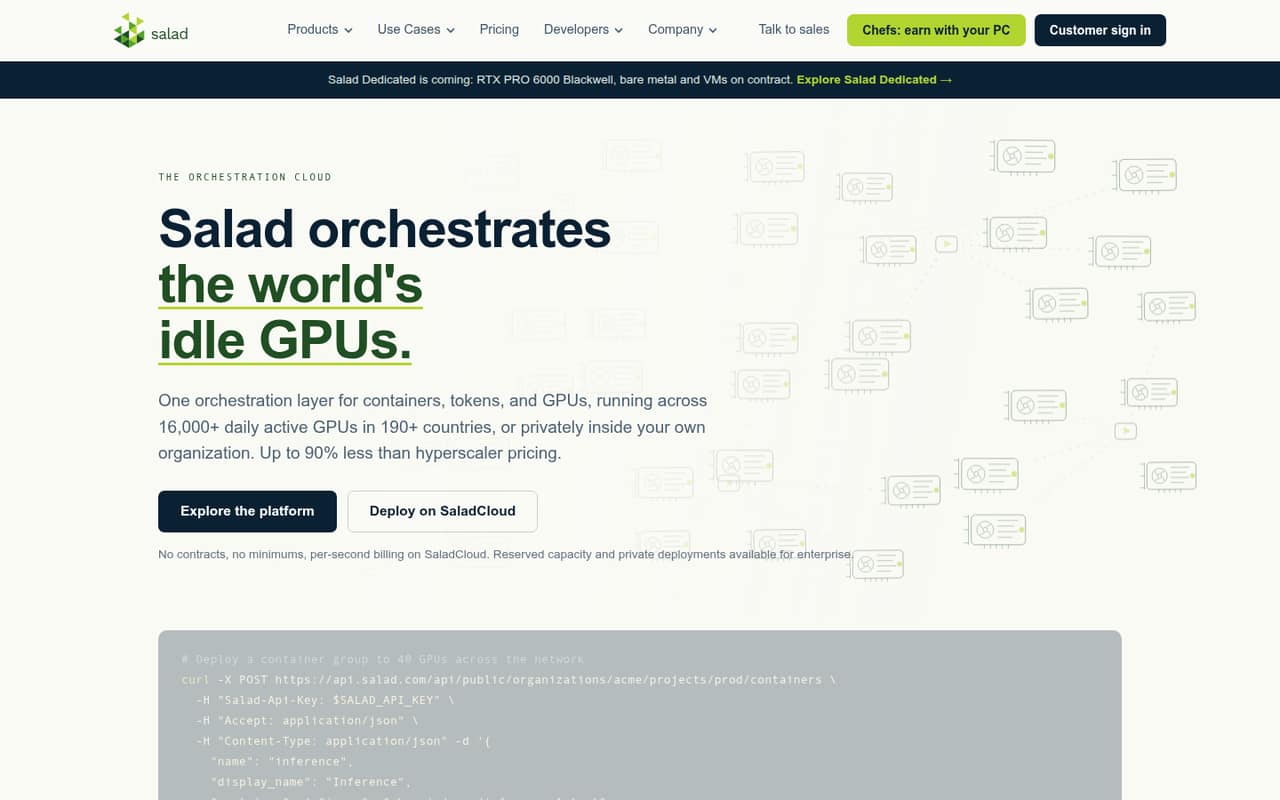
- Best for idle GPU fleetsSaladCloudSaladCloud
SaladCloud targets cost-sensitive GPU inference, containerized batch workloads and teams with idle GPU fleets. It is marked self-hostable, and its listed starting price is $43.8. The low-rate positioning does not answer whether capacity will be available when a production job runs. Review capacity expectations and the applicable pricing terms before making it part of a time-sensitive pipeline.
What works
- OpenAI-compatible endpoint for open-weight models
- Container orchestration spans distributed GPU pools
- Community Cloud starts at $0.015 per GPU-hour
What doesn't
- No free plan or free trial is listed
- AI Gateway token and flat-plan rates are not published
- Distributed capacity may not suit uniform-hardware workloads
- Best for hosted modelsNovita AINovita AI
Novita AI combines hosted models with managed GPU capacity and supports teams prototyping agent runtimes. Its APIs are described as token-priced, and a free plan is listed. For a production estimate, check both token-priced API costs and GPU costs: they may apply to different parts of the workload. Confirm the relevant limits before settling on an architecture.
What works
- One API covers 200+ models
- Model categories include text, image, audio, video and vision
- Dedicated endpoints use isolated resources
What doesn't
- GPU and dedicated endpoint rates are not listed
- SDKs and supported programming languages need confirmation
- Rate limits are not published
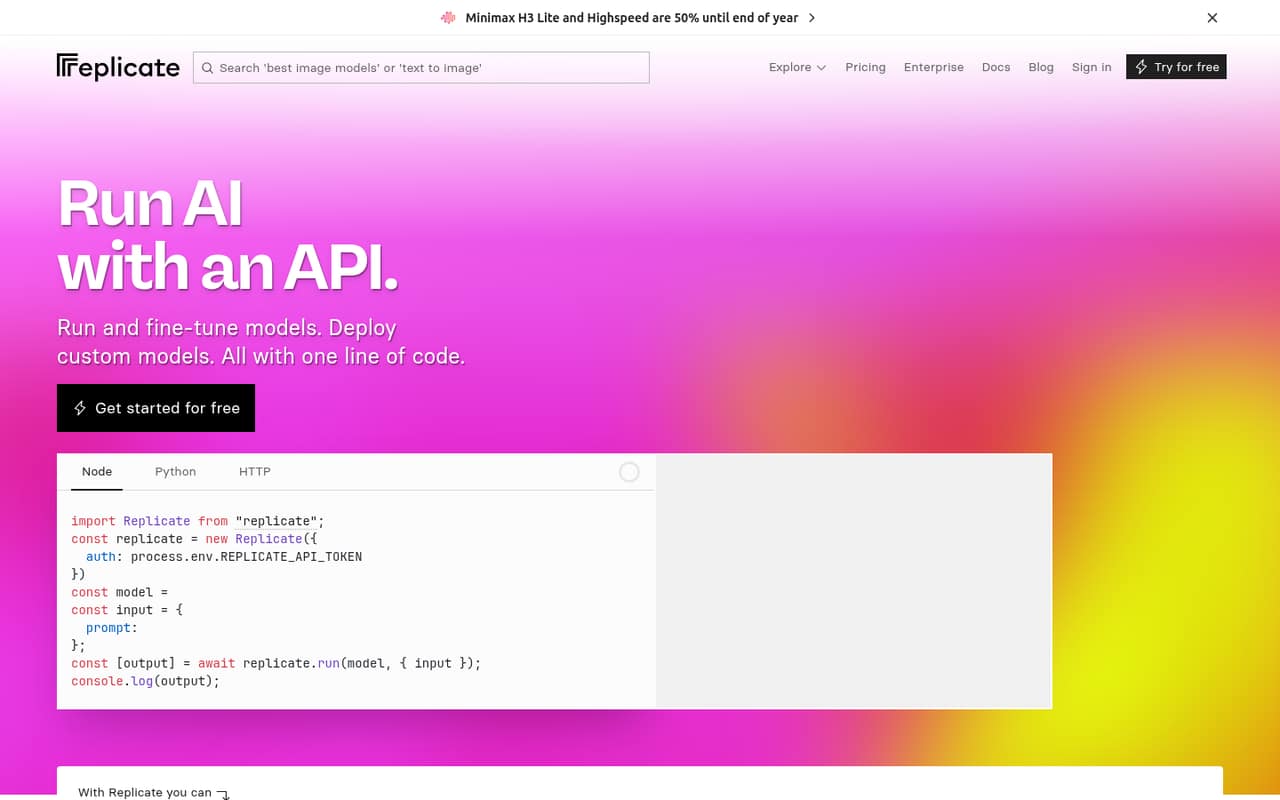
- Best for prototypingReplicateReplicate
Replicate suits teams prototyping with multiple models, deploying custom models or serving apps with variable demand. Its hosted model API is described as simple to integrate, and a free plan is listed. Costs depend on each model and run, so a single platform-level estimate is not enough. Price the models and execution patterns your application will actually call.
What works
- Thousands of community-published models are available through an API
- Run image, speech, music, video and language models
- Node, Python and HTTP integration options
What doesn't
- Public-model prices vary by model and output type
- Private-model bills grow with hardware time
- Free-tier limits are not published
- Best for open-model APIsFireworks AIFireworks AI
Fireworks AI targets teams serving open models through an API, training custom models and handling variable production traffic. It is marked self-hostable, and its listed starting price is $8. The starting price is not a full production estimate: check model costs and the controls available for your workload. It is a candidate when inference and model training belong in the same evaluation.
What works
- Serverless, reserved-throughput and in-cloud deployment options
- Open-model inference and custom-model support
- Ensembling routes models for task-level cost and accuracy
What doesn't
- No free plan for the platform is listed
- Model-specific rates make cost estimation less direct
- Rate limits and detailed API specifications need confirmation
- Best for API evaluationSambaNova CloudSambaNova Cloud
SambaNova Cloud is aimed at porting OpenAI API applications, testing production model access and evaluating inference cost per token. It is marked self-hostable, and a free plan is listed. Before production use, confirm model rates, request limits and production terms with the vendor. The described API entry point makes it relevant for an evaluation, not a substitute for those checks.
What works
- OpenAI-compatible APIs ease application porting
- Production and Preview model access
- Multiple models available through SambaStack
What doesn't
- Free access requires purchased credits for first requests
- Numerical usage limits are not published
- Developer prices vary widely by model
- Best for low latencyCerebras InferenceCerebras Inference
Cerebras Inference is positioned for low-latency workloads and supports OpenAI API-compatible integrations. In-region deployment is also among its stated fits, and it is marked self-hostable. The vendor’s production cost and limits need confirmation, so teams should validate both before designing around a particular traffic level. Consider it when latency and deployment region are core requirements.
What works
- Drop-in OpenAI API compatibility
- Public endpoint for regularly updated open models
- Cloud, dedicated and on-prem options
What doesn't
- Developer plan is not intended for production
- Enterprise pricing is custom
- Rate-limit values are not published
- Best for GPU clustersLambda CloudLambda Cloud
Lambda Cloud is dedicated AI GPU infrastructure for teams training foundation models, running distributed workloads and seeking managed cluster operations. It fits teams that need cluster compute rather than only a model-serving endpoint. Confirm integration details and total costs before scaling. For an inference-only use case, compare the operational work of a GPU cluster with a managed inference API.
What works
- Offers self-serve instances and production clusters
- Lists NVIDIA B200 and H100 cluster options
- Managed clusters reduce operational work
What doesn't
- GPU-hour usage can make costs grow quickly
- No free plan or free trial is listed
- Reserved-cluster prices are not published
- Best for GPU sourcingHyperbolicHyperbolic
Hyperbolic combines hosted GPU capacity with inference and managed Kubernetes, and targets OpenAI-compatible integrations. A free plan is listed, with pricing from $0. Its credit costs and production guarantees need verification, so do not treat the starting price as a forecast for sustained workloads. It is worth evaluating when GPU sourcing and inference are both in scope.
What works
- Offers H100, H200 and B200 GPU capacity
- Combines instances and reserved GPU clusters
- Inference API is OpenAI-compatible
What doesn't
- Compute credit prices are not published
- Free tier has no GPUs or inference
- SDKs, languages and CLI are not named
03How we chose
We ranked these platforms for developer and technical-team fit, weighing the stated API and deployment use cases, model choice, container and GPU requirements, and suitability for production workloads. We also considered listed starting prices and free plans, plus whether a platform is marked open source or self-hostable. API and SDK coverage, documentation, rate limits and full usage costs matter in a real integration, so confirm the details that apply to your models and traffic. Reddit sentiment can add context, but anecdotes do not replace vendor terms. We did not claim hands-on testing or benchmarks.
04Choose the serving boundary before the vendor
Start by deciding what you want the platform to operate. A hosted inference API is a different integration from GPU infrastructure where your team supplies a container, manages a model or runs a cluster. GroqCloud, Cerebras Inference and SambaNova Cloud are described around API-compatible integration; Runpod focuses on GPU capacity and custom containers; Lambda Cloud targets managed GPU clusters. Ollama is a local runtime, not a like-for-like replacement for a managed hosted endpoint.
Then map the boundary to your application: who loads and updates weights, where inputs and outputs travel, and what happens when a model or capacity is unavailable? Check API and SDK coverage, authentication, model identifiers, request limits and error behavior in the vendor docs. If the vendor’s published integration details do not answer these questions, ask before you build a production dependency around them.
05Estimate the bill and test the exit path
Price the workload you intend to run, not the platform’s starting figure. Replicate’s cost depends on the model and each run; Novita AI describes token-priced APIs and also asks teams to verify GPU costs. Runpod lists hourly rates, while several platforms list a free plan or a starting price. Those figures are not interchangeable. Estimate request volume, model mix, runtime or token use, and any separate compute charges; ask the vendor about rate limits, capacity terms and production guarantees.
Also decide how you would move. Check whether the model, weights, container and application code can run elsewhere, and what data you can export if you leave. The published options mark some tools as open source or self-hostable, but verify the applicable licence and what it covers. A compatible API can ease application changes; it does not by itself make models, data or deployment portable.
Questions people ask
What is the best AI inference platform overall?
Baseten is our top pick for teams serving custom models in production because its stated fit includes dedicated GPU capacity and VPC deployment. GroqCloud is a better match for OpenAI-compatible, latency-sensitive applications, while the right choice depends on your model, deployment boundary and production requirements.
Which AI inference platform is open source?
Ollama and Baseten are marked open source and self-hostable. Fireworks AI, Cerebras Inference and SambaNova Cloud are marked self-hostable. Check each vendor’s licence and what it covers before building around a self-hosted deployment; self-hosting status alone does not establish the terms for every component.
How much do AI inference platforms cost?
Costs vary by platform and workload. Listed starting prices include $0.27 for Runpod, $8 for Fireworks AI, $43.8 for SaladCloud and $16.67 for Ollama, which also has a free plan. Other platforms list free plans or usage-based pricing. Confirm units, model rates and compute charges with the vendor.
Should I use a hosted API or self-host inference?
Use a hosted API when you want the vendor to provide inference access; consider self-hosting when deployment control, local operation or infrastructure requirements matter. Ollama is a local runtime, while Runpod and Lambda Cloud focus on GPU infrastructure. Compare operational responsibilities, capacity, cost and portability for your workload.