
We may earn a commission if you buy through links on this page. It never changes a score or a ranking. How we make money
The bottom line
Dedicated AI GPU infrastructure, with integration details and total costs to confirm before scaling.
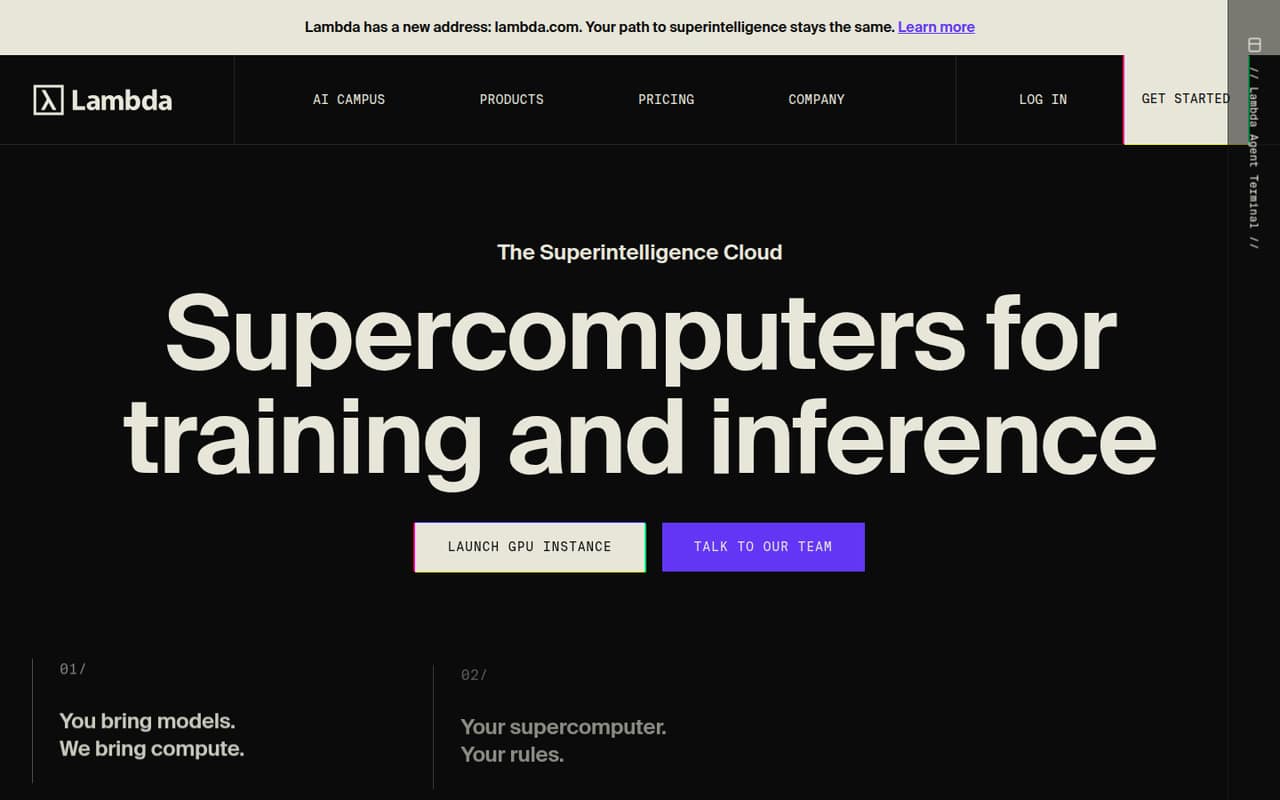
Lambda Cloud is hosted GPU infrastructure for training foundation models and serving inference. Teams can choose self-serve GPU instances, production-ready clusters, or managed clusters and superclusters. Its homepage lists single-tenant infrastructure and SOC 2 Type II certification.
The fit is strongest for teams that need GPU capacity and cluster operations, not an endpoint for calling a hosted model. GPU-hour prices are published, but there is no free tier, and some reserved-cluster rates are not published. Confirm the provisioning API, regional availability, and full production costs with Lambda before committing.
Good fit if
- AI teams training foundation models
- Distributed workloads on GPU clusters
- Teams seeking managed cluster operations
Skip it if
- Developers seeking a model inference API
- Projects that require a free tier
- Teams needing published reserved rates
ScoresHow it rates
What works
- Offers self-serve instances and production clusters
- Lists NVIDIA B200 and H100 cluster options
- Managed clusters reduce operational work
- Single-tenant, shared-nothing architecture
- SOC 2 Type II certification
What doesn't
- GPU-hour usage can make costs grow quickly
- No free plan or free trial is listed
- Reserved-cluster prices are not published
- Homepage does not establish API or SDK details
- Regional capacity and service limits need confirmation
01What Lambda Cloud is, technically
Lambda Cloud is vendor-operated GPU cloud infrastructure, not a model API, software library, or self-hosted server. It supplies compute for training foundation models and serving inference. The homepage presents several deployment shapes: self-serve GPU instances for testing and prototyping, 1-Click Clusters for distributed workloads, managed clusters, and single-tenant superclusters.
That puts Lambda beneath your ML framework and application layer. Your workloads run on Lambda's GPUs; your team remains responsible for its models and application logic. The homepage describes AI campuses combining high-density power, liquid cooling, and NVIDIA GPUs. Its supercluster offer includes single-tenant NVIDIA GB300 NVL72 clusters with NVIDIA Quantum-2 InfiniBand. 1-Click Clusters are listed for NVIDIA HGX B200 and H100. Lambda also offers co-engineering support and says it manages clusters so teams can focus on AI workloads. This is infrastructure for teams that need compute capacity and cluster operations, rather than a hosted endpoint that abstracts away the hardware.
02Lambda Cloud API, SDKs and docs
The homepage describes a cloud-compute workflow: launch a GPU instance for prototyping, or contact Lambda about clusters and managed infrastructure. Its primary call to action is “Launch GPU instance,” and it also offers a route to talk to the team. That is a provisioning and infrastructure integration surface, not evidence of a model-serving API.
The homepage does not name an API style, SDK, programming language, CLI, webhook, or plugin. Before building automation around Lambda, confirm in the vendor's docs whether instance and cluster lifecycle operations are available through an API or CLI, which authentication method they use, and what SDKs and languages are supported. Also check whether your existing orchestration tools can provision resources and retrieve status programmatically. For production, verify how deployments, networking, storage, and monitoring fit your stack; the homepage describes GPU and cluster offerings but does not establish those operational interfaces. Treat the “1-Click Clusters” label as a product option, not proof of a particular API or integration method.
03Lambda Cloud pricing for developers
Lambda lists GPU-instance prices per GPU-hour, from $0.69 for NVIDIA Quadro RTX 6000 to $7.99 for a NVIDIA B200 SXM6 (2-GPU listing). Other listed options include NVIDIA HGX B200 at $7.69 per GPU-hour, NVIDIA HGX H100 at $4.59, and NVIDIA Tesla V100 at $0.79. Production-cluster rates vary by GPU count: an NVIDIA HGX B200 (16 GPUs) is $9.86 per GPU-hour, while the 256+ GPU tier is $8.87. The NVIDIA H100 cluster rates range from $6.16 for 16 GPUs to $5.54 for 256 GPUs.
There is no free plan, and the pricing data lists no free trial. The bill grows with GPU-hours consumed, so multiply the rate by GPUs and runtime when estimating a job. The pricing page lists no monthly or annual billing. Reserved 1-year-plus cluster prices are not published. Prices checked November 6, 2026, are scheduled to take effect November 16; current prices are available after login until then. Applicable sales tax, VAT, or GST may apply.
04Lambda Cloud: open source, self-hosting and lock-in
Lambda Cloud is presented as infrastructure operated by Lambda, not as a self-hosted server. The homepage does not offer a self-hosted deployment. Lambda does not publish an open-source license for the cloud service in the product material, so teams should treat the service as vendor-operated infrastructure and ask Lambda about any separately licensed software before adopting it.
The homepage does not describe a data-export process. Ask how to retrieve model artifacts, datasets, logs, and other stored data, and whether storage or egress charges apply. Your model code and data formats may be portable, but jobs configured around Lambda-specific provisioning, networking, or cluster operations could require changes when moved. The homepage does not establish those interfaces or migration tools. Before a long reservation or production rollout, confirm resource export, data retrieval, termination procedures, and the steps required to move workloads to another GPU provider or your own infrastructure.
05Lambda Cloud in production
Lambda's production pitch centers on dedicated GPU clusters, managed operations, and single-tenant infrastructure. The homepage lists single-tenant, shared-nothing architecture, hardware-level isolation for caged clusters, and SOC 2 Type II certification. It also names NVIDIA Quantum-2 InfiniBand for GB300 NVL72 superclusters and production-ready HGX B200 and H100 1-Click Clusters.
Those features do not answer every operational question. Before depending on the service, ask about capacity by region, provisioning lead times, GPU and cluster availability, maintenance windows, service-level commitments, and support response times. The homepage does not publish rate limits, uptime figures, or availability guarantees. Pricing is per GPU-hour, so idle capacity and long-running jobs can raise spend; get an estimate for your expected GPU count and runtime. Verify how to monitor jobs, recover from failures, access data, and scale or terminate clusters. Confirm that the actual configuration and security controls meet your compliance requirements rather than relying on the certification alone.
Questions people ask
Is Lambda Cloud a model inference API?
Lambda Cloud is GPU infrastructure for training and serving inference workloads, not a hosted model endpoint in the product description. You run your workload on its GPU instances or clusters. Confirm the available provisioning and serving interfaces in Lambda's docs before designing an integration.
Which GPUs and clusters does Lambda Cloud offer?
The homepage lists HGX B200 and H100 instances, production-ready B200 and H100 1-Click Clusters, and single-tenant GB300 NVL72 superclusters. The pricing information also lists a range of self-serve GPU configurations, including A100, A6000, GH200, A10, and V100 options.
Does Lambda Cloud have a free tier?
The pricing information lists no free plan or free trial. Self-serve instances are priced per GPU-hour. The lowest listed instance rate is $0.69 per GPU-hour for NVIDIA Quadro RTX 6000; check the current price after login because the listed rates have a scheduled effective date.
Is Lambda Cloud suitable for production workloads?
Lambda lists production clusters, managed clusters, single-tenant architecture, and SOC 2 Type II certification. Those features may suit production AI workloads, but confirm availability, support commitments, service levels, security controls, and cluster pricing with Lambda before relying on it.
Can I automate Lambda Cloud with an SDK or CLI?
The homepage does not identify an SDK, CLI, programming language, or API style. Check Lambda's developer documentation for supported provisioning interfaces, authentication, and language support before choosing it for automated infrastructure workflows.