
We may earn a commission if you buy through links on this page. It never changes a score or a ranking. How we make money
The bottom line
A flexible GPU cloud with clear hourly rates, but production reliability needs close attention.
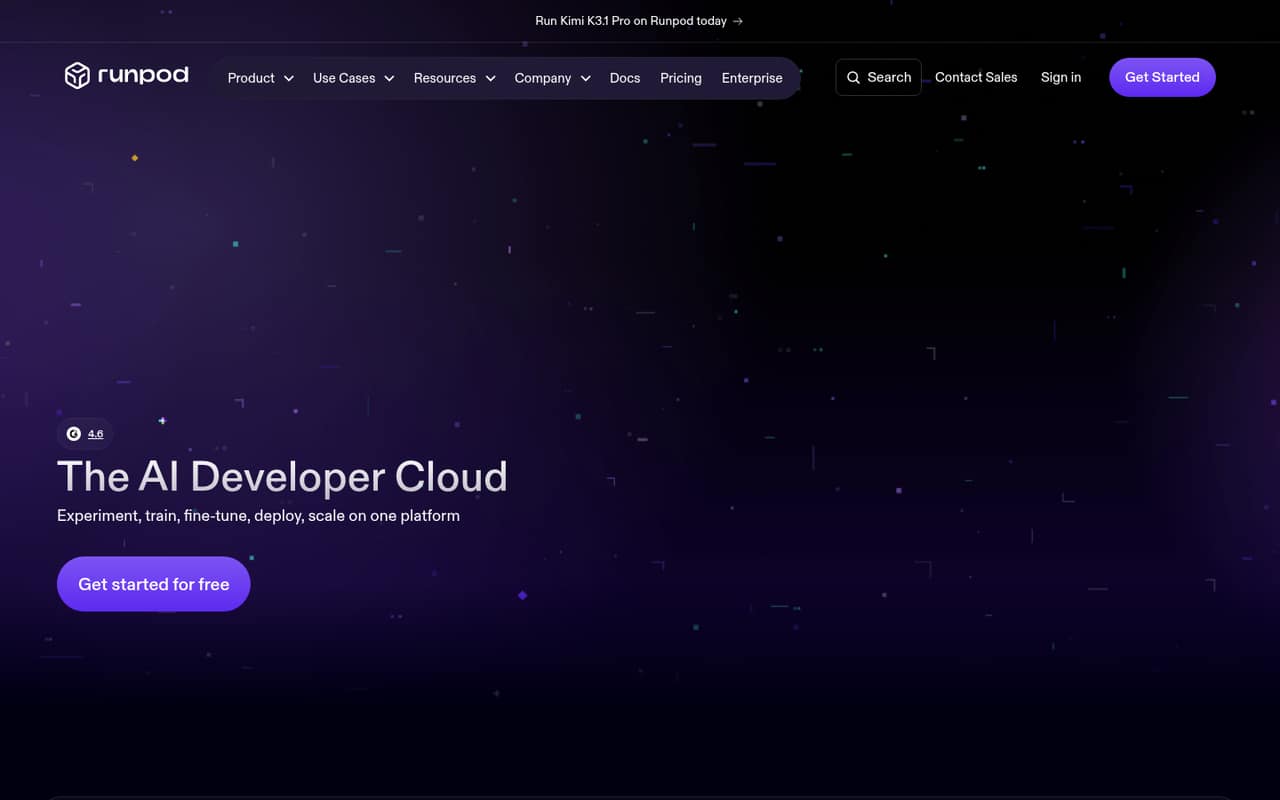
Runpod is a hosted AI developer cloud with GPU Pods, autoscaling Serverless endpoints and multi-GPU Clusters. It fits teams that need GPU capacity without buying hardware, from interactive development to deployed inference.
Hourly prices and a broad GPU selection make costs easy to model at a basic level. But Reddit reports include inconsistent availability, template failures, slow downloads and data-loss concerns; teams should test their own workloads and keep independent copies of important artifacts.
Good fit if
- Teams needing on-demand GPU capacity
- Inference workloads with variable traffic
- Developers using custom containers
Skip it if
- Workloads requiring guaranteed GPU availability
- Teams needing published support SLAs
- Sensitive data that must stay local
ScoresHow it rates
What works
- Pods, Serverless and Clusters share one platform
- More than 30 GPU SKUs across 31 regions
- Serverless endpoints scale to zero when idle
- Hourly GPU rates suit bursty workloads
- Homepage says network storage has no egress fees
What doesn't
- GPU availability and reliability complaints appear on Reddit
- Storage, downloads and idle compute can add costs
- Support response times are criticized by some users
- Source licence and self-hosting options are not published
- SDK and language support needs checking in the docs
01What Runpod is, technically
Runpod is a hosted cloud GPU platform, not a model library or a server you install in your own environment. It provides GPU Pods for interactive development, training and persistent compute; Serverless endpoints for inference; and Clusters for distributed training and large-batch inference.
In a typical stack, Runpod supplies the compute layer beneath your container, framework and application code. You can build and fine-tune models in a Pod, then deploy a handler to Serverless or use Clusters for multi-GPU work. The homepage describes bringing your own containers, framework and code, and says Pods, Serverless and Clusters sit in one account. It lists more than 30 GPU SKUs and 31 regions. Serverless queues requests and assigns them to workers, while the vendor advertises scaling to zero when idle. That makes Runpod a potential fit when purchasing and operating GPU hardware is not practical, but it also makes your workload dependent on the vendor’s capacity and service.
02Runpod API, SDKs and docs
The integration model centers on GPU Pods, a Serverless handler and public inference endpoints. The homepage says to write a handler and push it to Serverless; Runpod manages request queues and worker assignment. A November 2026 blog announcement describes using curl and Python with Public Endpoints, giving developers command-line and Python entry points for endpoint calls.
Runpod also supports custom Docker images and Pod templates, according to its homepage and template-building post. That lets teams package a framework and dependencies rather than start from a fixed runtime. The vendor advertises real-time logs, monitoring and metrics, and FlashBoot cold starts under 200ms. These are useful integration surfaces, but they do not establish which official SDKs, language versions, CLI commands, API protocols or webhook options are supported. Check the vendor’s docs for current SDK and API coverage before choosing a client library or building deployment automation around it. Reddit users describe some initial setup friction with templates and GPU environments.
03Runpod pricing for developers
Runpod bills compute by use, not by monthly or annual subscription. The pricing page lists Secure Cloud Pods from $0.27 per GPU hour for an RTX A5000, $1.79 for an A100, $2.89 for an H100 PCIe and $8.99 for a B300. Community Cloud prices differ; listed examples include H100 PCIe from $1.99 per hour and H200 from $3.59. Serverless is priced per worker hour, from $0.58 for 16GB GPUs; an H100 is $5.39 per hour and an RTX 4090 is $1.34.
Clusters list H200 SXM at $6.35 and A100 SXM at $2.15 per GPU hour. Some Cluster GPUs and Reserved Clusters require a sales quote. The pricing page lists no free plan or trial, although the homepage invites users to get started for free; ask Runpod what that offer includes. Storage is extra: Container Disk costs $0.10/GB/month, while Standard Network Storage is $0.07/GB/month under 1TB. Serverless Public Endpoints can also charge by request or input volume.
04Runpod: open source, self-hosting and lock-in
Runpod is presented as a hosted cloud service. The vendor does not publish a source licence or a self-hosting option on its homepage, so teams should ask whether any part of the control plane can be run independently before making that a requirement.
There is some portability at the workload layer: the homepage says you can use your own containers, framework and code, and the vendor describes saving custom Docker images as Pod templates. Those assets can reduce the effort of rebuilding elsewhere, but they do not make Runpod’s orchestration, endpoint setup or storage portable by themselves. Reddit users discuss downloading trained files and moving data to network storage; one thread describes a slow download while a Pod remained active. Keep source data and important model artifacts in storage you control, and test export paths and transfer times before relying on Runpod as the only copy.
05Runpod in production
Runpod advertises autoscaling, queue management, failovers and Serverless cold starts under 200ms. Those capabilities can help with variable inference traffic, but the homepage’s scale and uptime claims are not a substitute for a workload-specific capacity test or a written service commitment. The vendor does not publish an uptime figure on its homepage; ask about availability commitments, capacity guarantees and incident escalation before depending on it for a critical service.
Reddit reports are mixed. Some users praise training and GPU use, while others describe unavailable GPUs, Pod startup timeouts, template problems and lost network-storage data. A Stable Diffusion user reported download speeds of 50–60KB/s for a trained file and said keeping the Pod active added cost. These are individual reports, not a measure of overall service quality, but they point to practical failure modes. Secure internet-facing tools such as Gradio with authentication, keep independent backups, and monitor Pod state, logs and spend. Confirm region and GPU availability for your workload before launch.
From the threadsWhat users say
Reddit sentiment is mixed: some users report successful training and fast GPU work, while others describe setup friction, availability problems, slow downloads and storage concerns. The posts are anecdotal and do not establish how often these failures occur.
I've trained loads of Loras on the AI Toolkit image on Runpod and lever had a single problem
After some confusion w/ setting everything up initially its going great
A 300MB file is not going to get downloaded on 50-60kbps
Questions people ask
Is Runpod on demand?
Yes. Runpod sells GPU Pods by the hour, and its pricing notes say Pods have no commitment. Serverless endpoints are usage-priced and can scale to zero while idle. Cluster and Reserved Cluster options also exist; Reserved Clusters require a sales quote and show reservation terms from one month upward.
How much is one GPU hour on Runpod?
Rates depend on the GPU and cloud type. The pricing page lists Secure Cloud Pods at $0.27 per hour for an RTX A5000, $1.79 for an A100 and $2.89 for an H100 PCIe. Community Cloud rates differ; H100 PCIe starts at $1.99 per hour in the listed examples.
How much does a Runpod GPU server cost?
A Pod’s compute charge depends on its GPU rate and how long it runs. For example, the pricing page lists an RTX A5000 at $0.27 per GPU hour on Secure Cloud. Storage can add to the bill: Container Disk is $0.10/GB/month, and Volume Disk is $0.10/GB/month while running or $0.20 while idle.
Can I make money with Runpod?
Runpod provides compute, not a guaranteed source of income. You can use it to train models or serve an application, but revenue depends on your product, customers and operating costs. Calculate GPU time, storage and endpoint charges against expected revenue, and account for development, downtime and data transfer before committing.
Does Runpod have a free tier?
The pricing information lists no free plan or free trial, while the homepage has a “Get started for free” call to action. It does not say what that offer includes. Check the current signup terms for any credits, eligibility rules or expiration dates before budgeting around free usage.