
We may earn a commission if you buy through links on this page. It never changes a score or a ranking. How we make money
The bottom line
A broad hosted model API with simple integration and costs that depend on every model and run.
Replicate is a hosted API for running community models, fine-tuning models and deploying custom models packaged with Cog. Its Node, Python and HTTP integration options give teams a direct way to add inference without managing model-serving infrastructure themselves.
Usage billing can suit irregular workloads, but prices vary by model or hardware, and the free tier's limits are not published. Reddit users report support delays and model failures, so teams with production dependencies should confirm limits and support commitments before relying on it.
Good fit if
- Teams prototyping with multiple models
- Apps with variable inference demand
- Developers deploying custom models
Skip it if
- Teams needing a published SLA
- Workloads needing predictable monthly bills
- Teams requiring self-hosted Replicate
ScoresHow it rates
What works
- Thousands of community-published models are available through an API
- Run image, speech, music, video and language models
- Node, Python and HTTP integration options
- Cog packages custom models for deployment
- Private models can scale with demand
What doesn't
- Public-model prices vary by model and output type
- Private-model bills grow with hardware time
- Free-tier limits are not published
- Rate limits and uptime commitments need confirmation
- Reddit users report support delays and model failures
01What Replicate is, technically
Replicate is a hosted API platform for running AI models. It sits between an application and model inference: your code sends a request to a hosted model, and Replicate returns its output. That lets a team add image, speech, music, video or language generation without setting up its own serving stack for each model.
The platform includes community-published models, model fine-tuning with your data and deployment for custom models. Replicate's open-source Cog tool packages custom models for deployment. The service bills for public models according to their usage unit and for most private models according to hardware time. Private models can scale up and down with demand.
In a typical application, Replicate is an external inference dependency, not a library that runs models locally. You manage the API token and application logic; Replicate handles hosted execution. That reduces infrastructure work, but puts model availability, request limits and operating costs on the critical path of your application.
02Replicate API, SDKs and docs
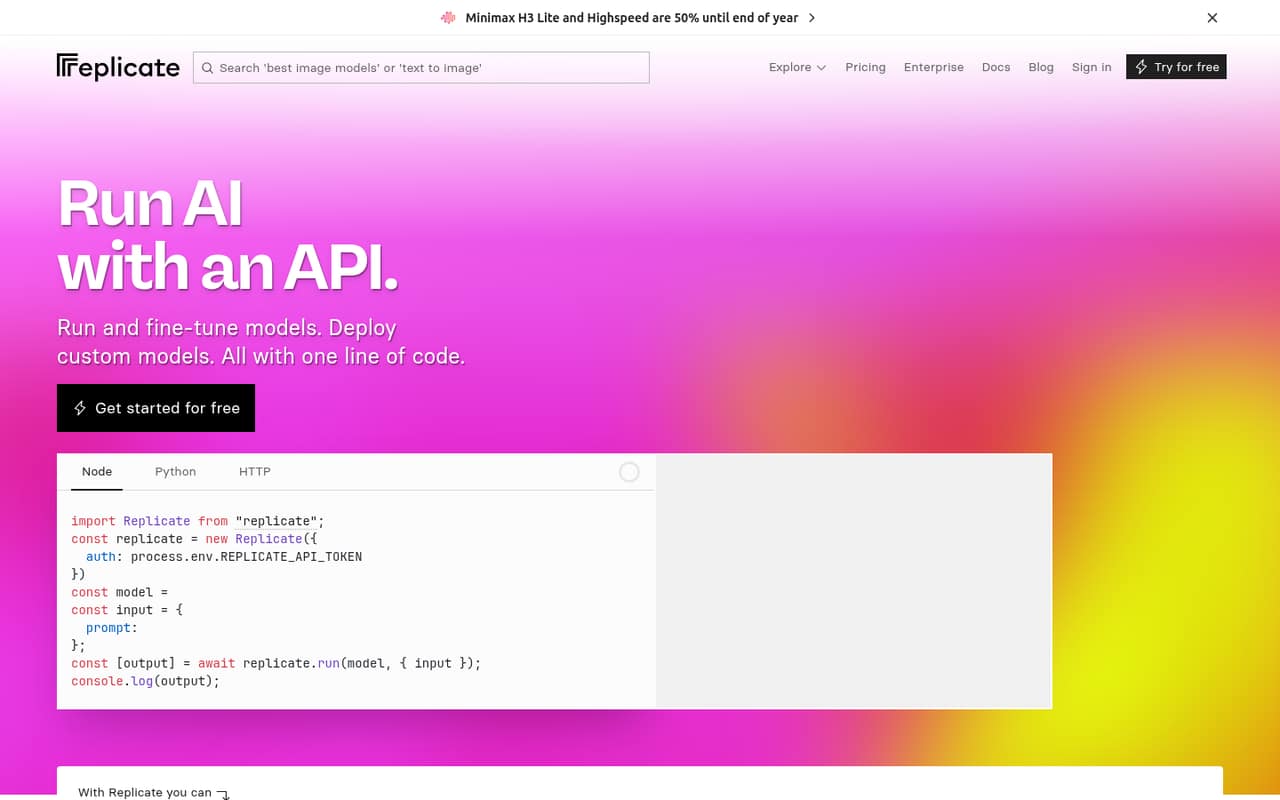
Replicate's homepage presents an API integration: its example creates a client with a REPLICATE_API_TOKEN, calls replicate.run(model, { input }) and reads the output. The homepage offers Node, Python and HTTP options, and its Node example imports the replicate package. Check Replicate's docs for the current SDK details and supported features in each language.
The model catalog is the other main integration surface. Developers choose a community or official model, inspect its inputs and outputs, then call it through the API. That provides a single platform for models across image, speech, music, video and language tasks, but each model can have its own input contract and billing unit. Model-specific behavior still needs to be handled in application code.
Cog is the tool for packaging custom models for deployment on Replicate. The vendor's homepage example does not name a CLI or a protocol beyond HTTP, so teams that need those surfaces should confirm their availability in the vendor's docs.
03Replicate pricing for developers
Replicate offers a free option, but the vendor does not publish its free-tier limits. There are no monthly or annual plans in the listed pricing. Public models are billed by model usage; private models are generally billed for the time their hardware is online. That means a project's cost depends on its model, volume and, for private deployments, selected hardware and runtime.
Examples show the range: FLUX 1.1 Pro and Recraft V3 are $0.04 per image, while FLUX Schnell is $3 per 1,000 images. DeepSeek R1 is $0.01 per 1,000 output tokens and $3.75 per million input tokens. Private compute ranges from CPU Small at $0.09 per hour to one A100 at $5.04 per hour and one H100 or H200 at $5.49 per hour.
Multi-GPU capacity can require committed-spend contracts; listed examples include four- and eight-GPU configurations. Enterprise and volume pricing is custom. Budget with model-specific rates and actual hardware runtime, not a flat subscription estimate.
04Replicate: open source, self-hosting and lock-in
Cog, Replicate's model-packaging tool, is open source. The Cog license is not named in the published product details, so check its repository and license before adopting it in a commercial codebase. Replicate's inference platform is presented as a hosted API; the vendor does not describe a self-hosted Replicate server.
That distinction affects portability. Cog helps package a custom model for deployment, but it does not make the hosted Replicate service self-hostable. The model, runtime and application input/output contract will determine how much work it takes to move inference elsewhere. Keep a provider boundary in your application and preserve model configuration and request/response handling outside provider-specific code where practical.
The vendor does not publish data-export terms in the published details. Ask how to export inputs, outputs, logs and model-related data, and what happens to stored data when an account or deployment is removed.
05Replicate in production
Replicate says private models can scale up and down automatically with demand. That can remove some capacity management, but production teams still need to model hardware-time costs and test how each model behaves under their workload. The vendor does not publish rate limits in the published details; confirm limits, uptime commitments and escalation paths before making the API a critical dependency.
Reddit reports are mixed, with a clear support concern. A thread in r/webdev describes unanswered support requests and a model that reportedly kept failing; other commenters say they use Replicate regularly. These are individual reports, not a service-level measurement, but the reported lack of response matters if an outage blocks your application.
Before launch, review the security and compliance terms for your data, set spending controls if available, and decide how the application handles failed or slow inference. Consider a fallback provider or self-hosted model path if a Replicate outage would interrupt a core product feature.
From the threadsWhat users say
Reddit sentiment is mixed: some users describe routine use, while others report failures and unanswered support requests. The main production concern in the discussions is how much help is available when inference breaks.
After reaching out for help, I got nothing: no response, no acknowledgment. Nada
vendor API with no SLA is a dependency, not a service. self-host the model or accept the risk
I use Replicate_com often. Am a big fan. I can see why CloudFlare bought them. But they just are an API service
each image generated is typically 1-2c. With hundreds of uses each month, this adds up to a few dollars
Questions people ask
Can I use Replicate for free?
Replicate offers a free option, and its homepage invites developers to get started for free. The vendor does not publish the free tier's limits in the published details, so check the current account and pricing pages before estimating how many runs you can make without charge.
How does Replicate charge for model runs?
Public models are billed according to their usage unit, which can be an image, token or second of output video. Most private models are billed for the time their hardware is online. Check the individual model price and inputs before building a cost estimate.
Can I deploy my own model on Replicate?
Yes. Replicate supports deployment of custom models using Cog, its open-source packaging tool. The platform then runs the deployed model as a hosted service. Review Cog's license and the model's runtime requirements before committing to that packaging path.
Can I self-host Replicate?
Replicate is presented as a hosted API platform, and the vendor does not describe a self-hosted Replicate server. Cog is open source and packages models for deployment, but that is distinct from self-hosting Replicate's hosted inference service.
What should I check before using Replicate in production?
Confirm rate limits, uptime commitments, support response expectations and data-handling terms with the vendor. Model prices and private hardware rates differ, so estimate costs using your expected request volume and runtime. Reddit users have reported support delays and model failures.