
We may earn a commission if you buy through links on this page. It never changes a score or a ranking. How we make money
The bottom line
Broad hosted model access and usage-based rates, but verify model limits and operational details first.
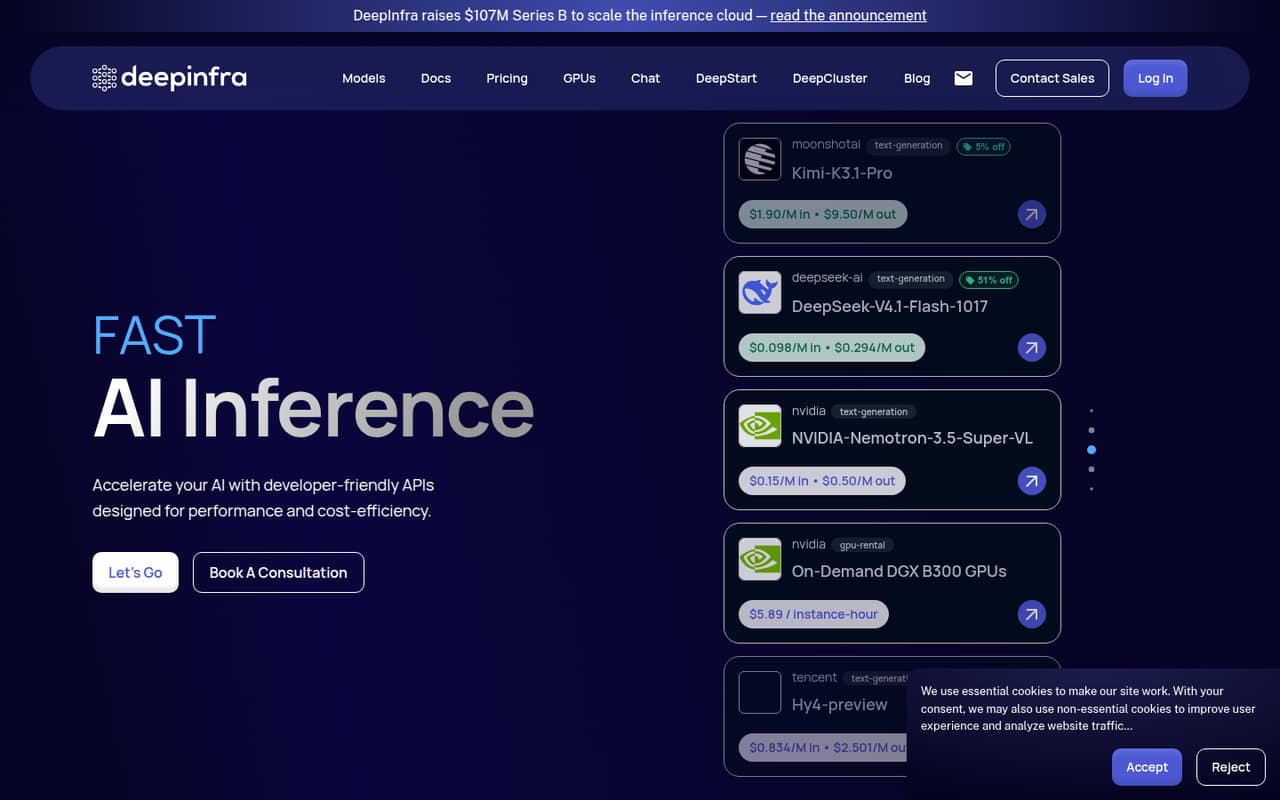
DeepInfra is a hosted AI inference API with more than 100 models for tasks including text, speech and image generation. Its pricing varies by model: some language models charge per input and output token, while most models are billed by inference execution time.
The service may suit teams that want to switch among models without operating inference infrastructure. Before production, confirm the API and SDK details, model-specific limits and how the zero-retention policy applies to your workload.
Good fit if
- Teams comparing hosted models
- Apps with variable inference usage
- Builders optimizing for model cost
Skip it if
- Teams requiring self-hosted inference
- Workloads needing published rate limits
- Buyers requiring a free tier
ScoresHow it rates
What works
- Catalog spans 100+ models and multiple task categories
- Pay-as-you-go pricing has no long-term contracts
- Some language models have per-token rates
- Homepage states a zero-retention policy
- SOC 2 and ISO 27001 certified, per DeepInfra
What doesn't
- No free plan or free trial is listed
- Most models use inference-time billing
- SDKs and supported languages need confirmation
- The vendor does not publish self-hosting details
- Reddit users report rate-limit errors and provider differences
01What DeepInfra is, technically
DeepInfra is a hosted AI inference service: your application sends requests to its APIs, and DeepInfra runs the selected models on its infrastructure. It is not a model library or a self-hosted server. It sits between your application and the model runtime, so your code can use hosted models without managing GPU capacity or serving infrastructure.
The catalog covers more than 100 models across categories including text generation, speech, image generation, embeddings, reranking and other tasks. DeepInfra says teams can choose infrastructure and models around cost, latency, throughput or scale. That makes the service relevant when a team wants to compare models or avoid running each model itself. The trade-off is provider dependence: requests, billing and production behavior rely on DeepInfra’s hosted service. Treat its zero-retention, security and infrastructure claims as vendor claims, and check their scope against your data and compliance requirements before sending sensitive workloads.
02DeepInfra API, SDKs and docs
The integration surface is DeepInfra’s hosted inference APIs. The homepage describes them as simple, developer-friendly APIs, but does not name an API protocol, programming languages, SDKs, CLI or framework integrations. Confirm the supported clients and request formats in DeepInfra’s docs before selecting it for a codebase; do not assume a particular language SDK or compatibility layer.
The model catalog is organized by task and model family, with a pricing page and documentation linked from the site. That gives developers places to check model choice and costs, but the homepage alone does not establish that every model shares the same interface or capabilities. Build a provider adapter in your application if you may change models or inference vendors: keep model identifiers, request parameters and response handling behind that boundary. Before committing, verify authentication, streaming behavior, error formats, retries and model-specific limits in the docs. The vendor advertises hands-on technical support, which teams can ask about when validating a production integration.
03DeepInfra pricing for developers
DeepInfra’s plan is Pay-as-you-go inference. The pricing page lists no free plan, free trial, monthly subscription or annual billing. Some language models are billed per 1 million input and output tokens; the cheapest listed example is $0.02 per 1 million input tokens and $0.04 per 1 million output tokens. Most other models are billed by inference execution time, so compare the selected model’s rate rather than assuming one platform-wide price.
The bill grows with the model and the amount of inference you run. Input and output may have different token rates, and cached tokens can have separate prices on model listings. The homepage also displays individual model rates, which can vary substantially. DeepInfra says there are no long-term contracts or upfront costs, but that does not cap usage. Set application-side budgets and monitor consumption by model. The vendor does not publish a single starting price for the full catalog; check the current rate for each model and confirm how execution-time billing is measured before estimating production spend.
04DeepInfra: open source, self-hosting and lock-in
DeepInfra is presented as a hosted inference service running on the vendor’s infrastructure. Its homepage does not publish a license for the service or identify a self-hosted version. Model weights may be described as open-weight on individual model pages, but that does not make DeepInfra’s API platform open source or grant permission to run its infrastructure yourself.
The vendor does not publish a data-export process for requests or outputs. Keep your prompts, outputs and application records in systems you control if you need them outside DeepInfra. Moving to another provider is likely to require changing the endpoint and checking model names, request parameters, response formats and behavior; the effort depends on your integration. Use an internal provider interface and avoid tying business logic to one vendor’s model-specific features. Ask DeepInfra about source licensing, self-hosting and data export if those are procurement requirements.
05DeepInfra in production
DeepInfra says its infrastructure runs in secure US-based data centers and lists SOC 2 and ISO 27001 certifications. It also says inputs, outputs and user data stay private under a zero-retention policy. Confirm the policy’s scope, certification documents, data location and any model-specific exceptions with the vendor before sending regulated or sensitive data.
The homepage does not state a general API rate limit or availability target. Ask about model-specific throughput, quotas, error handling and support escalation, then test those conditions in your own workload. In one Reddit thread, a paying customer reported repeated rate-limit errors and another commenter reported a brief provider outage. A separate discussion describes differences between first-party and third-party model behavior; those reports are anecdotal, but underline that model name alone may not guarantee identical results across providers. Track latency, errors, token usage and output quality per model, and keep a fallback path for critical requests.
From the threadsWhat users say
Reddit sentiment is mixed and mostly focused on provider behavior rather than the catalog. Users describe rate-limit and availability concerns, while others point to harness configuration and provider differences as factors in model quality.
they kept returning "rate limit" errors for a paying customer
InferX and DeepInfra behaved much more like each other
90% is harness, 10% is model
we fixed the pricing shortly after you reported it
Questions people ask
What does DeepInfra do?
DeepInfra provides hosted APIs for running AI models. Its catalog includes more than 100 models across tasks such as text generation, speech, image generation, embeddings and reranking. Applications send inference requests to DeepInfra rather than managing the model-serving infrastructure themselves.
Does DeepInfra have a free tier?
The pricing information lists no free plan or free trial. DeepInfra’s listed option is Pay-as-you-go inference, with charges based on the selected model and its billing method. Check current model rates before estimating costs for development or production.
How is DeepInfra pricing calculated?
Some language models are priced per 1 million input and output tokens. Most other models are billed by inference execution time. Rates vary by model; the cheapest listed token-priced example is $0.02 per 1 million input tokens and $0.04 per 1 million output tokens.
Does DeepInfra retain prompts and outputs?
DeepInfra’s homepage says its zero-retention policy keeps inputs, outputs and user data private. For sensitive or regulated workloads, ask the vendor to clarify the policy’s scope, how it applies to specific models, and what data may be retained for operational or legal reasons.
Can I self-host DeepInfra?
DeepInfra presents its inference service as hosted on the company’s own infrastructure. The vendor does not publish a self-hosted version of the platform. Some catalog models may be open-weight, but that is separate from licensing or hosting DeepInfra’s service.