
We may earn a commission if you buy through links on this page. It never changes a score or a ranking. How we make money
The bottom line
Distributed GPU infrastructure with low listed rates, but production capacity and pricing need careful review.
SaladCloud combines a hosted, OpenAI-compatible API for open-weight models with a container platform that schedules Docker workloads across distributed GPU pools. Teams can use on-demand Community Cloud, contract for dedicated hardware, or run the orchestration stack on their own devices.
The main trade-off is between low-cost, distributed capacity and the predictability of reserved infrastructure. GPU pricing is listed by model and priority, but AI Gateway token rates and flat-plan prices are not published on the pricing information available to us. Confirm capacity, service guarantees and the full bill with Salad before moving production traffic.
Good fit if
- Cost-sensitive GPU inference
- Containerized batch workloads
- Teams with idle GPU fleets
Skip it if
- Workloads needing uniform hardware
- Teams requiring published API rates
- Projects that need a free tier
ScoresHow it rates
What works
- OpenAI-compatible endpoint for open-weight models
- Container orchestration spans distributed GPU pools
- Community Cloud starts at $0.015 per GPU-hour
- Private Cloud can run on organization-owned devices
- Dedicated bare metal and VMs available on contract
What doesn't
- No free plan or free trial is listed
- AI Gateway token and flat-plan rates are not published
- Distributed capacity may not suit uniform-hardware workloads
- SDK and language support needs confirmation in the docs
- Dedicated capacity requires a contract
01What SaladCloud is, technically
SaladCloud is a hosted GPU infrastructure platform with two main integration layers: an OpenAI-compatible AI Gateway for model inference and Salad Container Engine for Docker workloads. It schedules containers across a distributed network of consumer GPUs, workstations and data-center servers. Community Cloud supplies on-demand capacity; Salad Dedicated offers reserved bare metal and virtual machines on contract.
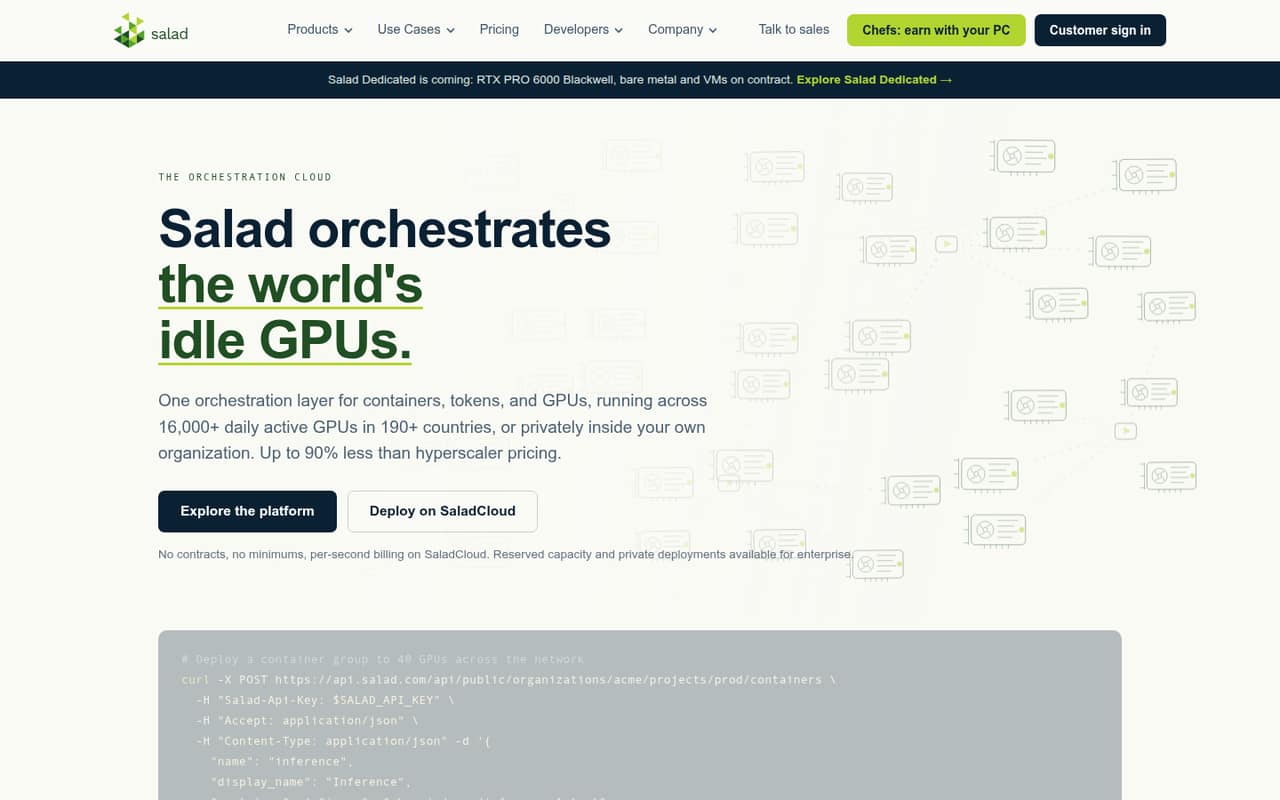
In an application stack, the AI Gateway can sit behind an existing client that calls an OpenAI-compatible endpoint. Container Engine sits below the workload, managing placement and reallocation across GPU pools. The homepage shows a REST request to the Salad API that creates a container group and sets image, CPU, memory, GPU class, replicas and restart policy. Teams can also run Salad orchestration on their own devices through Private Cloud, which the vendor says keeps company data on those devices. This is infrastructure, not a model-training library or a local GPU runtime.
02SaladCloud API, SDKs and docs
The homepage demonstrates a REST API at api.salad.com, using a Salad API key and JSON requests. Its example creates a container group, selects a GPU class, sets resource requirements and requests 40 replicas. Container Engine supports Docker workloads, and the vendor describes the containers as OCI containers. The AI Gateway is OpenAI-compatible and serves open-weight models, so it can fit into clients built for that API shape.
Salad also lists Virtual Kubelet for scheduling Kubernetes pods onto SaladCloud, plus Recipes & Models for one-click deployments. The developer hub links to documentation, getting-started material, recipes and GitHub. The homepage does not name SDK languages or a CLI; confirm SDK availability and supported languages in the vendor’s docs before choosing an integration. It also says the API is shared across Community Cloud, Dedicated and Private Cloud. That offers a consistent deployment surface, but teams should validate which API operations and features apply to each environment.
03SaladCloud pricing for developers
SaladCloud has no listed free plan or free trial. Community Cloud advertises GPU access from $0.015 per GPU-hour, while the listed GPU table gives model- and priority-specific hourly rates. For example, an RTX 5090 ranges from $0.250 to $0.600 per GPU-hour; an RTX 3080 ranges from $0.060 to $0.155. The vendor says usage is charged for running seconds, and the monthly figures assume 730 hours at the Lowest rate: $182.50 for an RTX 5090 and $43.80 for an RTX 3080.
Your compute bill grows with the number of running instances and their runtime. The AI Gateway is billed per token or through a flat monthly plan, but those prices are not published in the information available to us. Salad Dedicated is contract-based, and no rate is listed. No add-ons are listed. Before launch, ask Salad which priority and GPU availability fit your workload, and get the total cost for API usage, reserved capacity and any required support in writing.
04SaladCloud: open source, self-hosting and lock-in
The vendor links to GitHub, but does not publish an open-source license for Salad Container Engine or say that the full platform source is available. Treat the orchestration layer as vendor-managed software unless Salad confirms the license and self-hosting terms. Private Cloud is a deployment option: Salad says organizations can run its orchestration stack on their own devices, with company data staying on those devices.
The AI Gateway’s OpenAI-compatible endpoint can reduce client-side migration work, while Docker and OCI containers give workloads a portable packaging format. Those do not guarantee that model configuration, scheduling behavior, secrets, logs or operational tooling transfer directly to another provider. The vendor does not publish a data-export process in the homepage information. Before adopting the platform, ask how to export logs and configuration, what data the gateway retains, and whether Private Cloud requires a contract or ongoing hosted services.
05SaladCloud in production
Salad’s architecture is designed to reallocate work when a node disappears. The vendor says Container Engine verifies nodes, isolates containers behind a hypervisor and streams logs. That is relevant for distributed hardware, but does not remove the need to test retry behavior, checkpointing and workload recovery. GPU capacity can vary across a network of consumer devices; confirm the availability and hardware mix for the regions and GPU classes your service needs.
The homepage cites 16,000+ daily active GPUs and nodes in 190+ countries. It does not publish API rate limits, a service-level agreement, detailed uptime targets or per-model capacity guarantees. Ask about these before making the gateway a critical dependency. The vendor says AI Gateway data is never used for training, and Private Cloud keeps company data on company devices. Review the security and Trust Center materials for your organization’s requirements, and confirm data retention, incident response and compliance coverage directly. Enterprise Support offers security review and a named team for large deployments.
Questions people ask
Does SaladCloud have a free plan?
No free plan or free trial is listed. Community Cloud is billed by GPU use, with an advertised starting price of $0.015 per GPU-hour. The model-specific price table lists separate hourly rates by GPU and priority. Ask Salad whether a trial or evaluation arrangement is available for your project.
Can I use SaladCloud through an OpenAI-compatible API?
Yes. Salad’s AI Gateway is an OpenAI-compatible endpoint for open-weight models. It is billed per token or through a flat monthly plan. The vendor does not publish those API prices in the available pricing information, so confirm rates and any request limits before routing production traffic.
Can SaladCloud run on my organization’s own GPUs?
Yes. Salad Private Cloud runs the orchestration stack on an organization’s own devices and provides a private, OpenAI-compatible token service. Salad says company data stays on those devices. Confirm deployment requirements, support terms and any contract costs with the vendor.
What happens when a GPU node disappears?
Salad says Container Engine reallocates work when a node disappears. Your application still needs suitable retry and checkpoint behavior, especially for long-running jobs. Ask Salad how scheduling, restarts and recovery work for your specific workload and whether any availability commitments apply.
Which languages and SDKs does SaladCloud support?
The homepage shows a JSON REST API using an API key, and an OpenAI-compatible endpoint for inference. It links to developer documentation and GitHub but does not name SDK languages or a CLI. Check the vendor’s documentation for current SDK support and examples in your language.