
We may earn a commission if you buy through links on this page. It never changes a score or a ranking. How we make money
The bottom line
A straightforward hosted status page, but check API limits, export options and plan ceilings before production.
Statuspage is a hosted incident communication service, not an uptime monitor or self-hosted server. It publishes service-component status and incident updates, with a REST API and integrations for monitoring, alerting, chat and help desk tools.
The free public page covers small deployments, but subscriber and team limits push growing teams toward paid plans. It suits teams that want to outsource availability of the communication layer; developers needing self-hosting, published API limits or a clearly documented migration path should check those points with Atlassian first.
Good fit if
- Teams publishing public incident updates
- Companies with existing monitoring integrations
- Internal service communications at scale
Skip it if
- Teams requiring self-hosted status pages
- Projects needing published API rate limits
- Teams seeking an uptime monitoring platform
ScoresHow it rates
What works
- Free public page includes 100 subscribers
- REST API access appears on public plans
- Integrates with monitoring, alerting, chat and help desk tools
- Supports email, SMS and webhook notifications on paid plans
- Private pages include employee-focused plan tiers
What doesn't
- Free page is limited to 100 subscribers
- API rate limits are not published
- SDK and language support needs verification
- Source availability and self-hosting are not published
- No overage pricing or data export details are published
01What Statuspage is, technically
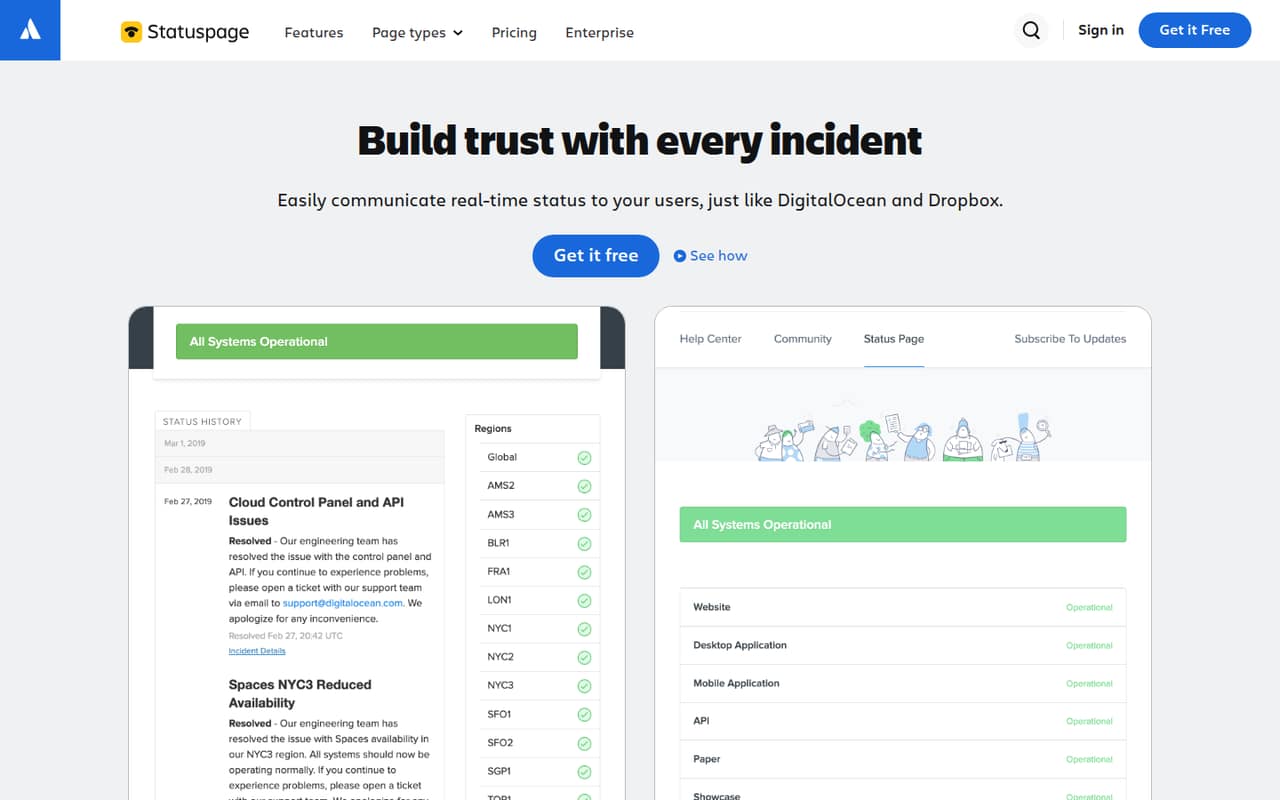
Statuspage is Atlassian’s hosted service for publishing incident communications. It is a SaaS application, rather than an uptime-monitoring agent, library, CLI or server that you install in your own environment. It sits alongside monitoring and incident-response systems: those tools detect or manage an issue, while Statuspage publishes the service status and updates to customers or employees.
Teams can create public, private or audience-specific pages, choose which service components to show, and communicate from investigation through resolution. The product also supports subscriber messaging through channels including email, text message and in-app messages. Its component catalog can show the status of third-party services, and Uptime Showcase presents historical uptime to customers and prospects. That makes Statuspage a communication endpoint in an incident stack, not a replacement for monitoring, alerting or incident management. Its hosted model reduces the need to operate the status page yourself, but also makes availability and migration planning dependent on the vendor.
02Statuspage API, SDKs and docs
The integration surface named by Atlassian is REST API access, available on the free public plan and paid public plans. The homepage also describes integrations with monitoring, alerting, chat and help desk tools, plus connections to more than 150 third-party components whose status can appear on a page. Paid plans list webhook notifications; that is a notification channel, not a published guarantee of a particular inbound webhook API.
The homepage does not name SDKs, programming languages or a CLI. Confirm SDK and language support in the vendor’s documentation before committing to an implementation. The API rate limits, request quotas and versioning policy are not published on the vendor's site, so ask Atlassian about those before building polling or incident automation around the API. Teams can also use incident templates and subscriber notifications without writing an integration. Slack and Microsoft Teams notifications are included in the listed public plans, while email, SMS and webhook availability varies by plan.
03Statuspage pricing for developers
The Free (Public Page) plan costs $0 per month and includes 100 subscribers, 25 components, two team members and two metrics. It includes email, Slack and Microsoft Teams notifications. Hobby (Public Page) is $29 per month for 250 subscribers and five team members; Startup is $99 for 1,000 subscribers and 10 team members. Business costs $399 for 5,000 subscribers, and Enterprise costs $1,499 for 25,000 subscribers.
Private Page plans start at Starter for $79 per month, with five team members and 50 employees; Growth costs $249, Corporate $599 and Enterprise $1,499, with employee caps rising to 300, 1,000 and 5,000. Audience-specific Page starts at $300 per month. These prices are listed per month. The bill grows by plan tier and its subscriber, employee, team-member and metric limits—not by a published API request or compute meter. The vendor does not publish overage prices or add-ons in these plans, so ask what happens when a limit is reached. Some Enterprise plans offer yearly purchase orders and invoicing; no annual discount is shown.
04Statuspage: open source, self-hosting and lock-in
Atlassian sells Statuspage as a hosted service. Its product material does not publish an open-source licence or a self-hosting option, so teams should plan to use the vendor-hosted service rather than assume they can deploy the application in their own infrastructure. The licence and source availability are not published; ask Atlassian directly if either is a procurement requirement.
The product details also do not describe a data-export or migration process. Before depending on Statuspage for customer-facing incident history, ask how to export subscribers, components, metrics and incident records, and whether those exports preserve enough structure to move to another service. Integrations and REST API access give teams ways to connect their stack, but they do not by themselves establish that the underlying data is portable. A migration may require rebuilding page configuration and subscriber workflows in the destination service.
05Statuspage in production
Before relying on Statuspage during an outage, check the limits that shape your incident workflow: subscriber or employee caps, team seats, metrics, notification channels and API rate limits. The vendor lists role-based access control on higher public and private tiers, team-member SSO on several plans, and IP allowlisting on some private plans. Compliance coverage, service-level commitments and API rate limits are not published in the product details; confirm them with Atlassian if they affect your production requirements.
Statuspage can show historical uptime and third-party component status, but its stated role is incident communication, not service monitoring. Keep detection and alerting independent. That separation matters for any hosted status page: a commenter on r/selfhosted warned that a self-hosted page could go down with the services it reports on, while another argued for isolating critical infrastructure. Reddit users discussing alternatives also describe Statuspage pricing as high, but those comments are individual opinions, not a pricing comparison. Test your notification and escalation process, and establish an export or fallback plan before an incident.
From the threadsWhat users say
Reddit discussion is mixed and often focused on alternatives rather than Statuspage itself. Commenters raise pricing concerns and debate the trade-offs of self-hosting a status page.
Very high pricing, is not what I'm looking for
Self hosting a status page is not a great idea
Self hosted status page... Won't it be down along with other self hosted stuff? )))
Their tools for building more sophisticated tests so you can test logins or deeper functions in your apps are better than most
Questions people ask
Is Statuspage free?
Yes. Free (Public Page) costs $0 per month and includes 100 subscribers, 25 components, two team members and two metrics. It also includes email, Slack and Microsoft Teams notifications. Teams that exceed those plan limits need to consider a paid public plan.
How does Atlassian Statuspage work?
Statuspage is a hosted service where teams publish component status and incident updates to public, private or audience-specific pages. Teams can communicate through subscriber notifications and connect monitoring, alerting, chat and help desk tools. It supports incident communication rather than replacing the systems that detect issues.
Does Statuspage have a REST API?
Yes. Atlassian lists REST API access on its public plans, including the free tier. The product details do not publish API rate limits, request quotas or SDK and language support. Confirm those details in the vendor’s documentation before building an integration that depends on particular request volumes or client libraries.
Can we use Statuspage for internal incidents?
Yes. Statuspage has private-page plans for communicating with employees about internal tools and services. Starter begins at $79 per month for five team members and 50 employees. Higher tiers increase those limits and add features such as SMS or webhook notifications, component subscriptions and access controls.
Can we self-host Statuspage or export our data?
Atlassian sells Statuspage as a hosted service; its product material does not publish an open-source licence or self-hosting option. It also does not describe a data-export process. Ask Atlassian about exporting subscriber, component and incident data before making Statuspage a long-term dependency.