
We may earn a commission if you buy through links on this page. It never changes a score or a ranking. How we make money
The bottom line
A straightforward managed platform, with rising costs and hosted-platform lock-in to weigh.
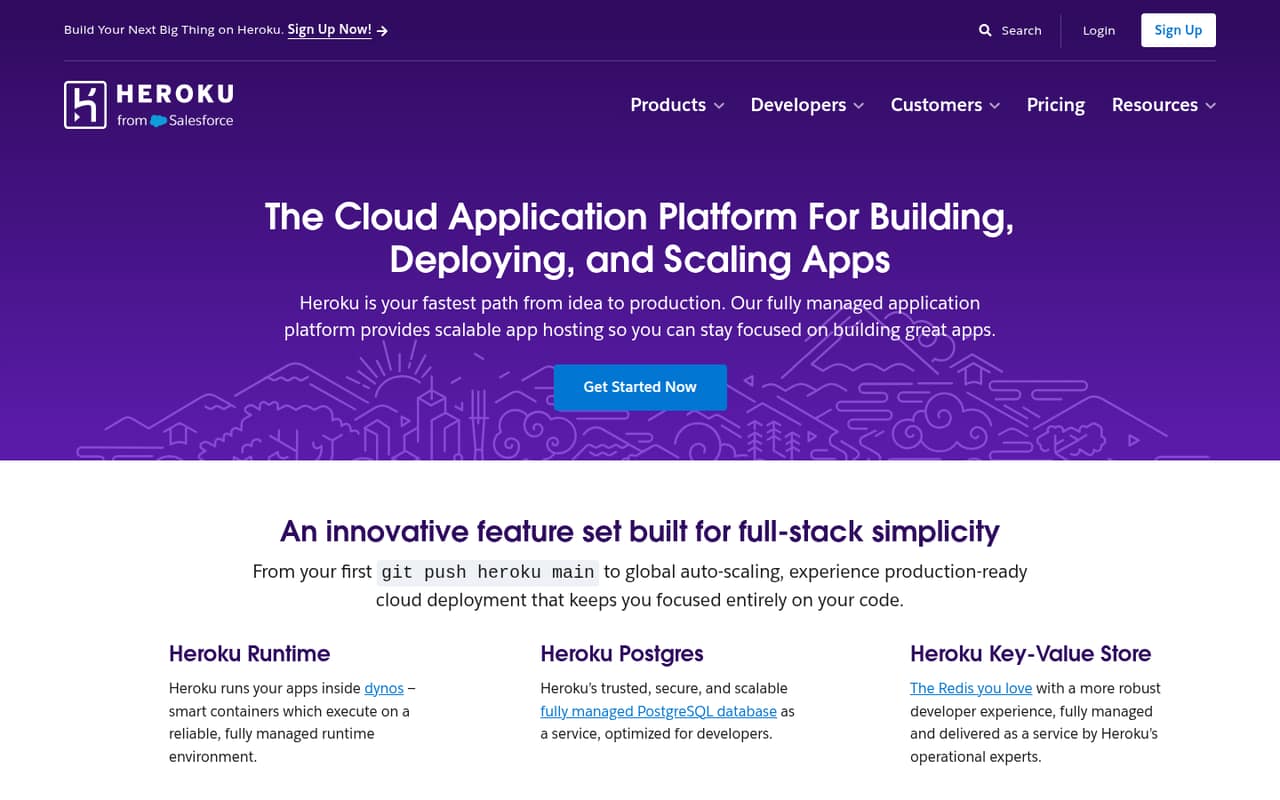
Heroku is a hosted application platform: it runs apps in managed dynos and offers managed PostgreSQL, a Redis-based key-value store, deployment tools and add-ons. GitHub integration, Review Apps and the Heroku CLI give teams a direct path from code to a running service.
The platform covers a broad set of languages and workload sizes, but its listed plans start at $5 per month and rise to thousands for larger private workloads. Reddit discussions include praise for the deploy workflow as well as concerns about cost, outages and the platform’s future.
Good fit if
- Teams that want managed app hosting
- GitHub-based deployment workflows
- Apps using supported languages and buildpacks
Skip it if
- Teams requiring self-hosted infrastructure
- Cost-sensitive, high-compute workloads
- Teams needing published SDK and API details
ScoresHow it rates
What works
- Managed runtime, PostgreSQL and Redis-based key-value storage
- GitHub deployments can create disposable Review Apps
- Supports nine named languages and Linux buildpacks
- Plans cover hobby projects through private workloads
- Managed AI inference, agents, MCP hosting and pgvector
What doesn't
- No free plan; Eco starts at $5 per month
- Compute prices rise to $2,400 per month
- Private plans require a Private Space
- Platform license and data export details need confirmation
- Reddit users raise cost, outage and continuity concerns
01What Heroku is, technically
Heroku is a hosted cloud application platform, not a library or a server you install in your own environment. It runs application processes in dynos on a managed runtime, with Heroku Postgres and a Redis-based key-value store available as managed data services. Deployment and operations sit between your application code and the underlying infrastructure: Heroku handles the runtime environment while your team manages the app and its configuration.
That makes Heroku a platform layer in an application stack. It aims to reduce the infrastructure work involved in building, deploying and scaling web apps, and offers add-ons and buildpacks to extend the runtime. Teams can deploy through GitHub integration or the Heroku CLI, then scale apps up or out across the listed dyno plans. The platform also includes managed inference and agents, MCP hosting, and pgvector for Heroku Postgres. Heroku describes itself as fully managed; the published materials do not establish a self-hosted deployment option.
02Heroku API, SDKs and docs
Heroku’s homepage describes a deployment-first integration surface: the CLI workflow includes git push heroku main, and the AI workflow includes heroku ai:models:create. GitHub integration can deploy a branch on each push, manually or automatically, and create a disposable Review App for a pull request. Heroku Flow supports continuous delivery, while buildpacks customize the language stack and add-ons connect third-party services.
The officially supported languages listed are Node.js, Ruby, Java, PHP, Python, Go, Scala, Clojure and .NET. Heroku also says a third-party buildpack can support any language that runs on Linux. The homepage does not name an API protocol or SDKs, so confirm the required SDK and API support in Heroku’s docs before choosing a language-specific integration. It names Heroku Postgres, the key-value store, managed inference and agents, MCP hosting, and pgvector as platform services. Review the docs for the precise setup and operational requirements of the services your app will use.
03Heroku pricing for developers
Heroku has no free plan in the listed pricing. Eco costs $5 per month and includes 0.5 GB RAM, 1x–4x compute and two process types; it sleeps after 30 minutes of inactivity. Basic is $7 per month, with 0.5 GB RAM and always-on service. For apps that need scaling and monitoring, Standard-1X is $25 per month; Standard-2X is $50 per month and lists 1 GB RAM.
The higher tiers change the bill sharply: Performance-M is $250 per month, while Performance-XL is $750 and Performance-2XL is $1,500. Private and Shield plans start at $125 and $150 per month respectively, and require private networking or provide PCI compliance as listed. Fir compute plans reach $2,400 per month for Compute 32CPU-64GB. These are monthly plan prices, not a complete project estimate: calculate the number and size of processes your app needs, and check current pricing for data services and add-ons. The pricing page lists no annual discount. Confirm billing behavior for scaling, data services and any other usage before production.
04Heroku: open source, self-hosting and lock-in
Heroku is presented as a fully managed hosted platform. The homepage does not provide a platform license or describe a self-hosting option, so teams that need source access or control over the hosting environment should confirm those points with Heroku before committing. It does describe buildpacks as extensible and says hundreds are available from the community; that does not establish the license of Heroku itself or of each buildpack.
The published materials also do not describe a data-export path or give a migration procedure. Ask how to export application data, database backups and configuration, and whether your chosen add-ons have independent export tools. Apps that depend on dynos, Heroku-specific deployment workflows, add-ons or managed data services will need replacements for those platform components when moving. Keeping application code and data services portable can reduce that work, but the exact migration effort depends on the app and its dependencies.
05Heroku in production
Heroku lists scaling up or out, autoscaling on several Performance plans, App Metrics, fast rollback and managed data services. Its homepage also says it maintains PCI, HIPAA, ISO and SOC compliance; teams should verify which services, plans and configurations apply to their requirements rather than treating that statement as a blanket guarantee. Private Spaces provide network-isolated runtime environments, and Shield plans list PCI compliance.
Check plan capacity, sleep behavior and the cost of the process count your app needs before launch: Eco sleeps after 30 minutes of inactivity, while Basic is listed as always on. The published pricing lists monthly plans but does not state request limits, rate limits or scaling overage rules; ask Heroku how those affect your workload. Reddit discussions include a Rails developer concerned about dyno prices, a user describing a serious outage, and a thread questioning the platform’s future. These are individual reports, not reliability measurements, but they make continuity, recovery and cost worth validating with your own requirements.
From the threadsWhat users say
Reddit sentiment is mixed, with clear affection for Heroku’s low-friction Git deployment alongside complaints about dyno prices and outage concerns. Some posts also question the platform’s future, but they do not establish an official discontinuation.
I have been learning on Heroku for a long time and love git push heroku master and slamming enter
Aside of the ridiculously overpriced dynos, of course
This recent incident has made me lose all confidence in Heroku as a platform
I shared a post that Heroku looks like it's going to be sunsetted
Questions people ask
Is Heroku part of AWS?
Heroku describes itself as a managed cloud application platform. The published Heroku homepage does not identify the underlying infrastructure provider. If your deployment depends on a particular cloud provider, region or data-residency arrangement, confirm those details directly with Heroku before choosing a plan.
Is Heroku being discontinued?
Heroku’s homepage presents its application platform and services, but a Reddit post speculating about a sunset is not an official status announcement. For a purchasing decision, check Heroku’s current announcements and ask its sales or support team about product availability and any service-specific end-of-life notices.
What languages can I use on Heroku?
Heroku lists Node.js, Ruby, Java, PHP, Python, Go, Scala, Clojure and .NET as officially supported languages. It also says a third-party buildpack can run any language that runs on Linux. Check the current Heroku docs for the buildpack and runtime requirements of your chosen language.
Does Heroku have a free plan?
The listed Heroku plans do not include a free tier. The lowest-priced option is Eco at $5 per month; it includes 0.5 GB RAM and sleeps after 30 minutes of inactivity. Basic costs $7 per month and is listed as always on. Check the current pricing page before budgeting.
Can I self-host Heroku?
Heroku presents its platform as a fully managed service, and its homepage does not describe a self-hosted installation. If hosting control or source availability is a requirement, ask Heroku directly about the platform’s license and deployment options before building around its services.