
We may earn a commission if you buy through links on this page. It never changes a score or a ranking. How we make money
The bottom line
A capable API for turning live web pages into agent-ready data, with operational caveats to check before scaling.
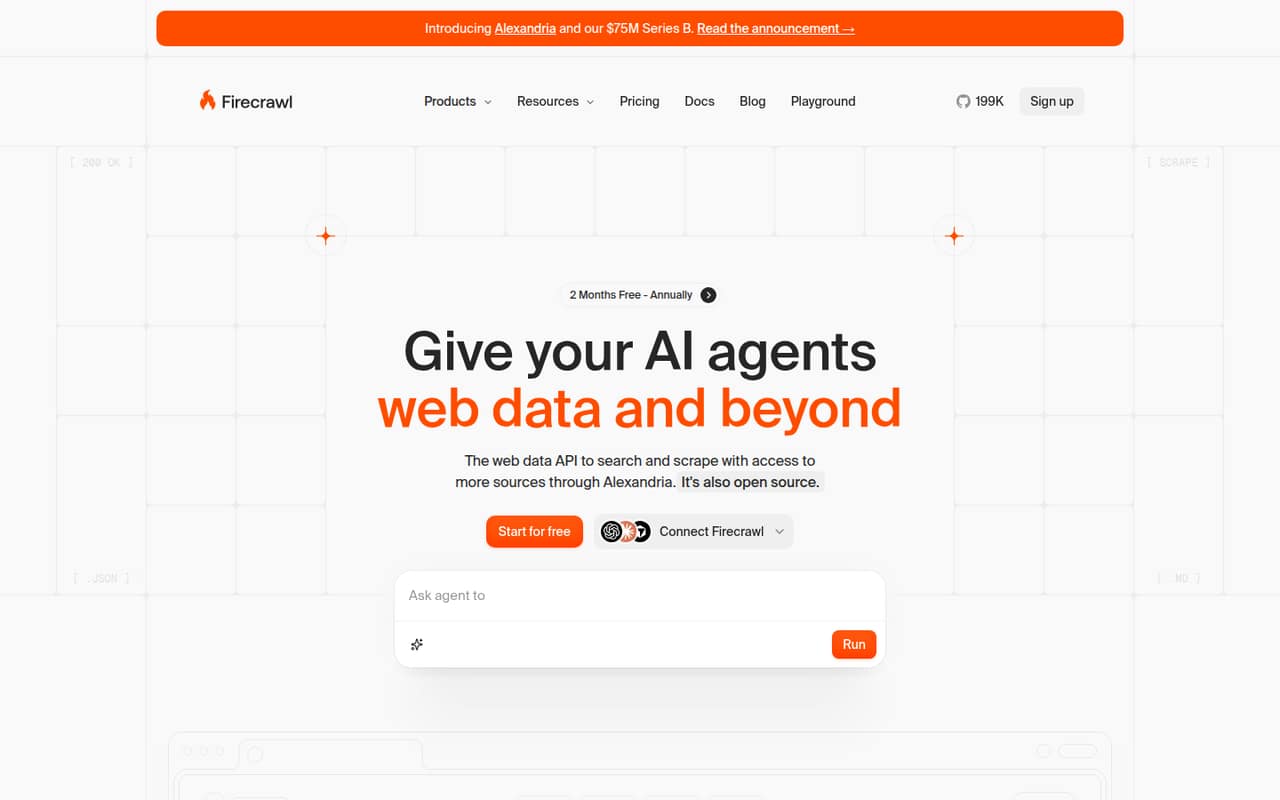
Firecrawl is a hosted web data API for search, scraping and page interaction, with a CLI and MCP connection options. Its Python example is short, and outputs include Markdown, JSON and screenshots; free usage starts at 1,000 monthly credits.
The trade-offs show up when you scale or self-host. Paid plans set monthly credit and concurrency limits, while Reddit users report mixed experiences with self-hosting and production reliability. Check the applicable limits, license and deployment requirements before building a critical pipeline around it.
Good fit if
- AI agents that need live web data
- Teams extracting pages into Markdown or JSON
- Prototypes that fit the free tier
Skip it if
- Workloads requiring guaranteed published rate limits
- Teams expecting effortless self-hosting
- Automations dependent on authenticated sessions
ScoresHow it rates
What works
- Search, scrape and interact through one product
- Outputs include Markdown, JSON and screenshots
- Python example uses a short integration path
- MCP and CLI options support agent setup
- Free tier includes 1,000 credits monthly
What doesn't
- Free plan has low rate limits
- Concurrency and credits vary by paid plan
- Self-hosting reports include setup and reliability complaints
- License and data export terms need confirmation
- Authenticated session handling can require separate browser automation
01What Firecrawl is, technically
Firecrawl is a web data API that sits between websites and an application or AI agent. Its hosted service searches the web, scrapes pages into formats such as Markdown and JSON, and lets a client interact with a page by clicking, scrolling, typing, waiting and navigating. It also parses documents including PDFs and DOCX files.
In a typical stack, an application sends a search or scrape request to Firecrawl, then passes the returned content to an LLM, index or downstream data pipeline. The vendor also presents Alexandria as a way to access the live web, official providers and specialized indexes. Firecrawl describes the service as open source and has a public GitHub repository; the homepage also promotes a CLI and MCP connection for agents. Those are integration options, not substitutes for checking how the hosted service and any self-hosted deployment differ. The product is not just a crawler library: the API handles web retrieval and page operations for the calling application.
02Firecrawl API, SDKs and docs
The homepage shows Python, Node.js, cURL and CLI as developer entry points. Its code example installs firecrawl-py, imports Firecrawl and initializes it with an API key. The same client can scrape a URL or search with a query and result limit; another example scrapes a page, reads its scrapeId and sends interaction prompts. The homepage also shows Markdown and JSON outputs alongside screenshots.
For agent setup, Firecrawl documents connecting through MCP or the CLI. Its example command is npx -y firecrawl-cli@latest init --all --browser, and the homepage describes connecting to any AI agent or MCP client. It also provides an agent-onboarding skill URL. These are useful paths for prototypes and agent workflows, but confirm SDK support, endpoint behavior and authentication details in the vendor's docs before choosing a language or building a production integration. The homepage presents integration examples rather than a full account of API limits or operational guarantees.
03Firecrawl pricing for developers
The Free plan costs $0 and includes 1,000 credits per month, 2 concurrent requests and low rate limits. The pricing page equates that allowance to 500 searches or 1,000 scraped pages. Hobby starts at $19 monthly, or $16 per month billed annually, with 5,000 credits and 5 concurrent requests. Standard is $99 monthly or $83 annually, with 100,000 credits and 25 concurrent requests.
Growth costs $399 monthly or $333 annually for 500,000 credits and 50 concurrent requests. Scale costs $749 monthly or $599 annually for 1,000,000 credits and 100 concurrent requests. Enterprise has custom credits and concurrency, dedicated support and an SLA; its price is custom. Annual prices are monthly equivalents and the pricing page says annual billing includes two months free.
Extra credits cost $5 per listed package: 1,000 on Hobby, 2,000 on Standard, 2,500 on Growth or 5,000 on Scale. Paid plans can also enable pay-as-you-go in $5 increments, up to a customer-set monthly limit. Model usage against credits and concurrency, not page count alone.
04Firecrawl: open source, self-hosting and lock-in
Firecrawl calls itself open source and links to a public GitHub repository. Reddit users also discuss running a self-hosted version. The vendor’s homepage does not name the repository’s license, so check the license file and terms before embedding it in a commercial product or modifying it for internal use.
The vendor presents structured outputs such as Markdown and JSON, which are formats a downstream system can store independently. That does not establish a specific data-export feature or guarantee that hosted account data can be migrated; ask the vendor about export and retention. Scraping and search results can be processed outside Firecrawl, but code that depends on its API, interaction flow or Alexandria sources will need replacement work if you move. Reddit comments about self-hosting range from successful setups to complaints about errors, setup complexity and differences from the hosted service. Treat self-hosting as an option to validate, not as a drop-in equivalent.
05Firecrawl in production
Plan capacity around the published concurrency and credit allowances: they range from 2 concurrent requests on Free to 100 on Scale. The Free plan also has low rate limits. The vendor does not publish a numeric requests-per-second limit on its homepage, so confirm rate limits, retry behavior and service commitments for your workload before launch. Enterprise lists dedicated support and an SLA; other plans list basic, standard or priority support.
The homepage advertises a 96% coverage result on its 1,000-URL benchmark, run Jan. 13, 2026. That is a vendor benchmark, not a guarantee for your target sites. Reddit users report self-hosting setup problems and differences from the hosted version; other comments flag timeouts, layout changes, rate limits and anti-bot updates as continuing scraper maintenance work. A commenter says Firecrawl worked for open pages but used Playwright for logged-in workflows involving persistent sessions. Check authentication, blocked-site behavior, data handling and compliance requirements directly with the vendor, and test representative pages before relying on extraction results.
From the threadsWhat users say
Reddit sentiment is mixed: users describe a quick start and useful results, while others criticize self-hosting, pricing and production reliability. Comments also point out that scraper APIs do not remove the work of handling sessions, blocks or changing sites.
Firecrawl: Probably the easiest to get started with
Self hosted repo is full of errors, less guidance on DIY
for open pages Firecrawl has been fine
proxies, rate limits, JavaScript rendering, and site changes are still where most of the engineering effort goes
Questions people ask
Is Firecrawl free to use?
Yes. The Free plan costs $0 and includes 1,000 credits per month, 2 concurrent requests and low rate limits. The pricing page equates the monthly credits to 500 searches or 1,000 scraped pages. Paid plans add credits and concurrency.
Can I self-host Firecrawl?
Firecrawl describes itself as open source, and Reddit users discuss self-hosting its repository. However, commenters report setup complexity and differences from the hosted service. Check the repository license, deployment instructions and feature parity before choosing self-hosting for a production workload.
What does Firecrawl return?
The homepage shows scraped content returned as Markdown, JSON and screenshots. Firecrawl also describes search results with full content, document parsing for formats such as PDF and DOCX, and page interaction actions including clicking, scrolling, typing and navigating.
Can Firecrawl work with logged-in websites?
Firecrawl describes page interaction and browser actions, but logged-in workflows can depend on persistent sessions, cookies or authentication prompts. A Reddit commenter reports using Playwright with separate persistent profiles for logged-in sites. Validate your authentication flow and target sites before committing.
How do Firecrawl credits and concurrency work?
Each plan includes a monthly credit allowance and a concurrency limit. Free includes 1,000 credits and 2 concurrent requests; Scale includes 1,000,000 credits and 100 concurrent requests. The pricing page equates credits to search and scrape quantities, and lists paid add-ons for extra credits.
Sources
- Firecrawl homepage
- Firecrawl pricing page
- Reddit: What is the best scraper tool right now? Firecrawl is great, but I want to explore more options
- Reddit: Best AI web scraping tools I've tried recently (and what I learned from each)
- Reddit: Low-cost alternatives to Firecrawl?
- Reddit: What web scraping tools are you using right now?