
We may earn a commission if you buy through links on this page. It never changes a score or a ranking. How we make money
The bottom line
Visual testing across browsers and devices, with custom pricing and deployment options for larger teams.
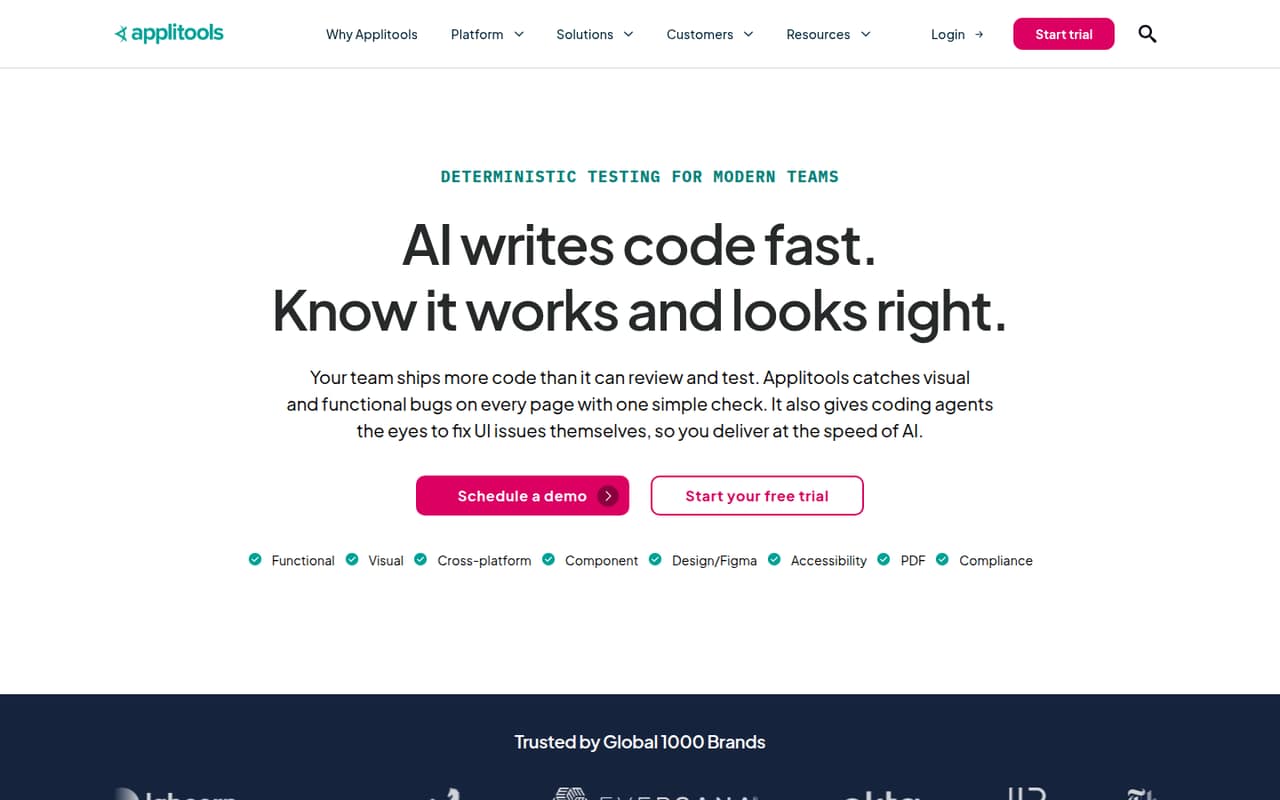
Applitools is a commercial testing platform for visual and functional checks on web and mobile apps. Eyes integrates with test suites and runs checks across browsers and devices; Autonomous lets QA teams create tests using plain English.
Its SaaS, dedicated-cloud and on-premises deployment options suit teams with different security needs. Starter is $667 per month when paid annually; Professional and Enterprise pricing is custom, so teams should confirm the full cost and integration fit before committing.
Good fit if
- Teams with frequent UI changes
- Cross-browser visual regression testing
- QA teams creating tests without code
Skip it if
- Teams requiring an open-source tool
- Projects needing published usage rates
- Teams standardizing on a named SDK
ScoresHow it rates
What works
- Visual AI checks dynamic content for meaningful changes
- Runs tests in parallel across browsers and devices
- Autonomous supports plain-English test authoring
- SaaS, dedicated-cloud and on-premises deployment options
- Starter includes unlimited users
What doesn't
- Starter costs $667 per month, billed annually
- Professional and Enterprise pricing is custom
- The vendor does not publish language-specific SDK details
- No free plan; free-trial terms are not published
- Data export and migration terms need confirmation
01What Applitools is, technically
Applitools is a commercial testing platform, not a standalone test framework or command-line tool. Its main products are Eyes, for visual and functional testing, and Autonomous, for creating and running tests with AI-assisted recording and natural-language authoring. Teams put it alongside their existing web and mobile test suites to compare application screens and find visual changes that conventional functional checks may not catch.
Eyes runs tests in parallel across browsers and devices, while Autonomous supports functional, visual and API tests. The platform can run as SaaS, in a dedicated cloud on Amazon, Azure or GCP, or on a customer’s own infrastructure. That makes deployment a choice about where the service runs, rather than a choice between a hosted product and a code library. Applitools describes integrations with test frameworks, SCM, CI/CD, bug tracking and chat tools. Teams should assess how those integrations fit their current pipeline and what test data moves to the chosen deployment.
02Applitools API, SDKs and docs
The integration surface Applitools names is its Eyes and Autonomous products, plus integrations with test frameworks, source-control management (SCM), CI/CD, bug-tracking and chat tools. The vendor advertises more than 60 integrations. Eyes supplies visual validation for developer test suites and agentic workflows; Autonomous adds natural-language test authoring and can create, execute and analyze functional, visual and API tests.
The homepage does not name programming languages, SDKs, a CLI or an API style for integrating Eyes. Confirm language-specific SDK support and setup instructions in Applitools’ documentation before choosing a framework or writing a migration plan. The vendor says documentation and tutorials are available for getting started. In evaluation, check whether the integration supports your test runner and CI environment, how credentials are managed, and how results are surfaced to developers. Applitools also lists SSO and SAML support, which matters when teams need centralized access management.
03Applitools pricing for developers
Applitools has no free plan. The homepage offers a free trial, but the vendor does not publish its duration or trial limits. Starter costs $667 per month when paid annually. It includes unlimited users and either 100,000 component checkpoints or 1,000 page checkpoints, plus Visual AI validation, cross-browser and device testing, and standard portal and email support.
Professional pricing is customizable and starts at 150 active pages or 1,500 components. It includes unlimited executions and two end-user training sessions. Enterprise has custom pricing, starts at 350 active pages or 1,500 components, and includes unlimited executions and a 99.99% uptime guarantee. The pricing page does not publish Professional or Enterprise rates, so ask for a quote against your expected page or component count and deployment needs. Professional add-ons include private cloud, SSO and more concurrent executions. Enterprise add-ons include real iOS and Android devices and custom on-premises deployment. Overages and checkpoint rollover terms are not published; confirm them before budgeting.
04Applitools: open source, self-hosting and lock-in
Applitools offers deployment in its SaaS environment, a dedicated cloud on Amazon, Azure or GCP, or on-premises inside a customer’s firewall. On-premises deployment is an Enterprise add-on, while private cloud is listed as a Professional add-on. These options change where the platform runs; they do not make it an open-source tool.
The vendor does not publish an open-source licence or source-availability terms. Data export and migration procedures are also not published. Before adopting Eyes or Autonomous, ask how to export test definitions, baselines, results and other project data, and whether those exports remain usable outside Applitools. Migrating tests may also require replacing product-specific integrations and workflows. Teams can reduce dependency by keeping test logic and application fixtures in their own repositories where the integration allows it, and by documenting how visual baselines are managed.
05Applitools in production
Applitools lists cross-browser and device testing, unlimited executions on Professional and Enterprise, and a 99.99% uptime guarantee on Enterprise. The vendor also says its products are ISO 27001 and SOC 2 Type II compliant and have current penetration-testing reports. Confirm which deployment and plan cover your security, availability and data-residency requirements; the uptime guarantee is listed for Enterprise, not Starter.
For scale, verify how active-page or component counts map to your application, what happens when you exceed them, and whether more concurrent executions are needed. Professional lists more concurrent executions as an add-on. Ask the vendor about trial limits, rate limits, retention and export terms before wiring results into release gates. Reddit discussion is limited: one commenter praised Applitools’ approach to visual comparison, while another noted that cost can matter for smaller teams. That is a reason to price your actual test scope, not evidence of production performance.
From the threadsWhat users say
The Reddit discussion is sparse and mixed. One commenter praises the visual comparison approach, while another flags cost as a consideration for smaller teams; the posts do not establish broad user sentiment.
The really cool part is that our AI is smart enough to only report differences that the human eye would pick up
For smaller teams, AI testing tools like Applitools, TestGrid CoTester, and Mabl can save time by automating repetitive tasks, but the cost might be a factor
No questions , but I did see a nice demo at TISQA
Questions people ask
What is Applitools Eyes?
Eyes is Applitools’ product for visual and functional testing of web and mobile applications. It uses Visual AI to identify meaningful visual changes, including in dynamic content, and runs tests in parallel across browsers and devices. Teams can use it to add visual validation to developer test suites and agentic workflows.
How does Applitools work?
Applitools uses Visual AI to compare application screens and identify visual changes it considers meaningful. Eyes supports visual and functional testing across browsers and devices. Autonomous lets QA teams create and run tests using plain English, with AI-assisted recording and natural-language authoring.
Does Applitools have a free plan?
Applitools does not list a free plan. Its homepage offers a free trial, but the trial’s duration and limits are not published. Starter is listed at $667 per month when paid annually, with 100,000 component checkpoints or 1,000 page checkpoints.
Can Applitools run on our own infrastructure?
Yes. Applitools lists SaaS, dedicated-cloud deployment on Amazon, Azure or GCP, and on-premises deployment inside a customer’s firewall. Its pricing information lists private cloud as a Professional add-on and custom on-premises deployment as an Enterprise add-on.
What should we ask before buying Applitools?
Confirm support for your test frameworks and programming languages, how active pages and components are counted, and the limits on checkpoints and concurrent executions. Ask for Professional or Enterprise pricing, trial terms, data export and retention details, and which deployment options meet your security requirements.