
We may earn a commission if you buy through links on this page. It never changes a score or a ranking. How we make money
The bottom line
A broad hosted scraping API with practical agent tooling, but limited public detail on portability and usage costs.
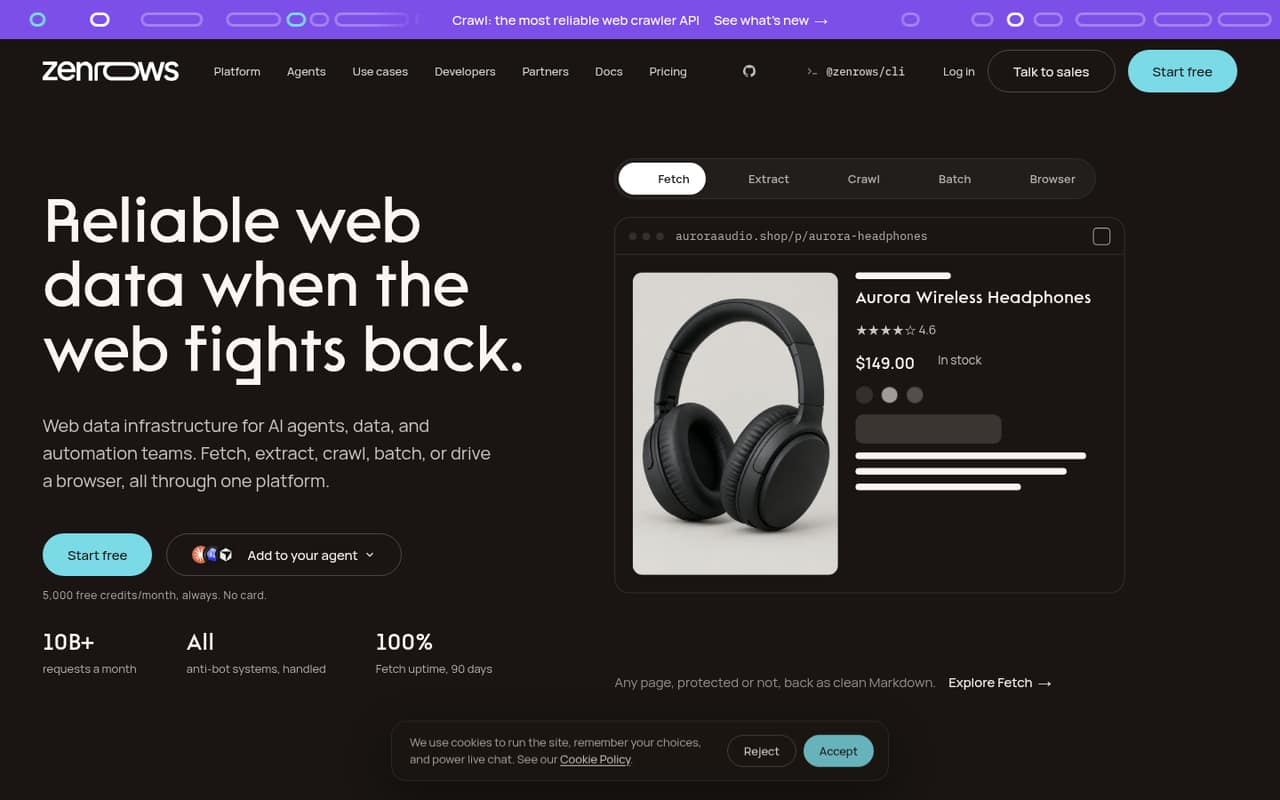
ZenRows is a hosted web data platform, not a scraping library or self-hosted server. Its Fetch, Extract, Crawl, Batch and Browser tools cover common collection workflows, with REST API, SDK, CLI and MCP integration options.
The free tier gives developers 5,000 monthly credits, while paid plans start at $16 per month. The platform is easy to connect to agent and automation stacks, but credit consumption, source availability and data portability deserve a closer look before production adoption.
Good fit if
- Agents that need live web access
- Teams processing protected pages
- Batch scraping and extraction workflows
Skip it if
- Teams requiring self-hosted scraping
- Projects needing published per-request costs
- Scrapers tied to custom browser infrastructure
ScoresHow it rates
What works
- Combines fetch, extraction, crawling, batch jobs and browser operations
- Offers Python, Node.js and Go SDKs
- CLI and MCP server support agent workflows
- Free plan includes 5,000 monthly credits
- Paid tiers scale concurrency and support
What doesn't
- Credit costs vary by feature and are not fully itemized
- Paid top-up pricing is not published
- Source availability and self-hosting options are not published
- Data export and migration paths are not published
- Free plan has five concurrent requests and no rollover
01What ZenRows is, technically
ZenRows is a hosted web data platform exposed through an API, SDKs, a CLI and agent integrations. It is not presented as a library that runs the scraping infrastructure locally or as a self-hosted server. The platform handles fetching standard, dynamic or protected pages, extracting structured data, crawling from a starting URL, asynchronous batch jobs and browser operations.
In a stack, it sits between an application or agent and the websites that application needs to read or operate. Fetch can return readable content, structured data or screenshots; Crawl follows links and bills each page as a Fetch. Batch adds retries, webhooks and status tracking for larger asynchronous jobs. Browser is for sites that require actions such as clicks, forms, logins or session state. That leaves your application responsible for deciding what to collect, processing results and handling its own downstream storage.
02ZenRows API, SDKs and docs
The homepage shows a REST API call to https://api.zenrows.com/v1/ with a URL, API key and response_type=markdown parameter. It lists SDKs for Python, Node.js and Go, with installation commands using pip, npm and go get. The CLI installs through npx -y @zenrows/cli init and supports fetch, extract and batch commands.
For agent integrations, ZenRows offers an MCP server and setup instructions for Claude Code, Cursor, VS Code, Windsurf, Zed and JetBrains. The homepage also lists integrations with LangChain, LlamaIndex, Flowise, n8n, Zapier, Make, Clay, Playwright, Puppeteer, Scrapy and Selenium. Documentation, SDK guides and an MCP setup guide are linked from the site. Those surfaces make it possible to start with a terminal command or connect an existing agent, then move to API or SDK calls in application code. Check the docs for endpoint parameters and tool-specific behavior before building around them.
03ZenRows pricing for developers
The Free plan costs $0 per month and includes 5,000 credits, five concurrent requests and no rollover; no card is required. Paid monthly plans start with Build at $16 for 45,000 credits and 20 concurrent requests. Launch is $58 for 250,000 credits and 50 concurrent requests, Growth is $166 for 1.2 million credits and 100 concurrent requests, and Scale is $458 for 5 million credits and 200 to 400 concurrent requests. Enterprise has custom pricing, unlimited volume and custom concurrency of 500 to 1,000+.
The bill grows with credit use, and the credit cost depends on the operation: residential bandwidth uses 25,000 credits per GB, while Browser uses five credits per minute. Paid plans allow top-ups up to 10 times per billing period; the top-up price is not published, and unused top-up credits roll over once. The listed prices are monthly. Annual billing saves 17%, but the per-month annual prices are not published. Check expected feature usage before estimating production spend.
04ZenRows: open source, self-hosting and lock-in
ZenRows presents itself as a hosted platform and provides API, SDK, CLI and MCP access. The homepage does not publish a software license or source-availability terms, so we cannot verify whether any part of the platform is open source. It also does not describe a self-hosted deployment option; teams should confirm hosting requirements with the vendor before adopting it.
Data export formats and account-level export procedures are not published on the homepage. Fetch supports output such as Markdown, HTML, text and PNG, which can help keep individual results in portable formats, but that is not the same as a documented bulk export or migration path. Applications can reduce integration lock-in by keeping ZenRows calls behind an internal interface and storing results in their own systems. Ask the vendor about retention, export and migration before sending production data.
05ZenRows in production
ZenRows publishes concurrency limits by plan, ranging from five requests on Free to 200–400 on Scale; Enterprise lists custom concurrency of 500–1,000+. The homepage claims 100% Fetch uptime over 90 days, but teams should ask for the applicable SLA and service history before treating that as a production commitment. Enterprise lists an SLA, SOC 2 and ISO 27001; confirm the scope and reports with the vendor.
Budget for credit use as well as concurrency: residential bandwidth consumes 25,000 credits per GB, and Browser consumes five credits per minute. The vendor says Batch includes retries, webhooks and status tracking, but teams still need to plan for job monitoring, idempotency and downstream queue handling. Reddit developers discussing scraping generally mention user-agent and browser choices, proxy rotation and persistent work queues. Those comments are not ZenRows-specific, but they underline the operational work around any large scraping pipeline. Validate target-site behavior and recovery paths before relying on collected data.
From the threadsWhat users say
Reddit discussion here concerns scraping in general rather than ZenRows reviews, so it offers little product-specific sentiment. Commenters share practical advice on browser layers, proxy rotation and queue persistence.
when you need to pull a HUGE data set and their isnt an API, then scraping is your only option
User-agent. And any headless browser engine will suffice
Proxy Rotation is the Key. Else you might get caught
Use persistent storage, not memory, to store your work queue
Questions people ask
What does ZenRows do?
ZenRows is a hosted platform for fetching, extracting and crawling web pages, running asynchronous batch jobs and operating a browser. It handles standard, dynamic and protected pages and can return readable content or structured data for applications, data workflows and AI agents.
Which languages have ZenRows SDKs?
The homepage lists SDKs for Python, Node.js and Go. It also shows a REST API, CLI and MCP server, so teams can integrate without relying on a language-specific SDK. Check the vendor’s documentation for current installation instructions and endpoint details.
How does ZenRows charge for web scraping?
ZenRows sells monthly plans with credit allowances and concurrency limits. Credit use depends on the operation: the vendor lists Browser at five credits per minute and residential bandwidth at 25,000 credits per GB. Paid-plan top-ups are available, but their price is not published.
Does ZenRows support crawling and batch jobs?
Yes. Crawl follows links from a starting URL and bills each page as a Fetch. Batch runs asynchronous jobs with retries, webhooks and status tracking. The homepage’s CLI examples show commands for creating batch jobs, and the platform also offers API and SDK integration surfaces.
Can I self-host ZenRows?
The homepage describes ZenRows as a platform and does not publish a self-hosted deployment option or software license. If your deployment policy requires self-hosting, ask the vendor directly about hosting, source availability and data handling before committing.