
We may earn a commission if you buy through links on this page. It never changes a score or a ranking. How we make money
The bottom line
Vapi handles voice-agent infrastructure; price usage carefully and verify your integration needs before production.
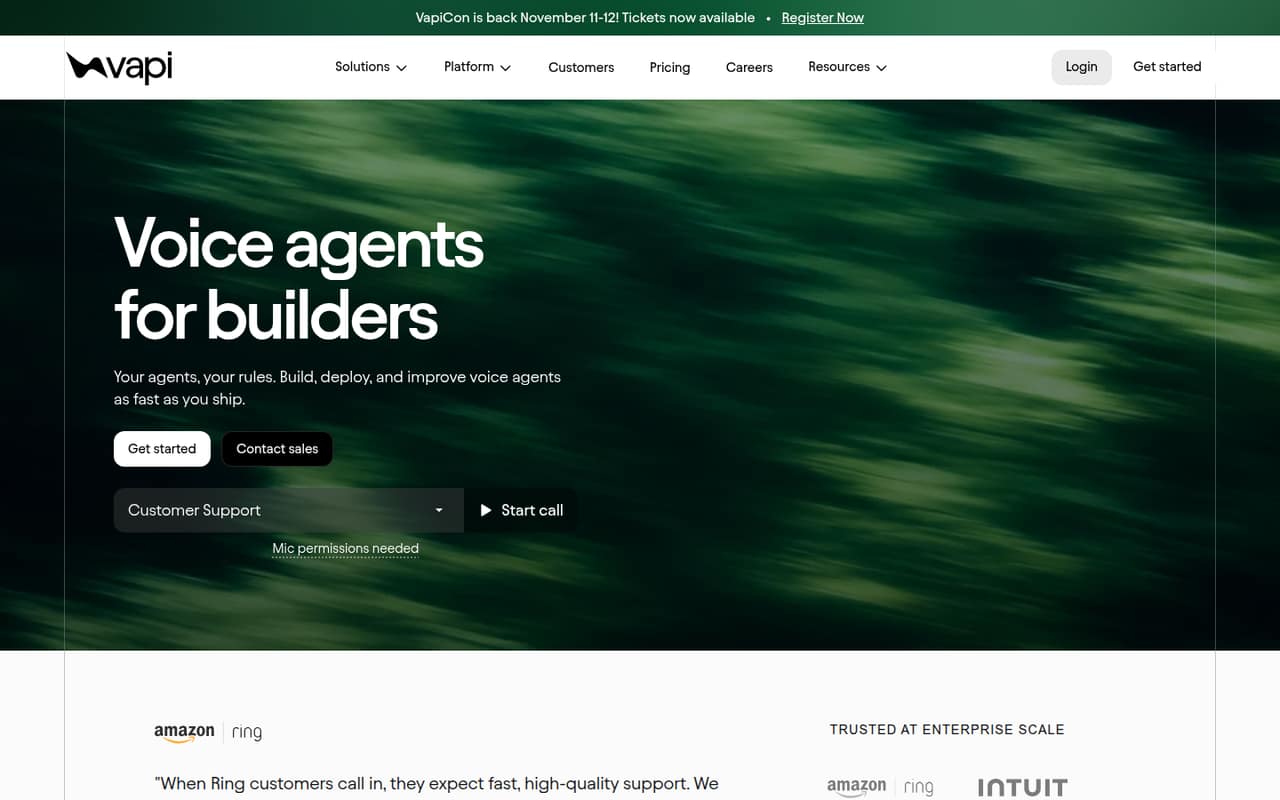
Vapi is a managed, API-native platform for configuring, deploying and monitoring voice agents. It combines call infrastructure with controls for conversation flow, telephony and integrations, plus enterprise access controls and guardrails.
The $5 in free credits make it possible to start without a monthly package, but hosting and transport charges can add up. Reddit users report mixed experiences: some find it useful for straightforward agents, while others say setup can be harder or prefer other tools for detailed workflows.
Good fit if
- Teams building managed voice agents
- Builders needing call monitoring
- Teams needing enterprise access controls
Skip it if
- Teams requiring proven self-hosting
- Builders needing a named SDK
- High-volume teams without usage estimates
ScoresHow it rates
What works
- Managed infrastructure for deploying voice agents
- Configures voice, conversation flow, telephony and integrations
- Call monitoring surfaces problems and improvement opportunities
- Enterprise features include SSO, OAuth2 and granular access controls
- Free package includes $5 in credits
What doesn't
- Usage and transport charges sit alongside package prices
- No Success includes only four concurrent calls
- Free package retains raw data for 14 days
- Self-hosting and source licensing require confirmation
- Reddit users report setup and workflow-fit concerns
01What Vapi is, technically
Vapi is a managed, API-native platform for building, deploying, monitoring and improving voice agents. It sits between your application and the services needed to run phone-based conversations: teams configure voice, conversation flow, telephony and integrations, while Vapi handles deployment infrastructure. That makes it a platform rather than a voice model, standalone library, CLI or self-hosted server.
The product is aimed at teams that want to ship agents without operating the voice infrastructure themselves. Its platform also provides call monitoring and insights to identify what works and where an agent needs improvement. For organizations, Vapi lists SSO, OAuth2, granular access controls and conversation guardrails. The architectural trade-off is managed convenience versus dependence on a hosted service. Before adopting it, decide which parts of the agent should live in Vapi and which systems—such as your CRM or telephony provider—need to remain independently replaceable.
02Vapi API, SDKs and docs
Vapi describes the platform as API-native and presents configuration of voice, conversation flow, telephony and integrations as the path from agent setup to deployment. The homepage does not name an API protocol, programming language, SDK, CLI or webhook interface. Treat “API-native” as an architectural signal, not a guarantee that your preferred language has a supported client.
Before committing, confirm the API surface, supported SDKs and authentication flow in Vapi’s developer docs. Check how agent configuration, call initiation, call status and monitoring data fit your application, and whether the integrations you need are supported directly. Telephony is a key integration point: a Reddit commenter describes Vapi’s SIP trunk integrations as straightforward, but that is one user’s report, not a compatibility guarantee. The platform’s managed infrastructure can reduce deployment work, while an integration-heavy application still needs an explicit plan for error handling, data flow and replacing external services.
03Vapi pricing for developers
The No Success Package has no monthly charge and includes $5 in free credits, then lists Vapi hosting at $0.05 per minute. It includes two organizations, one phone number, four concurrent calls and 14 days of raw data retention. Core costs $29 per month, with two organizations, five phone numbers, 10 concurrent calls, 30 days of retention and ZDR. The package is prepaid and auto-renews.
Pro is a $999 monthly minimum plus 10% of the Vapi hosting fee. It includes 10 organizations, 10 phone numbers, 30 concurrent calls, 180 days of retention and a 99% uptime SLA. Premier has custom pricing, with a 99.9% uptime SLA and a one-hour P0 response SLA. Add-ons include HIPAA compliance at $2,000 per month, extra concurrency at $10 per line monthly and extra organizations at $20 each monthly. Transport fees vary: Twilio inbound is $0.008 per minute and outbound is $0.014; Vonage is $0.00814 and Telnyx is $0.0055. Vapi Telephony/SIP, WebSockets and Daily WebRTC transport are free.
04Vapi: open source, self-hosting and lock-in
Vapi’s managed-infrastructure model means the default deployment is hosted by Vapi, not a server you operate. The vendor does not publish a source licence or self-hosting terms on its homepage, so confirm those points with Vapi rather than assuming the platform can run in your environment.
The same caution applies to data export and migration. Before production, ask how to export call records, agent configuration and any other data your application depends on, and what formats are available. Keep your application’s business logic and customer records portable where practical, and document the telephony and model services the agent relies on. Those steps reduce the cost of changing platforms if pricing, product fit or compliance requirements change.
05Vapi in production
Check concurrency and retention against your call volume before choosing a package: No Success allows four concurrent calls and retains raw data for 14 days; Core allows 10 calls and 30 days; Pro allows 30 calls and 180 days. Pro lists a 99% uptime SLA, while Premier lists 99.9%. Vapi’s homepage also claims sub-500ms average latency and says enterprise deployments can scale to millions of calls; confirm which guarantees apply to your contract and configuration.
The homepage lists SOC 2, HIPAA and PCI compliance, but HIPAA compliance is a $2,000-per-month add-on in the pricing details. It also describes AI guardrails intended to prevent hallucinations and protect data integrity; treat those as controls to validate, not a substitute for your own checks. Reddit feedback is mixed: one commenter says Vapi can be harder to use, while another recommends it for mechanical use cases. Test your actual call flow, integrations, failure handling and compliance requirements before relying on it.
From the threadsWhat users say
Reddit sentiment is mixed. Some commenters say Vapi works for straightforward use cases, while others describe setup friction or prefer alternatives for more detailed workflows.
Vapi has worked pretty well for me, but they have their issues
That should get you going
However I must admit there is hidden cost. Hosting and server management
Questions people ask
What does Vapi do?
Vapi is a managed platform for building, deploying, monitoring and improving voice agents. Teams configure voice, conversation flow, telephony and integrations, while Vapi handles infrastructure. It also offers call insights, enterprise access controls and conversation guardrails.
How much does Vapi cost per minute?
The No Success Package lists Vapi hosting at $0.05 per minute after $5 in free credits. Transport can add fees: for example, Twilio inbound is $0.008 per minute and outbound is $0.014. Other transports have different rates, and package charges may also apply.
Can I self-host Vapi?
Vapi describes its infrastructure as managed. Its homepage does not publish a source licence or self-hosting terms, so ask Vapi directly whether self-hosting is available and what parts of the platform can run in your environment before designing around it.
What security and compliance features does Vapi offer?
Vapi lists SSO, OAuth2, granular access controls and AI guardrails. Its homepage also states SOC 2, HIPAA and PCI compliance. The pricing details list HIPAA compliance as a $2,000-per-month add-on, so confirm which controls and compliance commitments apply to your plan.
How many concurrent calls does Vapi support?
The No Success Package includes four concurrent calls, Core includes 10 and Pro includes 30. Premier offers custom terms. Additional concurrency is listed at $10 per line per month. Confirm the required capacity and any applicable service commitments with Vapi before a production launch.