
We may earn a commission if you buy through links on this page. It never changes a score or a ranking. How we make money
The bottom line
Upbound extends Crossplane with managed operations and fleet governance, but production pricing starts at $1,000/month.
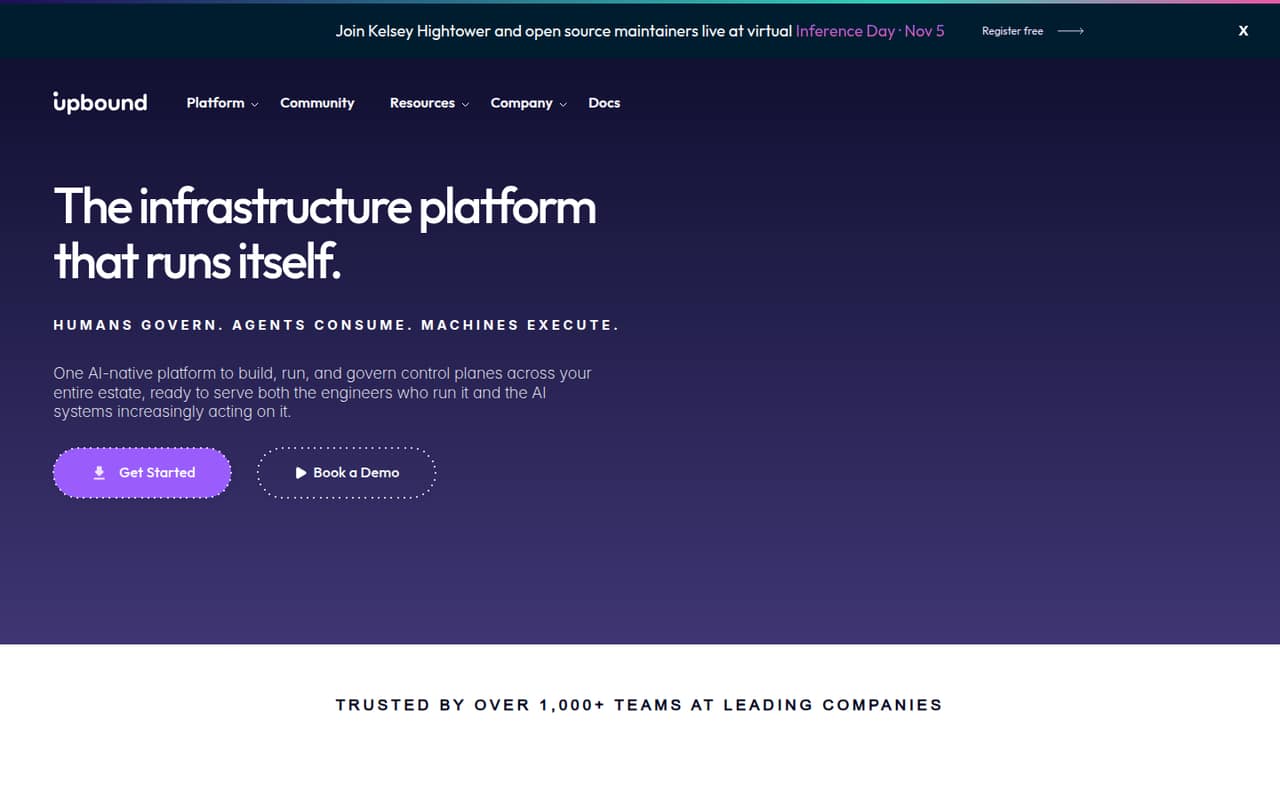
Upbound is a platform for building, running, and governing infrastructure control planes on Crossplane, the CNCF project it helps develop. Those control planes reconcile infrastructure to a declared state and provide a shared API and view for engineers, agents, and automation.
Community is free, while Standard starts at $1,000 per month and adds usage-based resource charges. Upbound is worth evaluating if your team wants a managed route to Crossplane and fleet governance; confirm the API integration details, included resource allocation, and total production cost first.
Good fit if
- Teams standardizing infrastructure APIs
- Crossplane users seeking managed operations
- Enterprises governing control-plane fleets
Skip it if
- Teams seeking a low-cost hosted API
- Projects needing published SDK guarantees
- Teams avoiding usage-based infrastructure bills
ScoresHow it rates
What works
- Built on CNCF Graduated project Crossplane
- Control planes reconcile declared infrastructure state
- Shared API and view for people and automation
- Standard includes Enhanced Runtime and Basic Support
- Business Critical offers self-hosted platform components
What doesn't
- Standard starts at $1,000 per month
- Resource usage adds tiered monthly charges
- Community plan inclusions are not listed
- SDK and language support needs verification
- Data export and migration details need confirmation
01What Upbound is, technically
Upbound is a platform for building, running, and governing infrastructure control planes. It is built on Crossplane, the CNCF Graduated project that Upbound helps develop. Rather than acting as a general cloud-provider API, a control plane gives teams an API for defining infrastructure and reconciles that infrastructure to its declared state.
In a stack, Crossplane control planes sit between teams or automation and the infrastructure they manage. Upbound adds a platform layer for operating those control planes across an estate, including fleet governance, SSO, security controls, and managed operations. The homepage says engineers, agents, and software use one API and one view. It also says the full platform runs anywhere, including air-gapped environments. Business Critical includes self-hosted Space, Console, and Hub. This makes Upbound relevant to platform teams standardizing infrastructure interfaces, not simply developers looking for a standalone SDK or cloud resource endpoint.
02Upbound API, SDKs and docs
The integration model centers on Crossplane control planes and a shared API. Upbound says engineers, agents, and automation work through the same API and view, while its homepage describes Kubernetes APIs as a contract between teams. Control planes continuously reconcile infrastructure to its declared state. That points platform teams toward defining and consuming infrastructure through control-plane APIs, rather than treating Upbound as a conventional cloud REST service.
The homepage links to documentation and an engineering deep dive on architecture, components, and workflows. It does not name SDKs, programming languages, a CLI, webhooks, or plugins. Confirm supported SDKs and languages in Upbound’s docs before choosing an integration approach. The Crossplane foundation and Kubernetes API framing are the clearest named integration surfaces. Upbound also says existing OSS Crossplane users can upgrade while keeping configurations, with managed operations and enterprise features. Check the upgrade documentation for the process and for compatibility with your installed configurations.
03Upbound pricing for developers
The pricing page lists a free Community plan, but does not list its inclusions. Standard starts at $1,000 per month and includes up to five control planes, ten team members, Enhanced Runtime, Official Packages, and Basic Support. The listed price is a starting point: plan tiers have consumption minimums and usage-based charges, and annual pricing is not published.
The pricing details say the first resources are included in the plan, but do not state the included quantity. Beyond that, resource-month pricing is tiered: the next 10,000 cost $1.0950 each, the following 10,000 cost $1.0220 each, the next 20,000 cost $0.9490 each, then 60,000 at $0.8760, 100,000 at $0.8030, and 200,000 at $0.7300. Pricing for the next 400,000 requires contacting sales. Upbound Insights is a paid add-on with no published price. Enterprise and Business Critical pricing is also not published. Ask Upbound for a usage estimate based on your expected resource count and plan minimum.
04Upbound: open source, self-hosting and lock-in
Crossplane is an open-source CNCF Graduated project, and Upbound says it is the company behind it. The homepage promotes upgrading from OSS Crossplane while keeping configurations, so teams can start with Crossplane rather than adopting the commercial platform first. The specific Crossplane licence is not stated on the homepage; verify its terms in the project repository before making a compliance decision.
Upbound’s Business Critical tier includes self-hosted Space, Console, and Hub, and the company says the full platform runs anywhere, including air-gapped environments. That is a distinct option from relying entirely on a vendor-hosted service. Upbound says the OSS upgrade preserves configurations, but that does not establish a complete exit path from its commercial services. The vendor does not publish a data export path here. Before adoption, ask how to export control-plane definitions, state, policies, and operational records, and which components continue to work if you leave the paid platform.
05Upbound in production
Upbound’s production model is based on control planes reconciling infrastructure continuously to declared state. The homepage also lists fleet-wide governance, SSO, encryption, policy enforcement, compliance controls, and secure supply-chain capabilities. Business Critical adds Advanced Security, Advanced Hosting, and Dedicated Support; Enterprise includes Enterprise Security, Control Plane Fleet Management, and SSO / SAML. Confirm which controls apply to your chosen plan and deployment model.
The pricing page’s consumption minimums and resource-month tiers can affect the bill as a fleet grows. The published plan summary does not give a control-plane or resource reconciliation rate limit, availability target, recovery objective, or included resource count. Ask Upbound for those operational limits, plus support response terms and a cost estimate for peak usage. The company says the platform can run in air-gapped environments, but teams should validate how updates, package supply, and support work in that setup. Standard includes Basic Support; higher-tier support details are plan-specific.
Questions people ask
What does Upbound do?
Upbound provides a platform for building, running, and governing infrastructure control planes based on Crossplane. Those control planes expose an API and reconcile infrastructure to its declared state. The platform adds operations and governance features for teams managing control planes across an infrastructure estate.
Is Upbound built on Crossplane?
Yes. Upbound is built on Crossplane, the CNCF Graduated project the company helps develop. Upbound says teams can upgrade from OSS Crossplane while keeping their configurations, then add enterprise security, support, and managed operations.
How much does Upbound cost?
Community is listed as free. Standard starts at $1,000 per month and includes up to five control planes and ten team members. Usage charges apply beyond included resources, with tiered resource-month rates. Enterprise, Business Critical, and annual prices are not published.
Can Upbound be self-hosted?
Upbound says the full platform runs anywhere, including air-gapped environments. Its Business Critical plan includes self-hosted Space, Console, and Hub. Ask the vendor which components can be self-hosted under your intended deployment and what support and update processes apply.
Can I use Upbound with AI agents?
The homepage says engineers, agents, and automation use one API and one view of the platform. It does not name agent-specific SDKs or languages. Check Upbound’s documentation for the supported API integration patterns and the authorization controls available for your agents.