
We may earn a commission if you buy through links on this page. It never changes a score or a ranking. How we make money
The bottom line
Good for fast-start support automation; check usage limits and integration needs before committing.
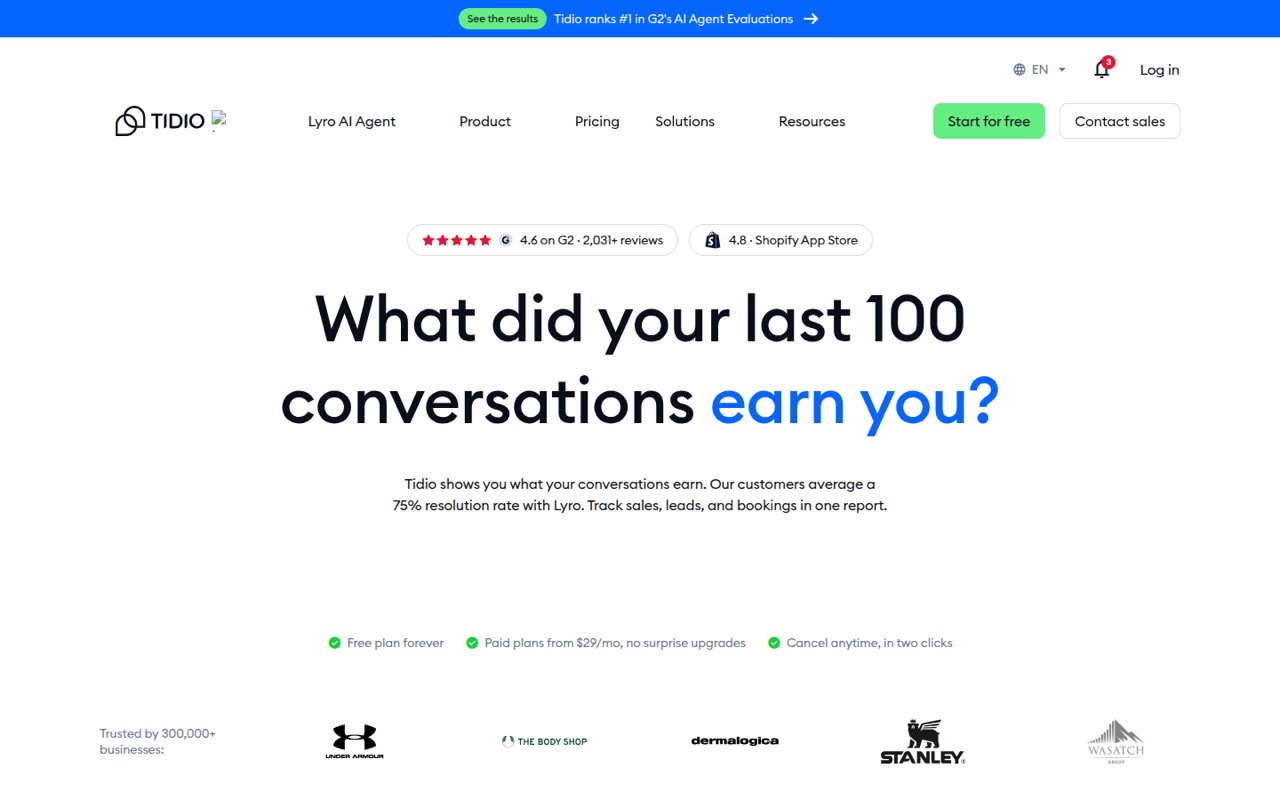
Tidio is a hosted customer service platform that combines live chat, email and social messages with Lyro, its AI agent, and visual automation flows. It suits teams that want to automate common support and sales conversations without building a chatbot from scratch.
The trade-off for developers is a limited named integration surface: Tidio lists OpenAPI, Zapier, script templates and 120+ integrations, but no specific SDKs or languages on its homepage. Free and paid plans also cap billable conversations and other usage, so estimate traffic and add-ons before using it in production.
Good fit if
- Small ecommerce support teams
- No-code chat and sales automation
- Teams using listed integrations
Skip it if
- Self-hosting or open-source requirements
- Custom integrations needing named SDKs
- Teams with unpredictable high chat volume
ScoresHow it rates
What works
- Combines live chat, email and social inboxes
- Visual builder includes 40+ ecommerce templates
- Lyro answers from verified business data
- OpenAPI, Zapier and 120+ integrations
- Free plan includes 10 seats
What doesn't
- No named SDKs, languages or CLI
- Conversation and visitor limits shape plan choice
- Monthly Starter and Growth rates are not listed
- Open-source licence and self-hosting are not published
- Reddit users report pricing and feature-limit concerns
01What Tidio is, technically
Tidio is a hosted customer service SaaS platform, not a library, CLI or self-hosted server. It puts live chat, email and social messages into a shared help desk, then adds Lyro, an AI agent that answers from a business’s own data, and a visual builder for automated sales and support flows.
In a typical stack, Tidio sits between a website or ecommerce storefront and the people handling customer conversations. Its flows can trigger chats around events such as cart abandonment or exit intent; Lyro can answer routine questions, recommend products and hand complex cases to a person. Smart Actions are intended to handle tasks such as order updates or lead qualification.
That makes it an application-layer support tool rather than infrastructure for building and hosting a chatbot yourself. Teams can start with the hosted widget and inbox, then connect other systems through Tidio’s stated integration options. It is most relevant when the main job is managing customer conversations, not building a custom AI service.
02Tidio API, SDKs and docs
Tidio’s homepage names OpenAPI, Zapier, script templates and 120+ integrations as ways to connect it with other systems. It also describes Lyro Smart Actions as integrating with external systems to take real-time action. The visual automation builder uses a drag-and-drop canvas and includes 40+ ecommerce templates, so basic flows do not require code.
The homepage names no SDK, programming language or CLI. Confirm SDK support and the exact OpenAPI operations in Tidio’s developer documentation before designing an integration around them. The product material also does not name a webhook or protocol surface, so ask Tidio whether your required events and actions are supported rather than assuming a particular integration pattern.
For a first implementation, check which of your systems are covered by the 120+ integrations, and whether Zapier or a script template can bridge the gaps. Tidio's website emphasizes a hosted app and visual configuration; teams needing a code-first workflow should verify API coverage, authentication, and development and test environments with the vendor.
03Tidio pricing for developers
Tidio has a free plan: it includes 50 billable conversations per month, 10 seats, basic live chat and ticketing, the first 50 Lyro AI conversations for the lifetime of the account, and the first 100 Flows visitors. Those caps make it suitable for an initial test, not unlimited production traffic.
Starter includes 100 billable conversations and 50 Lyro AI conversations as a one-off. Its listed $24.17 per month is the annual-billing rate; Tidio does not publish a separate straight monthly rate on the pricing page. Growth starts at 250 billable conversations and lists $49.17 per month at the annual rate. Plus lists $300 per month at the annual rate, with custom conversation limits and usage charges; Premium requires a sales quote.
Standalone Lyro starts at $32.50 per month for 50 conversations, and standalone Flows starts at $24.17 for 2,000 visitors reached. The no-branding add-on is $16.67 per month. Check how extra usage is priced before launch: custom limits and discounted usage rates are listed for Plus, but a general overage rate is not published.
04Tidio: open source, self-hosting and lock-in
Tidio is offered as a hosted SaaS platform. Tidio does not publish an open-source licence or a self-hosting option on the vendor's site, so teams requiring source access or deployment in their own environment should ask the vendor before evaluating it further.
The vendor's site also does not describe data export or migration tooling. Ask which conversation records, customer data, automation configurations and AI knowledge sources can be exported, in what formats, and whether exports include attachments and history. Those details determine how much work it takes to move to another help desk.
Some lock-in is practical rather than technical: flows, inbox workflows and Lyro’s business-specific knowledge may need to be recreated elsewhere. Tidio lists integrations and OpenAPI, but that alone does not establish that all configuration or conversation data is portable. Confirm export coverage and termination procedures in writing if the platform will hold important customer support records.
05Tidio in production
The main production constraint is metered capacity. Free and Starter cap billable conversations, while Growth starts at a higher included volume; Flows and Lyro also have separate visitor or conversation allowances. The pricing page does not publish a general overage rate, so confirm what happens when usage reaches a plan limit and whether service pauses, prompts an upgrade or bills extra.
Tidio’s homepage describes Lyro as grounded in verified business data, able to say “I don’t know,” and able to hand complex cases to humans. Those are useful safeguards, but teams should check handoff behavior, knowledge updates and routing against their own support processes. The vendor's site does not publish API rate limits, uptime commitments, or detailed security and compliance terms for each plan; ask Tidio for those before making it business-critical.
Reddit comments are mixed and anecdotal. Users report concern about add-on costs, usage caps, limited programmability and support, while another commenter recommends monitoring conversation and automation usage. These are signals to validate limits and support expectations, not a reliability finding.
From the threadsWhat users say
Reddit comments show a mixed-to-negative picture, with some users liking the AI or finding Tidio suitable to start. Common complaints center on usage costs, feature limits and support; these are individual reports, not a representative reliability measure.
Make sure the tool can smoothly hand questions to humans when needed
Honestly the pricing is crap and entirely geared towards nickle and diming you for add ons or burning credits in seconds
The AI bot is good but I wish it was a bit more programmable
When I reached out to support, they weren't very helpful either
Questions people ask
What is Tidio used for?
Tidio combines live chat, email and social messages in a shared customer service inbox. Teams can use Lyro to answer routine questions from their business data, and use visual flows for sales and support automation such as cart recovery, lead capture and proactive chats.
How much does Tidio cost per month?
Tidio has a free plan. The pricing page lists Starter at $24.17 per month and Growth at $49.17 per month on annual billing; it does not publish separate straight monthly rates for those plans. Plus lists $300 per month on annual billing, while Premium requires a quote.
What are Tidio’s free plan limits?
The Free plan includes 50 billable conversations per month and 10 seats, plus basic live chat and ticketing. It also includes the first 50 Lyro AI conversations for the lifetime of the account and the first 100 Flows visitors. Check the pricing page before relying on those allowances in production.
Does Tidio have an API or SDK?
Tidio lists OpenAPI, Zapier, script templates and 120+ integrations. Its homepage does not name specific SDKs, programming languages or a CLI. Confirm the available API operations, authentication methods and SDK support in Tidio’s developer documentation before choosing an integration approach.
Can Tidio’s AI hand conversations to a person?
Tidio says Lyro hands complex cases to a human with context, and describes smart redirections to the right person. Confirm how routing and handoff work with your team’s channels and operating hours, and test your common questions and escalation paths before depending on the AI for customer support.
Sources
- Tidio homepage
- Tidio pricing page
- Reddit: Doing a benchmark : Tidio alternatives
- Reddit: Considering Tidio but concerned after reading reviews - what's your actual experience?
- Reddit: Considering a Switch from Tidio Testing Other Platforms
- Reddit: Is it naive for one to think they can use Tidio, ChatBase, Landbot, etc, to create AI Chat Bots for businesses?