
We may earn a commission if you buy through links on this page. It never changes a score or a ranking. How we make money
The bottom line
TestRail gives QA teams a shared record of testing, but costs and API limits grow with the team.
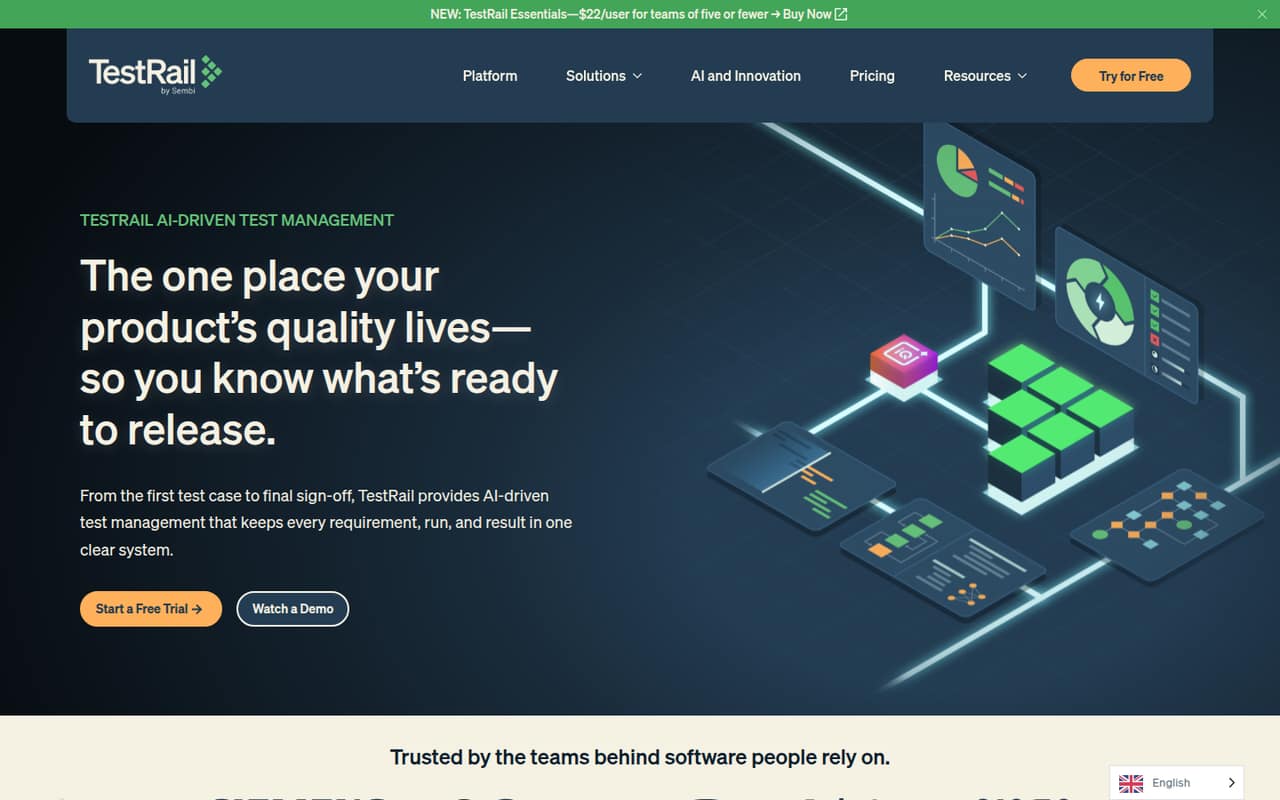
TestRail is a commercial test-management application for organizing cases, plans, execution and results. It integrates with Jira and Azure DevOps, exposes a REST API and CLI, and offers AI features for case generation, script scaffolding and test prioritization.
It fits teams that need traceability and reporting across manual and automated testing. The trade-offs are per-user pricing, tiered API limits and a mixed user picture: Reddit users praise its breadth, while others report self-hosted version issues or are looking to switch.
Good fit if
- QA teams managing shared test suites
- Teams using Jira or Azure DevOps
- Organizations needing coverage reporting
Skip it if
- Teams only storing a few cases
- Projects requiring an open-source tool
- Teams needing uncapped API requests
ScoresHow it rates
What works
- Centralizes cases, defects, plans and results
- Connects Jira and Azure DevOps workflows
- Tracks requirement-to-test coverage across projects
- REST API and CLI support integrations
- AI suggestions stay subject to human review
What doesn't
- No free plan; trial lasts 30 days
- Per-user pricing raises costs as teams grow
- REST API limits vary by plan
- On-premise deployment requires 10+ seats
- Reddit users report self-hosted version issues
01What TestRail is, technically
TestRail is a commercial test-management application offered as a hosted service, with an on-premise deployment option on Professional or Enterprise for teams with 10 or more seats. It sits between requirements and the work used to verify them: teams organize test cases, build plans, assign execution, record results and connect defects. The goal is a shared record of what has been tested and what remains at risk, rather than separate spreadsheets and reports.
In a delivery stack, TestRail works alongside issue tracking and development tools, not as a test runner or replacement for them. Its integrations connect Jira and Azure DevOps with requirements, defects and automated test results. Teams can use it for scripted, exploratory, manual or automated testing, and its dashboards report coverage and execution across projects. AI features add test-case generation, script scaffolding and risk-based prioritization, with suggestions reviewed before entering workflows. That makes TestRail a system of record for testing activity, while execution still happens in your existing tools and frameworks.
02TestRail API, SDKs and docs
TestRail provides a REST API and CLI, alongside a two-way Jira issue integration and an Azure DevOps app. The REST API limits depend on the plan: 100 requests per minute on Essentials, 180 on Professional and 300 on Enterprise. Build integrations around the API or CLI to link test activity with your existing delivery stack; confirm the supported operations and authentication details in the vendor docs before designing a production sync.
The homepage does not name language-specific SDKs, so confirm SDK support in TestRail’s docs rather than assuming an official client exists. Its AI test-script feature is separate from that integration surface: it generates commented automation scaffolding from test cases, with Java or Python and Selenium, Playwright, Cucumber or Behave as the stated choices. That output is intended for review, not described as an execution service. The vendor’s integration claims focus on Jira, Azure DevOps, the API and CLI; teams with other tools should confirm connector availability and maintenance requirements before committing.
03TestRail pricing for developers
TestRail has no free plan; the vendor offers a 30-day free trial. Essentials starts at $22 per user per month with annual billing, for teams of up to five users. At five seats, that is $110 per month equivalent, or $1,320 for a year paid upfront. It includes 50 GB storage and 100 REST API requests per minute.
Professional is listed at $38 per user per month with annual billing and unlimited users; the pricing FAQ says $39, so confirm the quote before budgeting. Its API limit is 180 requests per minute. Enterprise is $78 per user per month, annual-only, with 500 GB storage and 300 requests per minute. Monthly billing is available for Essentials and Professional, but monthly prices are not published. The bill scales by seat count, and moving up a plan changes storage, API capacity and governance features. Concierge Service has no published price. On-premise deployment on Professional or Enterprise requires 10+ seats and a 12-month minimum contract; its price is not published.
04TestRail: open source, self-hosting and lock-in
TestRail is a commercial product, not presented as an open-source project; the vendor does not publish a source license. It is not hosted-only: the vendor lists an on-premise option for Professional and Enterprise, subject to a 10-seat minimum and a 12-month contract. The on-premise price is not published.
TestRail manages structured cases, plans, runs and results, so migration means moving more than a list of case titles if your team relies on execution history, traceability or reports. A Reddit commenter suggests exporting TestRail data to CSV, but confirm with the vendor which records and relationships a bulk export preserves before planning a migration. The vendor does not publish export formats here. Ask about export scope, attachments, history and API access, and test the resulting data in your target tool before ending a subscription.
05TestRail in production
Plan around the API tier before building a frequent sync: Essentials allows 100 requests per minute, Professional 180 and Enterprise 300. Storage is 50 GB on Essentials and Professional, rising to 500 GB on Enterprise. The vendor lists SSO, MFA and audit logs on Enterprise; its homepage also mentions data-residency options. Confirm the exact controls, retention behavior and support commitments that apply to your deployment before using TestRail as compliance evidence.
Reliability reports on Reddit are mixed and anecdotal. In one thread, a user on self-hosted version 8 reports missing fixes compared with the cloud version and says image copy-and-paste was broken for storing test results. Another commenter says TestRail was useful for quick runs, bug history and reporting. These reports are not a reliability guarantee. Ask about upgrade cadence, uptime commitments and image handling for your chosen deployment, and monitor API responses and rate-limit behavior in any production integration.
From the threadsWhat users say
Reddit comments show both continued use and active searches for alternatives. Users value TestRail’s testing and reporting features, while cost and self-hosted issues are recurring concerns.
I still prefer TestRail for all its options and useful functions
we’re paying around $2,500 per year for the license, which feels excessive since we don’t use most of its features
The cloud version is fixed but we use self-hosted which they haven't updated with some of the major bug fixes
I am leading the effort to move away from Testrail at my company
Questions people ask
Does TestRail offer a free plan?
No. TestRail has no free plan, but the vendor offers a 30-day free trial. Essentials starts at $22 per user per month with annual billing and is limited to teams of five users. Confirm the trial terms and what happens to your data when it ends before starting an evaluation.
Does TestRail integrate with Jira and Azure DevOps?
Yes. The vendor lists two-way Jira issue integration and an Azure DevOps app, as well as a REST API and CLI. The integrations connect requirements, defects and automated test results. Confirm which workflows and data fields your team needs before relying on an integration.
Can TestRail run tests?
TestRail organizes test cases, plans, execution and results; the vendor describes it as supporting manual and automated testing, not as a test runner. It can connect automated results to test records. Its AI test-script feature generates scaffolding for review using Java or Python and named frameworks.
Can we self-host TestRail?
The vendor lists an on-premise option on Professional or Enterprise. It requires at least 10 seats and a 12-month minimum contract, and the price is not published. Ask the vendor about deployment requirements, upgrade cadence and support terms for your environment.
What are TestRail’s API limits?
The listed REST API limits are 100 requests per minute on Essentials, 180 on Professional and 300 on Enterprise. If an integration polls frequently or synchronizes large test suites, estimate request volume and confirm how the API responds when a limit is reached.