
We may earn a commission if you buy through links on this page. It never changes a score or a ranking. How we make money
The bottom line
Strong hybrid coverage and deployment choice; confirm API fit, SaaS cost, and data portability first.
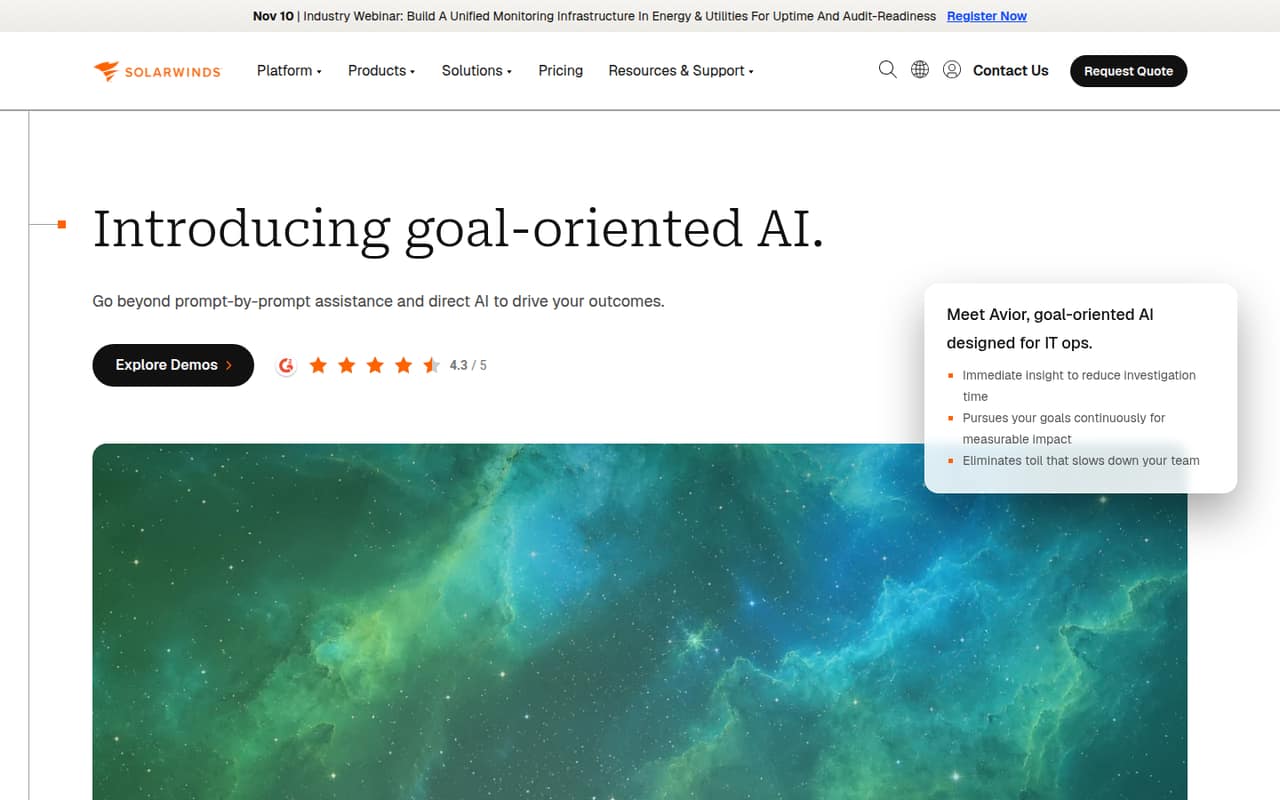
SolarWinds Observability is a commercial monitoring platform for networks, infrastructure, databases, applications, digital experience, logs, and security. Teams can deploy it as SaaS, self-hosted, or hybrid, with AI-assisted event correlation, anomaly detection, and root-cause investigation.
The main trade-offs are commercial terms and integration clarity. Self-Hosted starts at $8 per node per month; SaaS pricing is not published on the published pricing details. The homepage names a public API and third-party integrations, but teams should confirm protocol, SDK support, export options, and the features available in each deployment before buying.
Good fit if
- Hybrid IT operations teams
- Organizations needing self-hosting
- Teams consolidating monitoring domains
Skip it if
- Developers seeking a free tier
- Teams requiring published SDK details
- Buyers needing transparent SaaS pricing
ScoresHow it rates
What works
- Monitors networks, infrastructure, databases, and applications
- Supports SaaS, self-hosted, and hybrid deployment
- Maps application and infrastructure dependencies dynamically
- Correlates events across environments to reduce alert noise
- Self-Hosted starts at $8 per node per month
What doesn't
- No free plan; trial lasts 30 days
- SaaS price is not published
- Public API details need verification before integration
- Node-based subscriptions can complicate budget forecasts
- Reddit users report renewal increases and support concerns
01What SolarWinds Observability is, technically
SolarWinds Observability is a commercial monitoring and observability platform, not a library or CLI. It runs as a hosted SaaS service, as a self-hosted deployment, or in a hybrid arrangement. In a typical stack, it sits alongside the systems being monitored, collecting operational signals across networks, infrastructure, databases, applications, digital experience, logs, and security.
The product is aimed at teams that need a shared view across on-premises and cloud environments. Its feature set includes dynamic dependency mapping, event correlation, anomaly detection, and root-cause investigation. SolarWinds says its AI can help detect issues, identify impact, and recommend next steps. Those features make it an operations layer for monitoring and incident investigation; it is not presented as an application runtime or a general-purpose AI API. Choose deployment based on data handling and operating constraints, then validate which monitored domains and workflows are included in that edition.
02SolarWinds Observability API, SDKs and docs
The homepage names a public API and third-party integrations as part of SolarWinds Observability SaaS. That gives engineering teams an integration surface, but it does not describe an API protocol, authentication flow, endpoint coverage, SDK languages, rate limits, or a CLI. Confirm those details in SolarWinds’ documentation before designing an integration, and ask whether the same API capabilities apply to Self-Hosted.
The product is primarily an operations platform rather than a developer framework. Its integration value is in bringing monitoring data and events into existing workflows: SolarWinds describes event correlation across environments, while its Incident Response product can ingest alerts and tickets from SolarWinds products and more than 200 third-party tools. That figure applies to Incident Response, not necessarily every Observability integration. Check connector coverage for the systems you rely on, and confirm how custom applications, microservices, Kubernetes, and containers are instrumented before estimating integration work.
03SolarWinds Observability pricing for developers
SolarWinds lists two subscription plans, priced per node per month. SolarWinds Observability Self-Hosted starts at $8 per node per month. SolarWinds Observability SaaS is also priced per node per month, but its price is not published. There is no free plan; both plans include a 30-day fully functional trial.
The bill scales with the number of nodes you license. The pricing page lists volume discounts, available by contacting SolarWinds for a quote. It does not publish a separate monthly rate for multi-year contracts; the page says multi-year contracts are billed annually. The SaaS plan includes metrics, traces, logs, user experience, custom apps, microservices, Kubernetes, containers, a public API, and third-party integrations. Self-Hosted starts at the stated per-node price and can run behind a firewall or in AWS, Azure, or GCP. Before budgeting, ask for a quote based on your node count and confirm how each environment and monitored component affects that count.
04SolarWinds Observability: open source, self-hosting and lock-in
SolarWinds Observability is sold as a commercial subscription. The vendor does not publish an open-source licence for the product, so do not plan on modifying or redistributing its source. Self-hosted deployment is available: SolarWinds says it can run behind a firewall or in AWS, Azure, or GCP. That gives teams control over deployment location, but it does not establish what telemetry leaves the environment or what data-export formats are supported.
Ask SolarWinds about export options, retention, and migration paths before onboarding production data. Node-based subscription licensing also creates a commercial dependency that teams should account for when planning an exit. A Reddit commenter says their team owns its data on the database, but that is an individual report, not a published export guarantee. Confirm the database and export terms directly, including whether historical data remains usable after a subscription ends.
05SolarWinds Observability in production
The product targets hybrid estates and offers SaaS, self-hosted, and hybrid deployment, but the available pricing information does not set out service-level commitments, ingestion limits, or rate limits. Confirm those terms, node-count rules, retention, and the effect of adding logs or monitored environments before sizing a production rollout. For self-hosting, include the infrastructure and operational work required to run the deployment in your environment.
Reddit feedback is mixed. One user reports a roughly 25% renewal increase and says Observability was about 30% more than their alternative renewal; those figures describe that customer’s quote, not standard pricing. Another commenter says support has declined. A different commenter praises owning the database and controlling its data. A Reddit user also claims their deployment is FIPS, NERC, and PCI compliant, but buyers should verify current certifications and scope with SolarWinds rather than rely on a comment. Ask about support response terms, security controls, and telemetry behavior for your deployment model.
From the threadsWhat users say
Reddit sentiment is mixed, with some users valuing control over data and hybrid coverage while others raise concerns about subscription costs and support. The comments are individual experiences, not a measure of typical pricing or service.
I love owning the DB and doing whatever I want with it
Support has gone downhill
It was about a 25% price increase
SolarWinds Observability is very slick, especially for hybrid/cloud-native stuff
Questions people ask
Can SolarWinds Observability run on-premises?
Yes. SolarWinds offers Observability Self-Hosted, which can be deployed behind a firewall or in AWS, Azure, or GCP. The product also has SaaS and hybrid deployment options. Confirm the specific monitoring features and data flows for the deployment model you plan to use.
Does SolarWinds Observability have a free plan?
No free plan is listed. SolarWinds lists a 30-day fully functional trial. After the trial, the published pricing details describe per-node monthly subscriptions; Self-Hosted starts at $8 per node per month, while SaaS pricing is not published.
Does SolarWinds Observability provide an API or SDKs?
The SaaS plan lists a public API and third-party integrations. The homepage does not name SDK languages or an API protocol. Check SolarWinds’ documentation for supported SDKs, authentication, endpoints, rate limits, and whether the same API coverage is available for Self-Hosted.
What does SolarWinds Observability monitor?
SolarWinds lists monitoring for networks, infrastructure, databases, applications, digital experience, logs, and security across on-premises, cloud, and hybrid environments. The SaaS plan also lists custom apps, microservices, Kubernetes, and containers. Confirm the specific integrations and collection requirements for your estate.
How is SolarWinds Observability priced?
Both listed plans use per-node, per-month pricing. Self-Hosted starts at $8 per node per month; the SaaS price is not published. SolarWinds lists volume discounts by quote, and says multi-year contracts are billed annually without publishing a separate monthly rate.
Sources
- SolarWinds Observability homepage
- SolarWinds Observability pricing page
- Reddit: SolarWinds Observability vs ManageEngine OpManager
- Reddit: SolarWinds Observability Self-Hosted: data privacy, network discovery, NetFlow and licensing questions
- Reddit: SolarWinds Platform vs SolarWinds Observability
- Reddit: SolarWinds Observability SaaS - what is classed as a 'Log' ?