We may earn a commission if you buy through links on this page. It never changes a score or a ranking. How we make money
The bottom line
Snyk spans code, dependencies, IaC, containers and AI security, but teams must manage alert noise and rising usage costs.
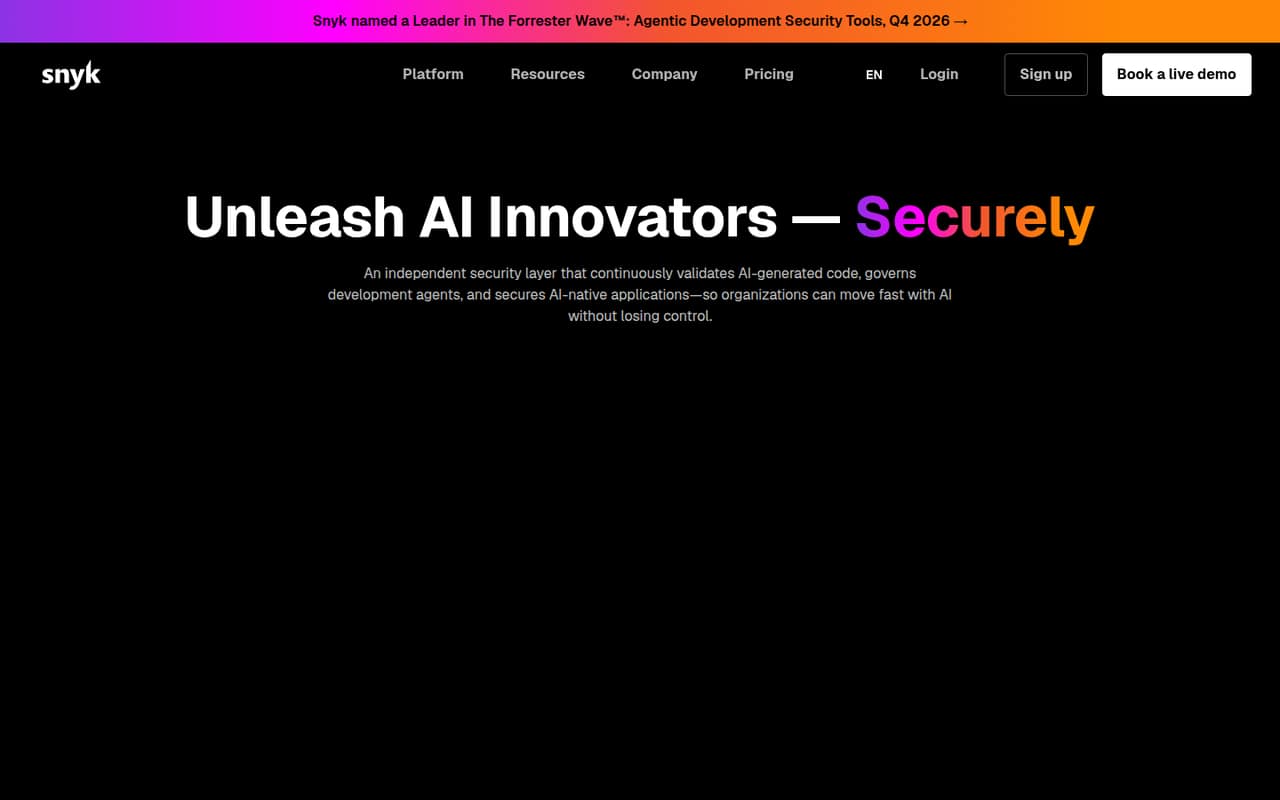
Snyk is a hosted application security platform for scanning code, open-source dependencies, infrastructure as code and containers. Its AI Security Platform adds code validation, agent protection and AI application governance, with integrations for IDEs, CI/CD pipelines and AI coding assistants.
The Free plan has firm test limits, Team costs $25 per month, and Enterprise is credit-based with custom pricing. Reddit reports range from positive experiences to complaints about alert overload, project housekeeping and builds hanging, so teams should plan triage and pipeline controls alongside deployment.
Good fit if
- Teams consolidating AppSec scans
- Developers securing AI-assisted workflows
- Teams using IDE and CI/CD integrations
Skip it if
- Teams needing public enterprise pricing
- Pipelines that cannot tolerate scan delays
- Teams without alert-triage capacity
ScoresHow it rates
What works
- Scans code, open-source dependencies, IaC and containers
- AI security covers code, agents and AI applications
- Integrates with IDEs and CI/CD pipelines
- Free plan available for individual developers and small teams
- Team plan includes Jira integration
What doesn't
- Free plan limits tests and projects
- Enterprise pricing requires contacting sales
- Enterprise usage can be invoiced beyond prepaid credits
- Reddit users report alert noise and project housekeeping
- The stated integration details do not settle custom API needs
01What Snyk is, technically
Snyk is a hosted application security platform that connects scanning and security controls to development workflows. It is not a library you embed in an application: teams use it to scan code, open-source dependencies, infrastructure as code and containers, then work with findings through development tooling.
Its AI Security Platform groups its capabilities into three areas: validating AI-generated code, protecting development agents and governing AI applications. Snyk also describes continuous offensive security as wrapping those pillars. That places it across the development stack, from code and dependencies through infrastructure and container images, rather than only at a production runtime boundary.
The product integrates with IDEs, CI/CD pipelines and AI coding assistants, including Claude Code, Cursor and Codex. The homepage describes a platform and workflow integrations; it does not position Snyk as a self-hosted scanning server. Teams evaluating it should map each scan type to the repositories, build steps and ownership process where they expect findings to land.
02Snyk API, SDKs and docs
Snyk's stated integration surface includes IDEs, CI/CD pipelines and AI coding assistants, with Claude Code, Cursor and Codex named as examples. The product also offers code and open-source scanning, and the Team plan includes Jira integration. This is enough to identify where Snyk fits into a developer workflow, but not enough to design custom automation around a particular API contract.
The homepage does not name a programming-language SDK, CLI, REST API style or webhook protocol. Before building internal tooling, confirm in Snyk's docs which API endpoints, SDKs, language support, CLI commands and event hooks are available for the plan and scan types you intend to use. Also verify how findings map to projects and repositories in your setup; Reddit users report duplicate-project cleanup and reimports as operational chores. Snyk's integrations can bring checks into existing tools, but the team still needs to decide which findings block builds and who triages exceptions.
03Snyk pricing for developers
Snyk's Free plan costs $0 per month and lists 5 projects, 100 Snyk Code tests, 200 Open Source tests, 300 IaC tests and 100 Container tests. Team costs $25 per month for up to 10 developers and includes 100 projects, 1,000 Snyk Code tests per month, Jira integration and next-business-day support. The pricing page shows monthly billing for both plans and no annual price.
Enterprise uses prepaid credits: one credit equals $1, credits apply across the Snyk Platform, and they are valid for the contract term. The rate card lists Code and Open Source at 1 credit per active contributor per day; IaC at 0.33; Secrets and Evo AI-SPM at 0.66; Container at 0.33 per monitored image per day; API and Web at 3 credits per provisioned target per day; Evo ADS at 1 per active machine per day; and Evo COS at 4,000 per assessment. Usage beyond prepaid credits is invoiced in arrears, and teams can top up mid-contract. Premium support and services cost extra; their prices are not published.
04Snyk: open source, self-hosting and lock-in
Snyk scans open-source dependencies, but that does not make Snyk itself open-source software. The vendor presents Snyk as a commercial platform; its product information does not publish an open-source license for the platform or describe a self-hosted deployment option. Treat it as a hosted service unless Snyk confirms otherwise for your contract.
The pricing details do not describe a data-export format or a migration path. Before onboarding, ask how to export project inventories, findings, policies and historical data, and whether those exports remain available after a contract ends. Lock-in risk depends partly on how much your team relies on Snyk-specific project mapping, policies and workflow integrations. Keep security gates and exception processes documented outside the tool, and avoid making Snyk the only place where remediation decisions are recorded.
05Snyk in production
Snyk can put checks into IDE and CI/CD workflows, but a production rollout needs explicit decisions about which findings fail a build, how exceptions are approved and who owns remediation. Otherwise, teams risk adding another alert stream without changing what ships. The Free plan's test caps and Enterprise's usage-based credit rates also make it important to estimate repository, contributor, image and target counts before scaling.
The vendor's homepage does not state rate limits or service-level commitments for the integrations described there. Confirm those details, plus scan behavior during outages and what happens when a plan's limits are reached, before making checks mandatory in release pipelines. Reddit users report excessive findings, duplicate projects and, in one thread, builds hanging. Other commenters say gradual remediation can help teams act on findings. Treat these reports as individual experiences, then pilot the workflow against your own repositories and define a fallback for blocked scans.
From the threadsWhat users say
Reddit sentiment is mixed. Some developers value Snyk, while others report noisy findings, manual project cleanup and pipeline interruptions; several comments also stress that security tools need a remediation process to be useful.
reports so much stuff that the devs just said fuck it and set allow_failure: true
the minute you engage with them as a company they will contact you and your colleagues so much that you will regret every second of looking at their product
It also hangs our builds way too often (1-2/5x)
2-3 a month are easy to fit in
Questions people ask
What does Snyk scan?
Snyk offers scanning for code, open-source dependencies, infrastructure as code and containers. Its AI Security Platform also addresses AI-generated code, development agents and AI applications. The exact checks and limits available depend on the plan and scan type, so verify those before rolling scans across all repositories.
How does Snyk fit into a development workflow?
Snyk says it integrates with IDEs, CI/CD pipelines and AI coding assistants, including Claude Code, Cursor and Codex. Team includes Jira integration. Decide which findings should block builds, where developers review results and how exceptions are approved before making checks mandatory.
Does Snyk have a free version?
Yes. The Free plan costs $0 per month and lists 5 projects, 100 Snyk Code tests, 200 Open Source tests, 300 IaC tests and 100 Container tests. It is aimed at individual developers and small teams; review the limits against your expected scan volume.
Can Snyk be self-hosted?
Snyk is presented as a hosted platform, and the vendor's product information does not describe a self-hosted deployment option. If your deployment or data-residency requirements depend on self-hosting, ask Snyk directly before adopting it and confirm available data export and retention terms.
How does Snyk protect AI development?
Snyk describes three AI security areas: validating AI-generated code, protecting development agents and governing AI applications. The platform is intended to cover AI code and workflows from development through production. Confirm the specific controls and plan coverage you need before relying on it for governance.