
We may earn a commission if you buy through links on this page. It never changes a score or a ranking. How we make money
The bottom line
A simple way to retrieve Google SERP data, with prepaid credits and production limits to plan around.
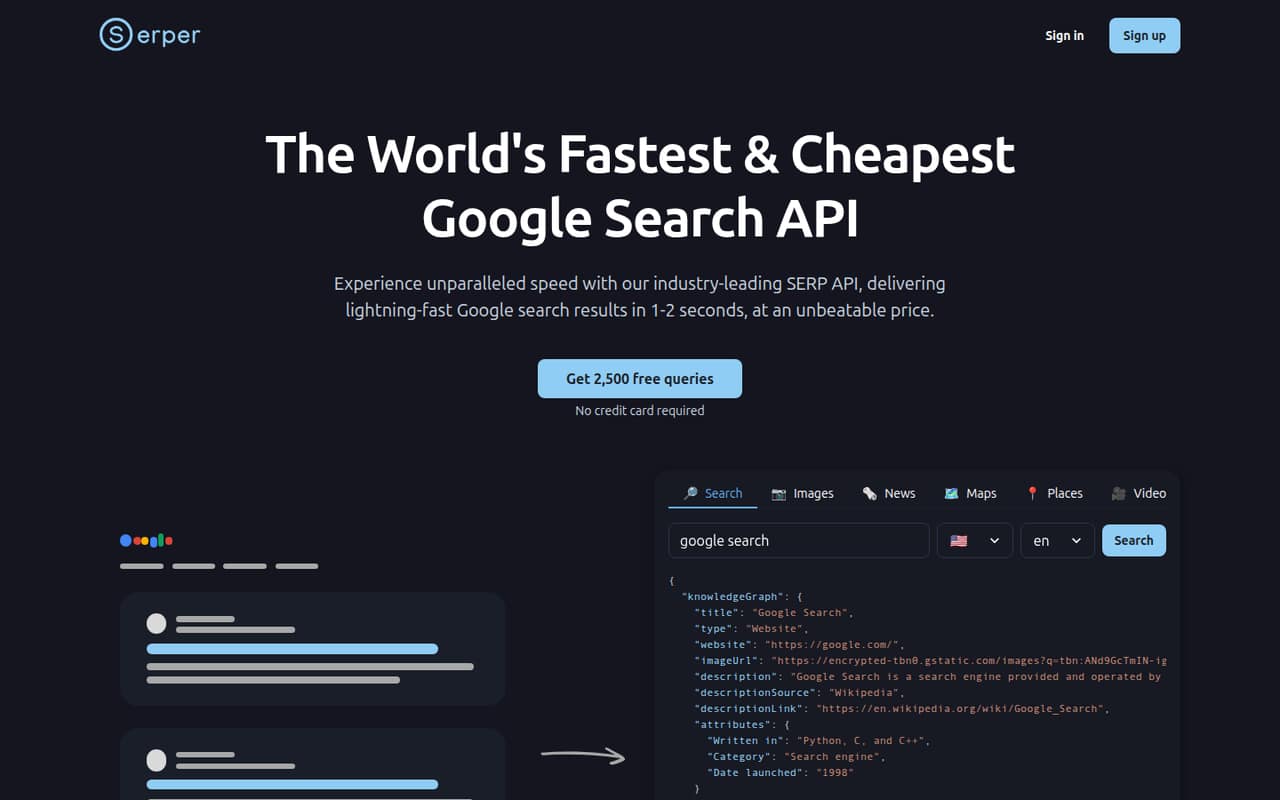
Serper is a hosted API for retrieving Google search results and related SERP data as structured responses. It covers search, images, news, maps, places, videos, shopping, Scholar, patents and autocomplete, and the homepage says results arrive in 1–2 seconds.
The 2,500-query free allowance and prepaid packages make it easy to price an initial workload. Production buyers should account for six-month package validity, tiered QPS limits and the need to buy more credits when a balance runs out.
Good fit if
- Apps that need Google SERP data
- Research and search-driven automations
- Teams with predictable query volumes
Skip it if
- Projects requiring self-hosted search infrastructure
- Workloads needing published overage rates
- Website crawling or full-page extraction
ScoresHow it rates
What works
- Free allowance includes 2,500 queries
- Supports ten Google query types
- Structured search-result data is returned
- Prepaid packages publish per-credit rates
- Paid tiers list QPS limits
What doesn't
- Paid packages expire after six months
- Overage costs are not published
- Free-tier rate limit is not published
- No self-hosting option is published
- SDK and language support needs confirmation
01What Serper is, technically
Serper is a hosted API that retrieves Google search results and SERP data for applications. It sits between your code and Google’s search-result pages: your application sends a query to Serper and consumes the returned result data instead of building and maintaining its own SERP retrieval system.
The homepage shows structured JSON containing fields such as organic results, titles, links, snippets, positions, related searches and people-also-ask results. Other query types include images, news, maps, places, videos, shopping, Scholar, patents and autocomplete. That makes Serper an option for search-backed products, research workflows and data enrichment—not a general website crawler or a search index you host yourself.
The homepage says results arrive in 1–2 seconds. Treat that as the vendor’s stated response time, not a production latency guarantee. Your application still needs to handle API failures, response changes and the vendor’s QPS limits.
02Serper API, SDKs and docs
Build against Serper’s API and consume its structured JSON responses. The homepage demonstrates result fields for organic listings, snippets, positions, knowledge graphs, related searches and other SERP elements. Its query types cover search, images, news, maps, places, videos, shopping, Scholar, patents and autocomplete, so one integration can support several search-oriented workflows.
The homepage does not name SDKs, programming languages, a CLI, webhooks or plugins. Treat the API as the integration surface and confirm SDK support, authentication details, request formats, error handling and language examples in Serper’s developer docs before choosing a client library. The published pricing tiers publish QPS limits, which you should factor into concurrency and retry behavior.
For an application that only needs Google SERP data, this is a narrower integration than operating a scraper stack. It does not replace a crawler when the job is to extract content from arbitrary websites; a Reddit commenter makes that distinction when discussing lead-generation workflows.
03Serper pricing for developers
Serper has a free allowance of 2,500 queries, requires no credit card and stops queries when the balance reaches zero. Paid access uses prepaid packages, not published monthly or annual subscriptions. Starter costs $50 for 50,000 credits ($1 per 1,000), Standard costs $375 for 500,000 credits ($0.75 per 1,000), Scale costs $1,250 for 2,500,000 credits ($0.50 per 1,000), and Ultimate costs $3,750 for 12,500,000 credits ($0.30 per 1,000). Each package is valid for six months.
The larger package lowers the listed cost per 1,000 credits, but increases the amount paid upfront. Published QPS limits rise from 50 on Starter to 100 on Standard, 200 on Scale and 300 on Ultimate. The free tier’s rate limit is not published. When a balance runs out, additional prepaid credits are required; overage costs are not published. Confirm how your query types consume credits and how remaining balances are handled before committing a production budget.
04Serper: open source, self-hosting and lock-in
Serper is sold as a hosted API. The vendor does not publish an open-source license or a self-hosting option, so teams should plan for a third-party service rather than a server they can deploy inside their own infrastructure.
The API returns structured search-result data, which your application can store in its own systems if its data terms allow. The vendor does not publish a data-export commitment on the vendor's site; check its terms and retention policies before making Serper the only place results or job history live.
Migration is likely to require replacing the API client and mapping another provider’s response schema into your application. Keep a provider boundary around search requests and normalize returned fields internally to reduce that work. Also confirm whether stored results can be retained and reused under the applicable terms.
05Serper in production
The paid packages list QPS limits of 50, 100, 200 and 300, depending on tier. The free tier’s QPS limit is not published, so do not assume its 2,500-query allowance can be used at production concurrency. Build for throttling, failed requests and credit exhaustion, and alert on balance and request volume. The homepage’s 1–2-second response claim is not a latency guarantee or service-level commitment.
Before launch, confirm authentication and key-rotation practices, data retention, security controls, compliance terms and support response commitments with the vendor. The published pages do not establish those production requirements. Reddit discussions include a user noting a $50 minimum purchase and another describing use for search-based email research. A separate commenter distinguishes SERP retrieval from scraping website content, which matters if your pipeline needs page extraction as well as search results.
Package expiry also affects capacity planning: prepaid credits are valid for six months. Forecast usage before buying a larger tier, and test your own query mix against the published QPS ceiling.
From the threadsWhat users say
The Reddit mentions show practical interest in Serper for search-based research and data enrichment, but the discussion is brief and not a broad assessment. One user flags the minimum purchase, while another is looking for more affordable alternatives.
I'm thinking of creating free plans on serper.dev, or serpapi, tavily, etc, to allow it to get more results
Serper has a minimum purchase amount (I believe $50)
after using serper.dev for a while, I'd like to figure out if there are good (and more affordable) alternatives
I’ve been trying different ones lately: Apify Google SERP scraper, Serper.dev, DataForSeo and even Semrush (but too expensive)
Questions people ask
What does Serper’s API return?
Serper returns Google SERP data as structured results. The homepage example includes organic listings with titles, links, snippets and positions, along with fields such as knowledge graphs, people-also-ask questions and related searches. Other query types include images, news, maps, places, videos, shopping, Scholar, patents and autocomplete.
Does Serper offer a free tier?
Yes. The Free tier includes 2,500 queries, requires no credit card and stops queries when the balance reaches zero. The free-tier rate limit is not published, so confirm it with Serper before using the allowance in a concurrent production workload.
How are Serper’s paid plans billed?
Paid plans are prepaid credit packages, valid for six months. The listed packages range from Starter at $50 for 50,000 credits to Ultimate at $3,750 for 12,500,000 credits. Monthly and annual billing prices are not published; check the current pricing page before purchasing.
Can Serper replace a web scraper?
Serper retrieves Google search results and SERP data. That is different from extracting content from arbitrary websites. A Reddit commenter draws the same distinction for lead-generation workflows. If your application needs page text or structured data from target websites, confirm whether you need a separate crawling or scraping tool.
Can I self-host Serper?
Serper is offered as a hosted API, and the vendor does not publish a self-hosting option. Teams that need infrastructure they control should confirm deployment and data-handling requirements with Serper before adopting it. Keep your application’s search integration behind an internal interface to make switching providers easier.
Sources
- Serper homepage
- Serper pricing, compiled via web search from serpbase.dev, cloro.dev, serphouse.com
- Reddit: What is your favorite tool for SERP scraping and why?
- Reddit: What are some free servcies (or harness?) that I could use to help run a deep research session?
- Reddit: Is anyone using the Serper API ?
- Reddit: Alternatives for Serper.dev and Exa.ai for news monitoring