
We may earn a commission if you buy through links on this page. It never changes a score or a ranking. How we make money
The bottom line
A broad, hosted search-data API; check plan limits, legal terms and response-schema lock-in before committing.
SerpApi is a hosted API service that returns structured search results and other data, including maps, shopping, jobs and product information. It offers JSON and Markdown output, location targeting, and a free plan with 250 searches per month.
Its range of APIs and language integration options make it relevant for search-backed applications and data pipelines. We would confirm throughput, overage behavior and legal coverage for the target use case before relying on it in production; Reddit comments include both praise for its capabilities and complaints about limits and usability.
Good fit if
- Search-backed applications
- Location-aware SERP data
- Multi-engine data pipelines
Skip it if
- Self-hosted search infrastructure
- Unbounded request workloads
- Teams avoiding vendor-specific schemas
ScoresHow it rates
What works
- Broad catalog of search and data APIs
- JSON and Markdown output
- Real-time requests, per the homepage
- Location targeting for Google results
- Free plan includes 250 monthly searches
What doesn't
- Throughput limits vary by plan
- Overage behavior is not published
- No self-hosted option is offered
- Response schemas can create migration work
- Reddit comments report limits and usability pain
01What SerpApi is, technically
SerpApi is a hosted API service for retrieving structured search engine results and other public data. It sits between an application or data pipeline and search services: your code sends an API request, and SerpApi returns results as JSON or Markdown. The service handles the browser work and CAPTCHA solving that would otherwise be part of collecting search pages directly.
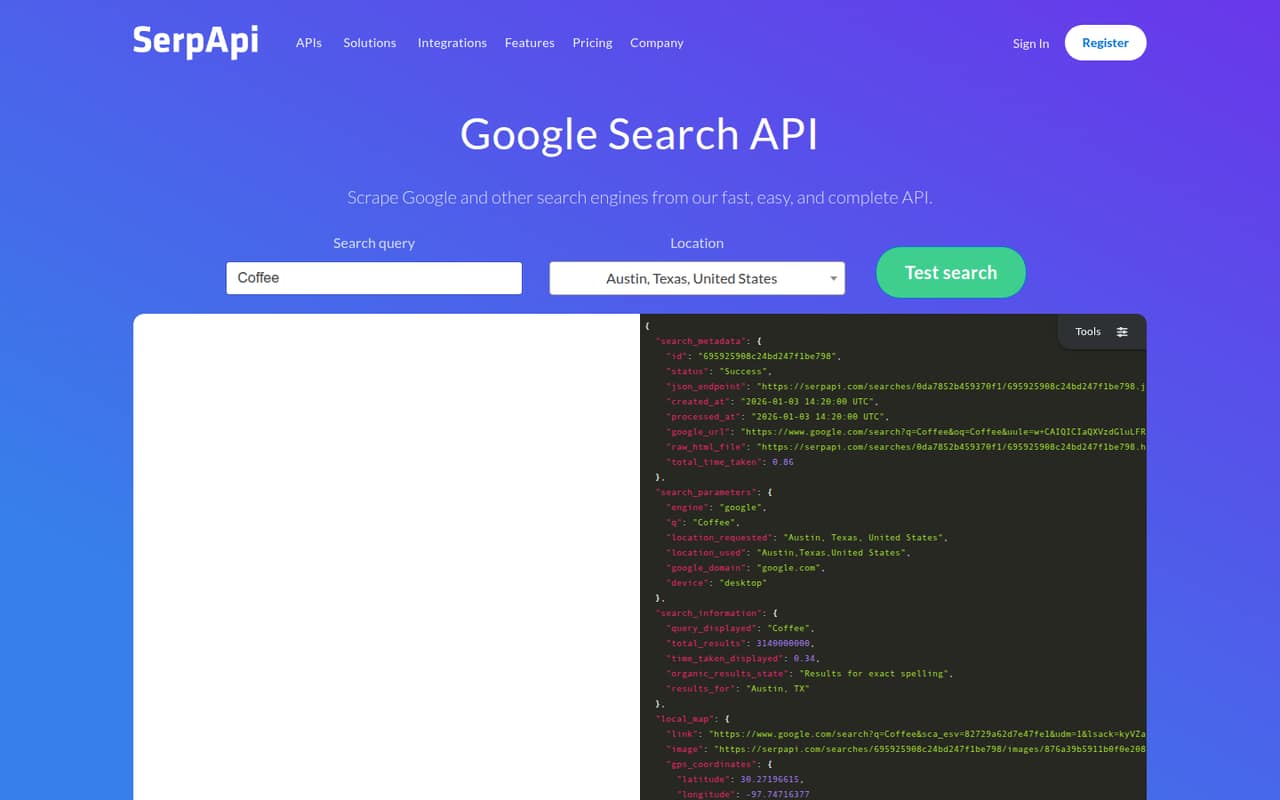
Its catalog extends beyond standard web search. The homepage lists APIs for Google and other search engines, maps, shopping, jobs, images, travel, reviews, products and more. A location parameter can return Google results for locations around the world, and the homepage says each request runs immediately. That makes SerpApi a data source for search-backed products, monitoring jobs or research workflows, rather than a search engine to host yourself. The vendor describes a full browser cluster and global IP infrastructure; your application consumes the resulting data rather than managing those components.
02SerpApi API, SDKs and docs
You build against SerpApi's APIs by making requests for a search engine or data type and consuming the structured result. The homepage lists output in JSON or Markdown, and examples of returned fields include links, prices, ratings and reviews. Location targeting is available for Google results. The homepage says requests run immediately, but confirm response and timeout behavior in the vendor's documentation before designing a synchronous workflow.
The homepage names integration options for Ruby, Python, JavaScript, Golang, PHP, Java, Rust, .NET, Swift and C++, as well as MCP and a CLI. It also links to APIs, integrations, features, FAQ, release notes and guides. These are listed as integration choices; confirm in SerpApi's docs which are SDKs, what versions they support and whether they cover the APIs you need. The homepage does not name a webhook or plugin surface, so plan around API requests and verify your preferred language's supported integration path.
03SerpApi pricing for developers
SerpApi's Free plan costs $0 per month and includes 250 searches per month, with throughput of 50 per hour. It also lists U.S. Legal Shield, ZeroTrace Mode and priority support. That is enough for a small integration or low-volume development, but the monthly search allowance and hourly throughput are separate constraints.
Paid plans are month-to-month: Starter is $25 for 1,000 searches and 200 throughput per hour; Developer is $75 for 5,000 and 1,000 per hour; Production is $150 for 15,000 and 3,000 per hour; Big Data is $275 for 30,000 and 6,000 per hour. Each plan lists U.S. Legal Shield. Enterprise has custom search volume and throughput, plus ZeroTrace Mode and priority support; the price is not published. The pricing page lists no annual billing or discounts. Overages, add-ons and the behavior after a plan's limits are not published, so ask SerpApi before estimating production spend.
04SerpApi: open source, self-hosting and lock-in
SerpApi is offered as a hosted service, not as a self-hosted server or library. The vendor does not publish an open-source licence or a self-hosted distribution on its homepage, so teams should treat the service as proprietary and hosted unless SerpApi confirms otherwise.
Results are returned to your application in JSON or Markdown, which gives you a straightforward way to store the data your own code receives. The vendor does not publish a separate data-export process. Migration risk is less about moving stored results and more about replacing SerpApi-specific request parameters, API coverage and response schemas. Keep a provider boundary in your code, normalize fields into internal models and retain the raw responses you need. That reduces coupling if you later switch providers or build a collection path of your own.
05SerpApi in production
Plan around both monthly searches and hourly throughput: the Free plan lists 250 searches per month and 50 throughput per hour, while Enterprise uses custom limits. The vendor says requests run immediately and that its infrastructure handles browsers and CAPTCHAs. Those statements do not replace checking timeout behavior, error responses, retries and service-level commitments for your workload. The vendor does not publish overage behavior in the pricing details, so establish what happens at plan limits before production.
The homepage lists U.S. Legal Shield, but describe the intended collection use case to the vendor and your legal team rather than treating that label as a legal opinion. Reddit reactions are mixed: one post says the 100-query monthly limit is challenging, while another calls the service painful to use; another commenter also acknowledges its capabilities. These are individual reports, not reliability data. Set request budgets, monitor errors and validate result fields as search pages change.
Questions people ask
Is SerpApi trustworthy?
SerpApi describes its service as collecting and parsing public search data, and its plans list U.S. Legal Shield. That does not settle whether a particular use is lawful or suitable for your organization. Review the vendor's security information, terms and data-handling practices, and assess your own collection purpose with counsel before depending on it.
Is SerpApi legal to use?
Legality depends on what data you collect, how you use it and the laws and terms that apply. SerpApi describes U.S. Legal Shield as covering lawful collection and parsing of public search data. Treat that as the vendor's stated coverage, not legal advice or a guarantee for every workload; confirm scope with the vendor and your counsel.
Why is Google suing SerpApi?
A Reddit thread title refers to Google taking legal action against SerpApi, but that alone does not establish the case's status, claims or outcome. We would not infer a legal conclusion from the headline. Before a purchase, ask SerpApi for its current position, the scope of any applicable legal coverage and how it affects your intended use.
How much does SerpApi cost?
The Free plan costs $0 per month for 250 searches and 50 throughput per hour. Paid plans start with Starter at $25 per month for 1,000 searches and 200 throughput per hour. Developer is $75, Production $150 and Big Data $275 per month; Enterprise pricing is custom.
Can I self-host SerpApi?
SerpApi is presented as a hosted API service, not a self-hosted server. The homepage does not offer an open-source licence or self-hosted distribution. If self-hosting is a hard requirement, ask the vendor whether a private deployment is available; otherwise, design your integration so you can replace the provider.