
We may earn a commission if you buy through links on this page. It never changes a score or a ranking. How we make money
The bottom line
A capable hosted scraping API; budget credits per target and validate real extraction success.
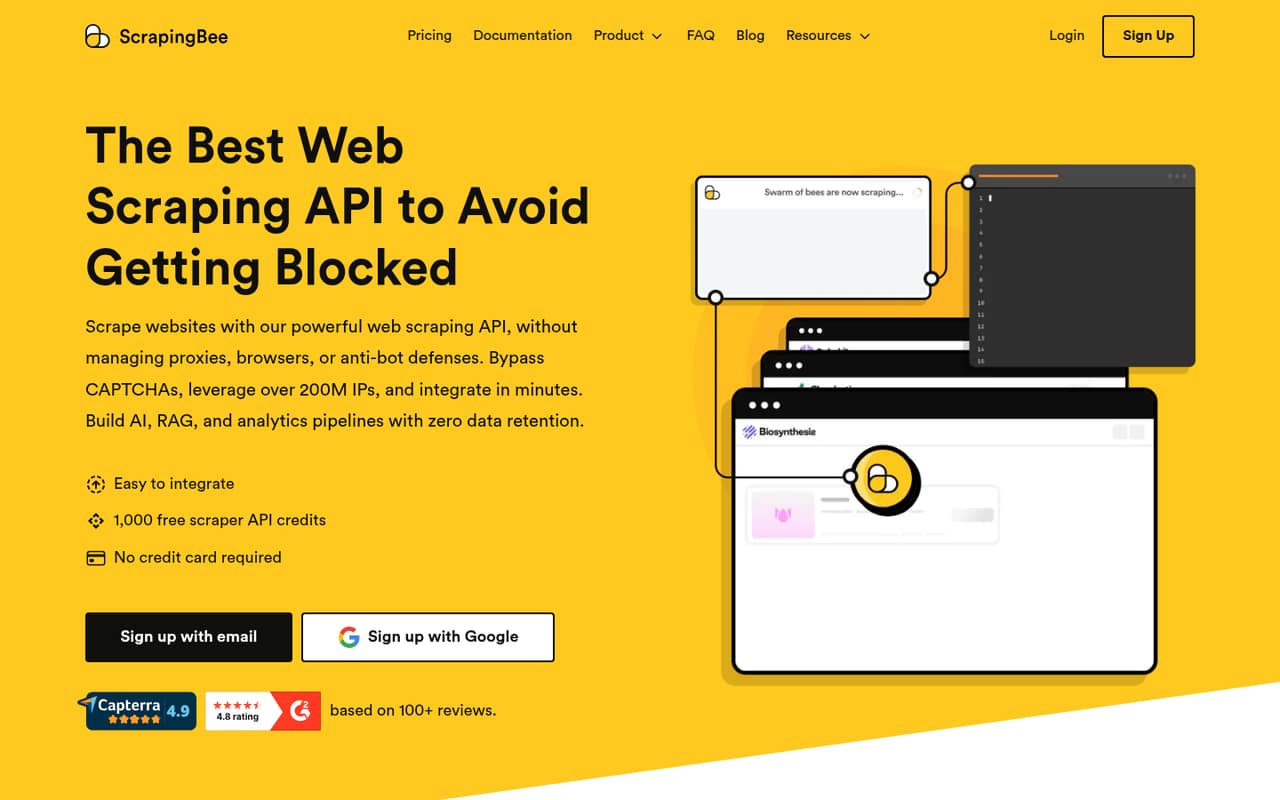
ScrapingBee is a hosted web scraping API for public websites. It combines automatic proxy rotation, headless Chrome rendering, structured extraction, and dedicated scraper APIs, with a CLI, MCP Server, and workflow integrations for connecting results to applications and AI workflows.
The main trade-off is usage: JavaScript rendering and premium proxies consume extra credits, which expire monthly. Reddit users report failures and slow responses on some targets, so validate parsed data and cost per successful result before making it a production dependency.
Good fit if
- Teams avoiding proxy infrastructure
- JavaScript-heavy public websites
- AI workflows needing structured web data
Skip it if
- Workloads needing self-hosted scraping
- Teams requiring predictable cost per page
- Critical targets without failure fallbacks
ScoresHow it rates
What works
- Automatic proxy rotation and country-level geotargeting
- Headless Chrome rendering with waits and scenarios
- Structured JSON or Markdown extraction
- Dedicated APIs for several common sources
- CLI, MCP Server, Make, n8n, and Zapier
What doesn't
- JavaScript rendering consumes five credits per success
- Premium proxies consume 10 or 25 credits per success
- Credits expire monthly without rollover
- Concurrency is capped by subscription plan
- Reddit users report target-specific failures and latency
01What ScrapingBee is, technically
ScrapingBee is a hosted web scraping API, not a scraping library or a self-hosted server. Your application sends a request for public website content; ScrapingBee handles proxy rotation, browser rendering, and anti-bot defenses, then returns page content or extracted data. That puts it between your crawler or data pipeline and the target website.
The HTML API returns raw page content for custom parsing. Other options include browser-rendered pages, Markdown, JSON from extraction rules or natural-language queries, and dedicated APIs for sources such as Amazon, Walmart, search results, YouTube, ChatGPT, and Gemini. You can use the results in analytics, e-commerce monitoring, or AI and retrieval workflows.
This setup removes the need to operate a proxy fleet and browser infrastructure, but it does not remove target-specific failure handling or downstream data validation. You still need to decide what counts as a valid result, handle retries, and monitor whether extracted fields are populated.
02ScrapingBee API, SDKs and docs
ScrapingBee’s integration surface centers on its web scraping API: request page content or use its extraction and dedicated scraper APIs. The homepage also names a CLI for running scraping workflows and connecting with AI coding tools, plus an MCP Server for giving an AI agent access to scraping. It describes HTML API, Markdown, AI extraction, CSS/XPath extraction, JavaScript scenarios, and screenshots.
For workflow automation, the vendor lists Make, n8n, and Zapier integrations. The CLI is presented for use with ChatGPT, Claude, Codex, Cursor, Claude Code, and Gemini. The homepage does not name programming languages or SDKs; confirm language-specific SDK support and current setup instructions in the vendor’s docs before choosing an integration path.
For browser-dependent pages, you can wait for selectors or browser events, run custom interactions, set viewport and headers, and capture screenshots. That gives teams options beyond fetching raw HTML, though you still need application-side checks for the fields your pipeline depends on.
03ScrapingBee pricing for developers
ScrapingBee offers 1,000 free API credits with no credit card required. Paid plans start at $19 per month for Hobby, which includes 75,000 credits and 25 concurrent requests. Freelance is $49 for 250,000 credits and 50 concurrent requests; Startup is $99 for 1,000,000 credits and 100 concurrent requests. Business costs $249 for 3,000,000 credits, while Business + is $599 for 8,000,000 credits.
The listed enterprise plans range from Enterprise 14 at $999 per month for 14,000,000 credits to Enterprise 120 at $5,799 for 120,000,000 credits. Higher plans include more concurrent requests, up to 900 on Enterprise 120. JavaScript rendering costs five credits per successful request. Premium proxies cost 10 or 25 credits per successful request, depending on whether JavaScript rendering is used. Credits expire after one month and do not roll over. Prices exclude VAT; annual rates are not listed. Check the pricing page for the current plan details and ask the vendor about how additional usage is handled.
04ScrapingBee: open source, self-hosting and lock-in
ScrapingBee is a hosted service accessed through its API and integrations. The vendor doesn’t publish an open-source licence, self-hosting option, or data-export path, so teams should treat it as a hosted dependency and confirm export options with the vendor before committing. The homepage says ScrapingBee uses zero data retention; confirm what that covers for requests, logs, and support workflows if your data handling requirements are strict.
Migration is possible at the application boundary, but not necessarily a drop-in switch. Your code may depend on ScrapingBee-specific request parameters, extraction behavior, dedicated APIs, and credit accounting. Keep your own normalized output schema and parser or validation layer, and store results in your own system. That limits how much downstream code must change if you replace the provider.
05ScrapingBee in production
Plan around both concurrency and credit consumption. The paid plans list concurrency caps from 25 to 900 requests, while JavaScript rendering and premium proxies increase the credits charged per successful request. Credits expire monthly, so demand spikes or a change in target mix can affect both spend and unused balance. Track successful parsed records and cost per result, not just HTTP status codes.
ScrapingBee says it uses zero data retention, but teams with security or compliance requirements should confirm the scope, traffic-log handling, and applicable terms with the vendor. Set timeouts, retry limits, and fallbacks in your own pipeline, and test representative URLs before expanding volume.
Reddit reports are mixed. One user said they were seeing failures on ScrapingBee targets where another provider worked; another commenter reported a 20-second response in a comparison. These are individual accounts, not controlled tests, but they reinforce the need to measure reliability against your own domains.
From the threadsWhat users say
Reddit sentiment is mixed: users report that ScrapingBee has worked for them, but some describe failures, slow responses, and credit pressure. The comments are anecdotal and vary by target and workload.
Also noticing a lot of failures where scrapfly would work
I was just comparing scraping APIs crawlio requests took less than 3s while scrapingbee 20 seconds
That burns through credits so fast
ScrapingBee. Got in when the started and they were very good
Questions people ask
What does ScrapingBee do?
ScrapingBee is a hosted web scraping API. It fetches public website content and can handle proxy rotation, JavaScript rendering, and anti-bot defenses. You can request raw page content, use CSS or XPath extraction, get JSON or Markdown outputs, or use dedicated scraper APIs for selected sources.
Does ScrapingBee support JavaScript-rendered pages?
Yes. ScrapingBee uses headless Chrome for JavaScript rendering. Its listed browser features include waiting for selectors and browser events, running custom scenarios, setting viewport and headers, and capturing screenshots. A successful JavaScript-rendered request uses five API credits.
Which programming languages have ScrapingBee SDKs?
The homepage names a CLI, MCP Server, and workflow integrations, but does not name programming languages or SDKs. Confirm language-specific SDK availability and current usage instructions in the vendor’s docs. The API is the core integration surface, with Make, n8n, and Zapier also listed.
How does ScrapingBee charge for proxy use?
Premium proxy requests use 10 or 25 credits per successful request, depending on whether JavaScript rendering is used. JavaScript rendering itself costs five credits per successful request. Check the current pricing page for plan balances, and account for credits expiring after one month without rollover.
Can ScrapingBee guarantee a successful scrape?
ScrapingBee handles proxies, browsers, and anti-bot defenses, but the homepage does not promise that every request to every target will succeed. Reddit users report failures on some domains. Validate the fields your application needs, monitor success by target, and build retries or fallback paths into your pipeline.