
We may earn a commission if you buy through links on this page. It never changes a score or a ranking. How we make money
The bottom line
A practical hosted scraping layer, but credit costs and success rates depend on your target sites.
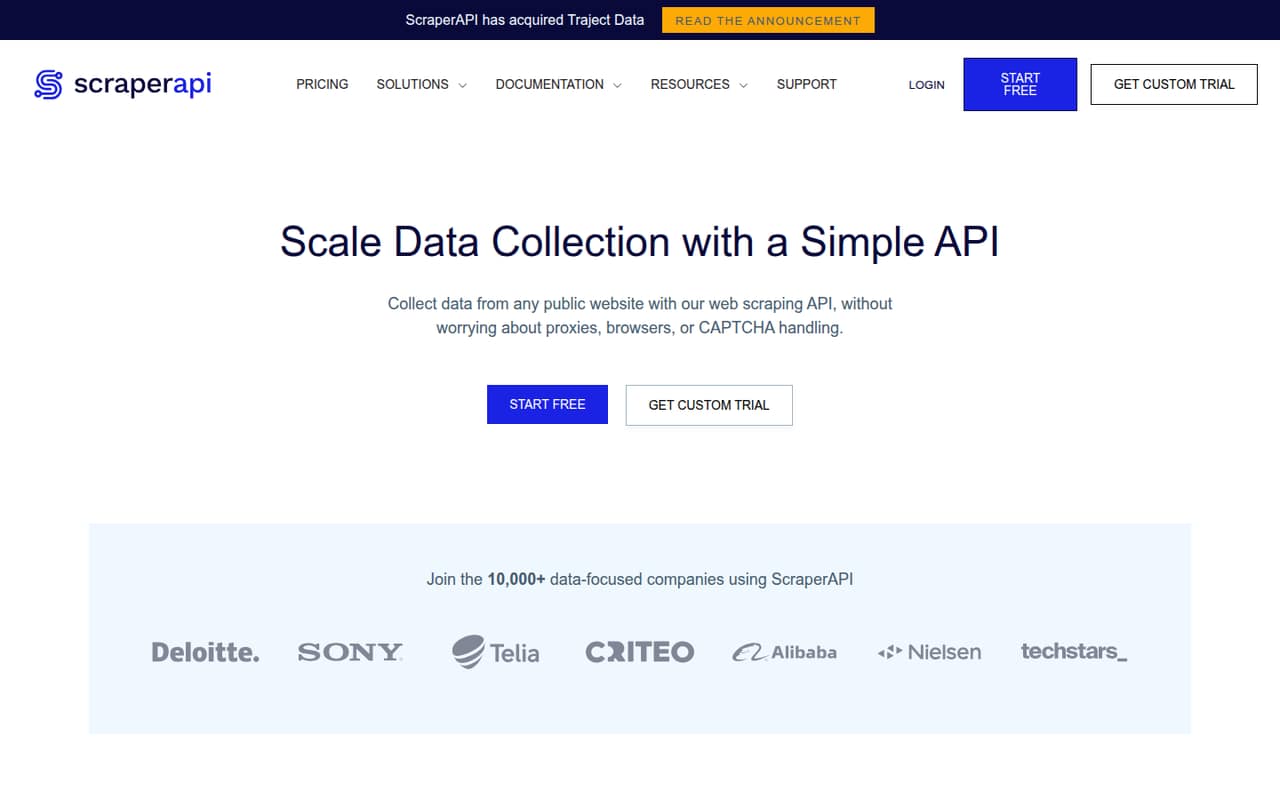
ScraperAPI is a hosted web-scraping API with structured JSON endpoints, asynchronous requests and no-code collection tools. It handles proxy rotation, CAPTCHA and browser handling, so your application can focus on collecting and using public website data.
The free account offers 1,000 API credits and up to five concurrent connections. Paid plans start at $49 per month, but Reddit users caution that credit use and successful product parsing vary by domain. Validate returned data and cost on your own target sites before committing to a plan.
Good fit if
- Teams replacing proxy infrastructure
- E-commerce and SERP data pipelines
- Developers needing structured JSON endpoints
Skip it if
- Teams requiring self-hosted scraping
- Projects needing a published SDK
- Workloads without parse-level validation
ScoresHow it rates
What works
- API handles proxy rotation, CAPTCHA and browser handling
- Structured JSON endpoints for Amazon, Google and Walmart
- Async Scraper supports millions of asynchronous requests
- Geotargeting covers over 50 countries
- Free account includes 1,000 API credits
What doesn't
- SDK and language support needs confirmation with the vendor
- No published source licence or self-hosted deployment
- Credit use can vary across target domains
- Excess concurrent requests are rejected with 429
- Public materials do not state an SLA
01What ScraperAPI is, technically
ScraperAPI is a hosted web-scraping API with additional low-code tools. It sits between your application or in-house scraper and the public websites you want to collect data from. The service handles proxy rotation, CAPTCHA and browser handling; your system can then process the returned data.
The product includes a general scraping API, structured data endpoints, an asynchronous scraper and DataPipeline automation. Structured endpoints return predictable JSON for domains such as Amazon, Google and Walmart. The homepage also describes Amazon Search results in JSON or CSV. For teams building their own collection stack, this is an extraction service rather than a replacement for downstream storage, validation or analytics. DataPipeline offers a no-code route for automating collection. ScraperAPI describes a proxy pool of over 40 million addresses in more than 50 countries, with geotargeting for localized requests.
02ScraperAPI API, SDKs and docs
The main integration surface is ScraperAPI’s web-scraping API, which you can connect to in-house web scrapers. The product also offers structured endpoints that return JSON, an Async Scraper for asynchronous collection, and DataPipeline for no-code automation. Amazon Search Scraper can return results in JSON or CSV; the homepage lists structured scrapers for Amazon, Google and Walmart.
The product materials do not name programming languages, SDKs, a CLI, webhooks or plugins. Before adopting it, confirm SDK availability and support for your language in the vendor’s docs. The same applies to request parameters, authentication, retry guidance and response schemas; check those details before designing a client around them. The API and structured outputs provide a direct integration path, but you should build your own validation around the fields your application depends on. For asynchronous jobs, confirm how submission, completion and result retrieval fit your workflow.
03ScraperAPI pricing for developers
A free account includes 1,000 API credits and up to five concurrent connections; the vendor also lists a seven-day free trial. Paid monthly plans start with Hobby at $49 for 100,000 credits and 20 concurrent threads. Startup is $149 for 1 million credits; Business is $299 for 3 million. Scaling costs $475 for 5 million credits, Professional $975 for 10.5 million, and Advanced $1,975 for 21.5 million. Enterprise starts at 22 million credits, with custom pricing.
Annual billing is listed at 10% off: the monthly equivalents are $44.10 for Hobby, $134.10 for Startup, $269.10 for Business, $427.50 for Scaling, $877.50 for Professional and $1,777.50 for Advanced, billed annually. Pay-as-you-go is available on Scaling, Professional, Advanced and Enterprise, but its per-credit rate is not published. Auto-upgrade applies to Hobby through Professional. Concurrency overages have no extra charge, but excess requests receive a 429 response.
04ScraperAPI: open source, self-hosting and lock-in
The vendor presents ScraperAPI as a hosted API and low-code service, not software to deploy in your own environment. The vendor does not publish a source licence or a self-hosted edition in its product materials, so teams that require either should confirm directly before evaluation.
A general data-export path is not published. Structured endpoints return JSON, and the Amazon Search Scraper is described as offering JSON or CSV; plan how your own systems will retain and export collected records. Lock-in is mainly at the integration and workflow layers: your client code, endpoint-specific parsing and any DataPipeline automation may need replacement if you leave. Keeping raw results, normalized records and validation logic in your own stack can make a provider change easier. Ask the vendor about export, retention and deletion before sending production workloads.
05ScraperAPI in production
Plan around credits and concurrency, not just request volume. The free account allows up to five concurrent connections; paid plans list between 20 and 500 or more concurrent threads. Requests above the concurrency allowance are rejected with HTTP 429, with no extra concurrency charge. The homepage claims a pool of over 40 million proxies across more than 50 countries; the pricing plans distinguish US and EU geotargeting from global geotargeting. Public product materials do not state an SLA.
The homepage claims CCPA and GDPR compliance; teams should still review the vendor’s terms and their own legal obligations for target sites and collected data. Reddit users recommend measuring successful parsed fields rather than treating an HTTP 200 response as success. One e-commerce discussion also warns that costs can change across Amazon, Walmart and smaller retailers. Validate records, track cost per usable result by domain, and set alerts for credit and 429 responses before scaling.
From the threadsWhat users say
Reddit discussion is mixed: users describe the service as a convenient way to offload proxy and CAPTCHA work, while warning that results and costs depend on the target domain. The comments favor measuring usable parsed records and cost per result rather than relying on headline pricing.
ScraperAPI is a great all-round choice if you want something simple that handles proxy rotation, JavaScript rendering, and CAPTCHAs automatically
Amazon cheap on paper, Walmart burns credits, then a smaller retailer needs JS and the invoice jumps again
make sure your success check is a real product parse, not status 200
Whatever stack you pick, write down which domains, what fields, and which vendor holds the traffic logs
Questions people ask
What does ScraperAPI do?
ScraperAPI is a hosted web-scraping API and collection service. It handles proxy rotation, CAPTCHA and browser handling, and offers structured endpoints that return JSON for domains including Amazon, Google and Walmart. It also provides asynchronous scraping and DataPipeline automation.
Is web scraping with ScraperAPI legal in the US?
ScraperAPI provides tools for collecting public website data, but using the service does not by itself determine whether a particular scrape is lawful. Review the target site’s terms, the data involved and your intended use with qualified counsel. The homepage claims CCPA and GDPR compliance; check the vendor’s terms and your own obligations.
Can I use ScraperAPI with ChatGPT?
ScraperAPI is described as an API and a set of low-code collection tools, not as a direct ChatGPT integration. You could build an application that calls its API and passes collected results to an AI service, subject to that service’s requirements and your data-handling rules. Confirm SDK and language support in ScraperAPI’s docs.
Does ScraperAPI return structured data?
Yes. The vendor says its structured endpoints return predictable JSON for popular domains, including Amazon, Google and Walmart. The Amazon Search Scraper is also described as returning results in JSON or CSV. Check the endpoint’s output against the fields your application needs.
What happens if my requests exceed the concurrency limit?
The pricing terms say concurrency overages have no extra charge, but requests above the plan’s concurrency allowance are rejected with a 429 response. Build queueing and retry behavior into your client, and monitor concurrency so rejected requests do not leave gaps in your collected data.
Sources
- ScraperAPI homepage
- ScraperAPI pricing page
- Reddit: Which is the best web scraping API for e-commerce sites?
- Reddit: Top Web Scraping APIs for Developers (2026)
- Reddit: Title: Best Web Scraping APIs? Here's What I Found After Comparing a Few
- Reddit: ScraperAPI Review: A Practical Web Scraping API in 2026