
We may earn a commission if you buy through links on this page. It never changes a score or a ranking. How we make money
The bottom line
Rocket.new connects research, app building and competitor tracking, but production teams should verify portability and limits.
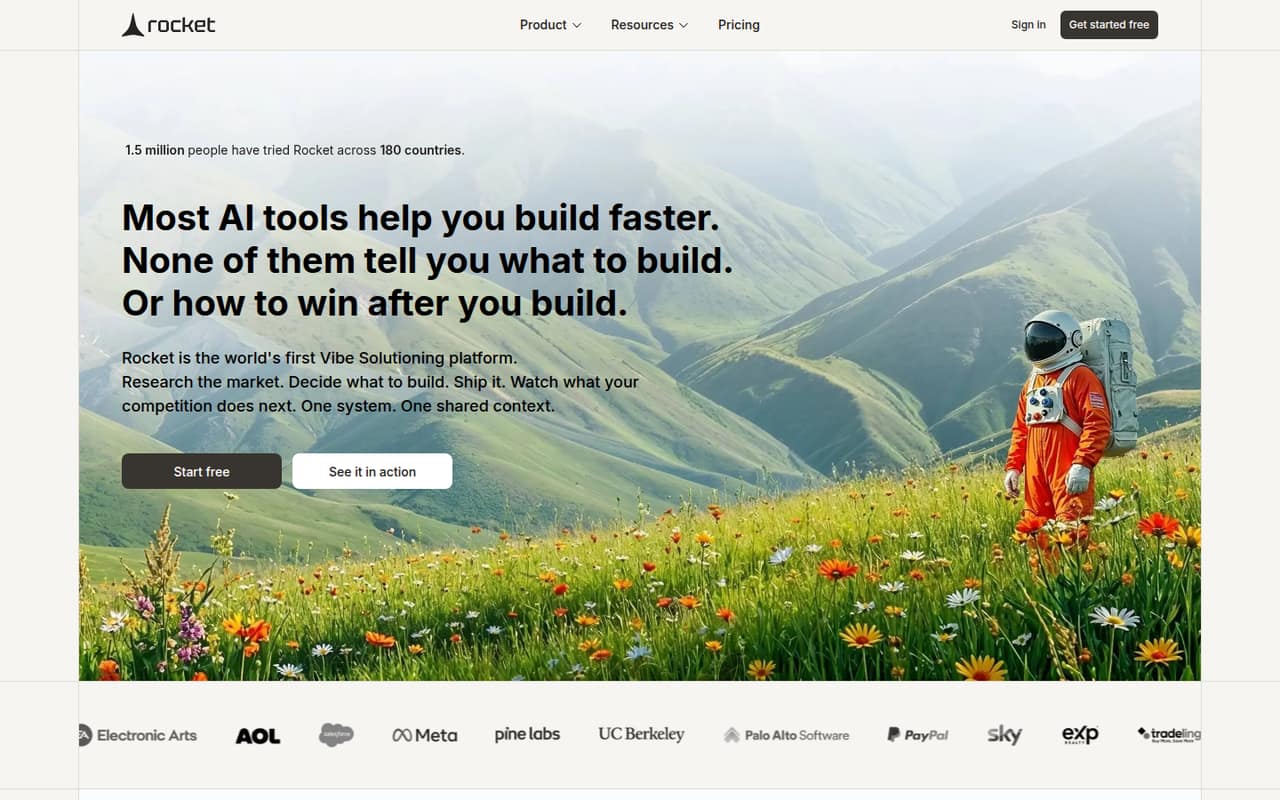
Rocket.new is a platform for researching what to build, generating apps from prompts or project context, and monitoring competitors. Its shared context can reduce handoffs between those tasks, and the Free plan offers a low-cost way to explore it.
We see it as a fast route to a prototype, not a proven substitute for an engineering workflow. The vendor publishes credit allowances but not how much a particular build consumes; Reddit reports range from quick starts to wasted credits and unusable results. Confirm export, reliability and support expectations before putting a production project on it.
Good fit if
- Founders validating product ideas
- Teams building app prototypes
- Competitor research and monitoring
Skip it if
- Teams requiring self-hosting
- Projects needing a documented SDK
- Production systems with fixed usage costs
ScoresHow it rates
What works
- Shared context connects research, building and competitor tracking
- Builds web and mobile apps from prompts or project context
- One-click deployment to staging and production environments
- Free plan includes 20 one-time credits that never expire
- Homepage lists SOC 2, ISO 27001 and GDPR
What doesn't
- No published credit cost per task
- No published license or self-hosting option
- SDK, language and CLI support need confirmation
- Additional credit pricing is not published
- Reddit reports include failed builds and wasted credits
01What Rocket.new is, technically
Rocket.new is a hosted platform that combines market research, AI-assisted app building and competitor monitoring. It is positioned as a connected product workflow, rather than as a standalone library, CLI or self-hosted server. Its Solve capability researches a problem or opportunity and produces a recommendation; Build turns a prompt or that project context into a web app, mobile app, landing page, SaaS product, internal tool or dashboard. Intelligence monitors competitors for changes such as pricing, launches, website updates and hiring signals.
The architectural idea is shared project context: research decisions can carry into app generation and then inform competitor tracking. That makes Rocket a layer for product discovery and prototyping, not simply a code editor or app runtime. The vendor says it provides staging and production environments with one-click deployment. It also advertises 25,000+ templates and connectors to internal systems, APIs and third-party tools. Teams should verify what generated code and deployment controls they retain before treating Rocket as part of a long-lived application stack.
02Rocket.new API, SDKs and docs
Rocket's main build surface is natural-language prompts and project context, with templates as another starting point. The vendor also names connectors to internal systems, APIs and third-party tools. Those are integration points for what you build; they do not establish an API for automating Rocket itself. Before making it a dependency in a codebase, confirm SDK, language, CLI, webhook and automation support in Rocket's documentation.
The homepage describes one-click deployment to staging and production, but does not give deployment protocols, runtime details or a code-level workflow. It says templates can be adapted to a project's brand, stack and goals. It does not name supported programming languages or SDKs, so confirm those with the vendor before planning a handoff to an engineering team. The practical integration model presented is a prompt-driven platform with connectors, not a documented developer toolkit. Ask for details on generated-code access, version control, environment configuration and how connector credentials are managed before building a production workflow around it.
03Rocket.new pricing for developers
Rocket has a Free plan at $0 per month with 20 one-time credits, unlimited team members and credits that never expire. Pro costs $25 monthly or $20 per month with annual billing; it includes 100 monthly credits and offers additional credits for purchase. Rocket costs $50 monthly or $40 per month annually for 250 monthly credits. Booster is $250 monthly or $200 per month annually for 1,500 monthly credits. The paid plans list unlimited team members, and unused monthly credits carry forward while subscribed on Pro, Rocket and Booster.
The pricing page lists annual billing as a 20% saving and says customers can cancel anytime. The vendor does not publish the price of additional credits or how many credits a particular prompt, build or deployment consumes. That makes it hard to forecast the cost of a multi-screen app from plan allowances alone. SSO, data localization, premium support and onboarding assistance are sales-gated, with prices not published. There is no published free trial detail beyond the Free plan.
04Rocket.new: open source, self-hosting and lock-in
Rocket is presented as a hosted platform. The vendor does not publish an open-source license or a self-hosting option, so teams that require either should ask before adopting it. The homepage also does not describe a data-export path or the format in which a project can leave the platform. A Reddit user asked whether a developer could download the full code, but that question does not establish that export is available.
Shared project context can make it easier to move from research to building inside Rocket, but it also creates a dependency on the platform's project model. Before committing, ask whether generated source code can be exported, whether it includes backend and deployment configuration, and whether it can be maintained outside Rocket. Also confirm how project data and connector credentials can be removed. Without published answers on export and portability, migration effort is uncertain.
05Rocket.new in production
The homepage says Rocket provides staging and production environments with one-click deployment. It lists SOC 2, ISO 27001, GDPR and CCPA, along with SSO/SAML, role-based access and audit logs. Those are useful procurement claims, but teams should verify the relevant certifications, data-handling terms and controls with the vendor. Ask for deployment architecture, uptime commitments, backup and recovery details, rate limits and credit consumption at your expected workload; those operational limits are not published on the vendor's site.
Reddit reports are mixed. One thread describes a user who spent three weeks without a usable site, while a commenter in another thread recommends using a generated MVP as a starting point and having a developer refactor it. A separate app-building thread includes complaints about credits being consumed without working functionality. These are individual reports, not reliability measurements, but they underline the need to validate build quality and support before production use. Keep a code review and fallback plan in place.
From the threadsWhat users say
Reddit sentiment is mixed, with some users describing a smooth start or useful MVP workflow and others reporting wasted credits, poor results or long troubleshooting. The comments are anecdotes, not reliability data.
Rocket.new felt pretty smooth at the start, like you can get something working really quickly without overthinking too much
I'd work out your MVP with it. Iterate until you have your perfect MVP. Then pass it to a developer to create a first version that's scalable
3 weeks later and I still dont have a usable sight. cant generate a search engine. all the links point to the same thing. a complete waste of money
I spend 6 million credits for a mockup with zero backend, zero frontend and virtually no functionality
Questions people ask
What can you build with Rocket.new?
The vendor says Rocket can build web apps, mobile apps, landing pages, SaaS products, internal tools and dashboards. You can start from a natural-language prompt or carry context from Rocket's research capability into the build. It also offers templates and connectors to internal systems, APIs and third-party tools.
Does Rocket.new deploy apps?
Rocket says it provides staging and production environments with one-click deployment. The vendor does not publish deployment protocols or infrastructure details in the pricing information. Before depending on it, ask about runtime control, backups, uptime commitments and how to move a deployed app or its data elsewhere.
Can developers export Rocket.new code?
The vendor's homepage and pricing details do not establish a code-export path. A Reddit user asked about downloading full code, but the question is not confirmation that export is supported. Ask Rocket whether source code, backend configuration and deployment settings can be exported and maintained outside the platform.
Does Rocket.new have an API or SDK?
Rocket names connectors to internal systems, APIs and third-party tools, but those describe integrations for projects, not necessarily an API for controlling Rocket. The vendor does not name a language, SDK or CLI in the homepage material. Confirm current developer interfaces and documentation with Rocket before planning an integration.
Is Rocket.new suitable for production apps?
Rocket advertises staging and production deployment and lists security and compliance features, including SOC 2, ISO 27001, GDPR, CCPA and SSO/SAML. Those claims do not settle application reliability or scalability. Verify the controls and service commitments you need, review generated code, and test the app's behavior before relying on it in production.
Sources
- Rocket.new homepage
- Rocket.new pricing page
- Reddit: Rocket.new vs Lovable vs Bolt – Which No-Code Builder Do You Prefer?
- Reddit: Rocket.new vs Emergent - anyone here actually used both?
- Reddit: Is it possible to build a complex web app with Rocket.new?
- Reddit: Tried rocket.new for app building – sharing my experience