
We may earn a commission if you buy through links on this page. It never changes a score or a ranking. How we make money
The bottom line
Railway streamlines deployment, but production teams should plan for usage costs and outage risk.
Railway is a hosted cloud platform that connects code repositories to app deployment, networking, scaling, and monitoring. Its visual canvas, automatic configuration, Docker support, previews, and rollbacks reduce the infrastructure work developers manage directly.
We see a trade-off: the workflow is approachable, but costs depend on resource use and the plan’s included credits. Reddit users report serious outages, so teams with strict availability needs should evaluate recovery and support before moving production workloads.
Good fit if
- Teams deploying apps from connected repositories
- Developers who want visual infrastructure controls
- Projects that benefit from preview environments
Skip it if
- Teams requiring a self-hosted control plane
- Workloads with strict availability guarantees
- Organizations needing a published SDK workflow
ScoresHow it rates
What works
- Deploys from connected repositories with automatic configuration
- Docker support and visual infrastructure canvas
- Private networking, public endpoints, SSL, and load balancing
- CPU, RAM, and replica scaling options
- Logs, metrics, traces, alerts, previews, and rollbacks
What doesn't
- Usage-based billing can make monthly costs variable
- Hobby and Pro fixed monthly prices are not listed
- The homepage names no API, SDK, language, or CLI
- A Railway self-hosted control plane is not documented
- Reddit users report outages that blocked project changes
01What Railway is, technically
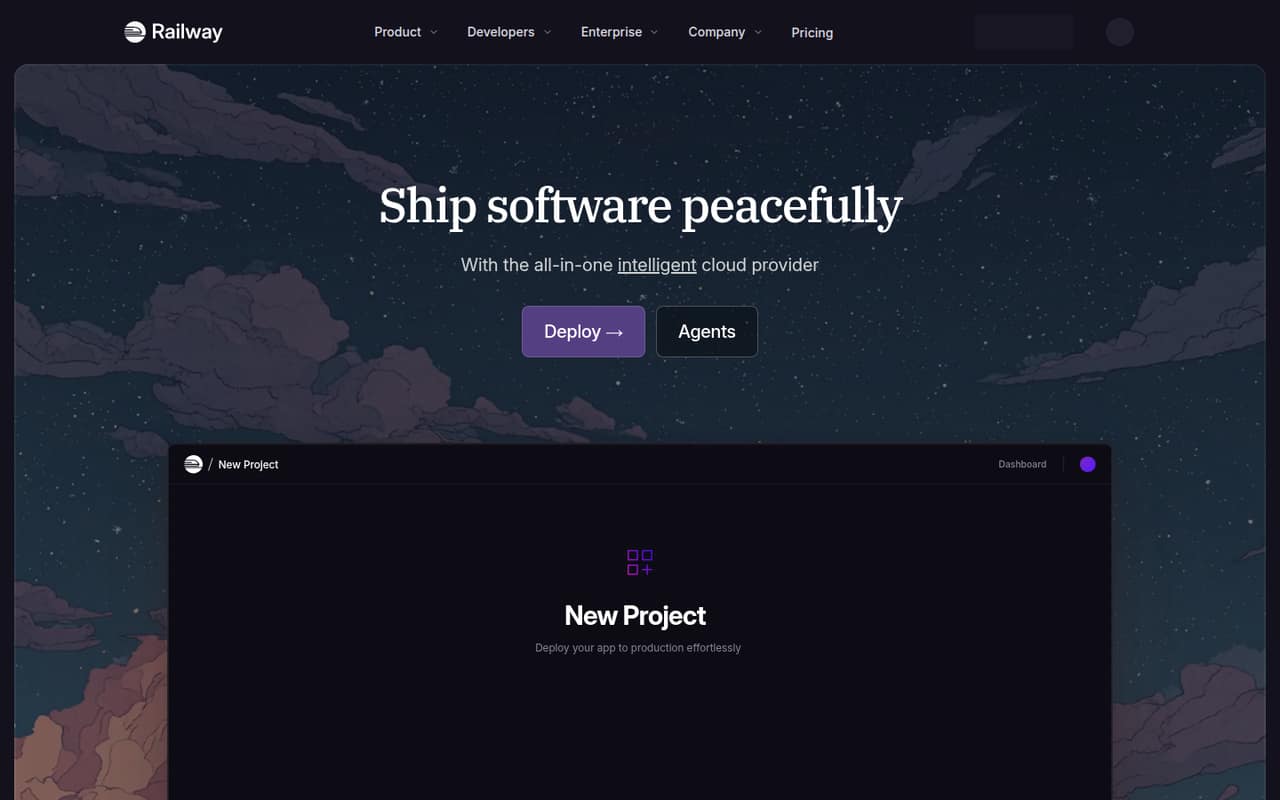
Railway is a hosted cloud platform for building, deploying, connecting, scaling, and monitoring applications. It sits between your code repository and the infrastructure that runs your services: connect a repo, and Railway handles deployment configuration, networking, runtime resources, and operational views in its cloud environment.
The platform combines deployment management with infrastructure controls in a visual canvas. Developers can edit settings in context, with YAML optional. Railway also offers public endpoints, private connections, SSL, load balancing, resource scaling, logs, metrics, traces, alerts, preview environments, and rollbacks. That makes it broader than a build tool or deployment CLI: it is a managed application platform with an interface for operating services after deployment.
The architecture favors convenience over control-plane portability. You manage deployments and resources through Railway rather than installing a Railway server in your own environment. The homepage also promotes deploying self-hosted third-party tools, which is different from self-hosting Railway itself.
02Railway API, SDKs and docs
The documented workflow starts with a connected code repository. Railway says it can read code and set configuration automatically, and it supports Docker-based deployment. Developers can manage infrastructure through a visual canvas and edit settings in context; YAML is optional. The integration surface named on the homepage is therefore repository connection, Docker support, and Railway’s web-based canvas.
The homepage names no public API, SDK, programming language, CLI, webhook, or plugin. For scripted provisioning or deployment automation, check Railway’s current docs for API access, supported SDKs, authentication, and any rate limits before designing around them. Do not assume a particular language client or CLI from the repository workflow alone.
Operational integrations include alerts sent through Slack, Discord, or email. The platform also groups logs, metrics, and traces, with custom dashboards and alerts. Preview environments can be created for pull requests, and Railway advertises one-click rollbacks. Confirm which of these controls are available on the plan you intend to use.
03Railway pricing for developers
Railway lists Free, Hobby, Pro, and Enterprise plans. Free is an evaluation tier, not an ongoing no-cost plan: it includes $5 in trial credits for 30 days, then lists a $1/month charge. During the trial it allows five projects; afterward it allows one project with 1 vCPU and 0.5 GB RAM per service, plus 0.5 GB of volume storage. It includes community support.
Hobby includes $5 in monthly usage credits, up to 48 vCPU and 48 GB RAM per service, 5 GB of volume storage, one developer workspace, and seven-day log history. Pro includes $20 in monthly credits, unlimited workspace seats, up to 1,000 vCPU and 1 TB RAM per service, 1 TB of volume storage, and 30-day log history. The pricing page does not list fixed monthly prices for either plan.
Usage is billed separately at $0.00000386/GB-second for memory, $0.00000772/vCPU-second for CPU, $0.00000006/GB-second for volumes, and $0.05/GB for egress. Object storage is $0.015/GB-month. Enterprise pricing is custom; listed add-ons for compliance, access controls, support, and dedicated VMs carry monthly commitments.
04Railway: open source, self-hosting and lock-in
Railway is presented as a hosted cloud platform, not as a server package customers install in their own environment. Railway’s product pages do not document a self-hosted Railway control plane or publish a Railway server license. Deploying self-hosted third-party software on Railway is a separate use case and does not make Railway itself self-hostable.
The vendor does not publish a data-export procedure on its homepage. Before committing production state, ask how to export service configuration, environment variables, logs, volumes, and database data, and what formats are available. The platform’s repository and Docker workflows may help move application code to another host, but they do not establish that Railway-managed infrastructure settings or stored data are portable.
Expect some migration work if you rely on Railway-specific networking, deployment configuration, or operational features. Keep application builds and data backups portable where possible, and verify the exit path before storing critical state in managed services.
05Railway in production
Railway lists large per-service resource ceilings on paid tiers and supports scaling CPU and RAM or adding replicas with load balancing. It also offers private connections, public endpoints, SSL, monitoring, alerts, and preview environments. Those features cover common application operations, but stated capacity ceilings are not the same as an availability guarantee. Confirm plan-specific limits, recovery behavior, and support commitments for your workload.
Reliability reports on Reddit are mixed but include serious complaints. In one r/webdev thread, a user said two incidents prevented project updates for more than a day and reported that support was also down. A commenter attributed an outage to Google Cloud. These are user reports, not an uptime measurement, but they make failure planning important.
The pricing page lists HIPAA BAAs for $1,000 with a monthly commitment. It also lists log history, RBAC, SSO, and audit logs for $2,000 with a monthly commitment. Confirm what those commitments cover, how backups and incident response work, and whether your compliance requirements are met before putting sensitive workloads on the platform.
From the threadsWhat users say
Reddit sentiment in the Reddit threads we read is sharply negative about Railway reliability, with users reporting outages that blocked changes and support. The comments provide little positive evidence about Railway itself, so teams should treat these reports as warnings to investigate rather than as a reliability measure.
We couldnt update a single project or make any changes in our system
After more than 24h Railway is still in chaos
Major outage even support is down
railways is down because gcp btw :P check their twitter
Questions people ask
Is Railway free?
Railway lists a Free tier with $5 in trial credits for 30 days, followed by a $1/month charge. After the trial, the tier allows one project, 1 vCPU and 0.5 GB RAM per service, and 0.5 GB of volume storage. Compute and other resource usage can add charges.
Can I deploy a Docker container on Railway?
Yes. Railway’s homepage lists Docker support and deployment from connected code repositories. It also says the platform can configure applications automatically. Check the current documentation for supported Docker workflows and any service-specific configuration requirements.
Does Railway support preview environments for pull requests?
Railway advertises preview environments that create a preview for every pull request. The homepage also describes unlimited environments and one-click rollbacks. Confirm plan-specific availability and any usage charges before relying on previews across a large team.
Can I self-host Railway?
Railway is presented as a hosted cloud platform, and its product pages do not document a self-hosted Railway control plane. Railway does promote hosting self-managed third-party tools on its platform; that is not the same as running Railway’s own infrastructure yourself.
What happens if Railway has an outage?
Railway’s homepage lists monitoring, alerts, and rollbacks, but those features do not guarantee service availability. Reddit users report outages that prevented project changes and affected support. Ask Railway about uptime commitments, incident communication, recovery options, and support response for your plan.