
We may earn a commission if you buy through links on this page. It never changes a score or a ranking. How we make money
The bottom line
A broad, self-hosted virtualization platform; paid subscriptions buy repository access and support, not more capacity.
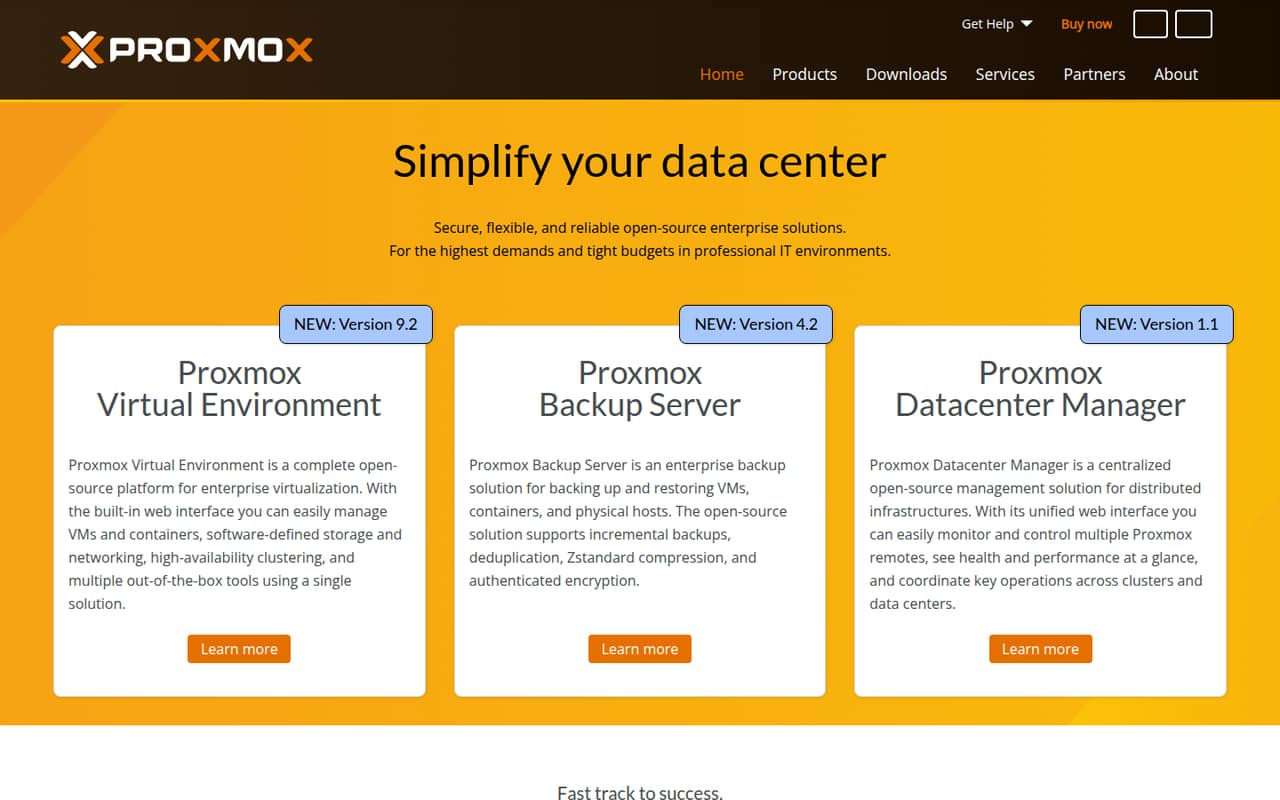
Proxmox VE is software for managing virtual machines, containers, storage, networking and high-availability clustering through a built-in web interface. It runs in your own environment rather than as a hosted cloud service, and its Free plan has no limits on sockets, cores, RAM, VMs or nodes.
The trade-off is that you operate the platform and should confirm the API, SDK and automation details against your needs before building around it. Paid subscriptions are priced per occupied CPU socket and add repository access and support options.
Good fit if
- Teams running their own virtualization infrastructure
- Operators consolidating VMs and containers
- Cost-conscious labs and data centers
Skip it if
- Teams seeking managed cloud virtualization
- Developers needing documented SDK coverage
- Operators unwilling to maintain hosts
ScoresHow it rates
What works
- Manages VMs and containers in one interface
- Includes software-defined storage and networking
- High-availability clustering is included
- Free plan has no VM or node limit
- Paid plans are priced per occupied socket
What doesn't
- You operate the platform on your own infrastructure
- API protocol and SDK details need verification
- Free plan uses the no-subscription repository
- Support tickets are limited on lower paid tiers
- Subscriptions are billed annually, excluding VAT
01What Proxmox VE is, technically
Proxmox VE is a self-hosted virtualization platform, not a hosted API, SaaS control plane or client library. It sits on your infrastructure and provides a built-in web interface for managing virtual machines and containers, software-defined storage and networking, high-availability clustering and other tools. That makes it a control layer for a data center or lab: administrators use it to manage workloads and related infrastructure from one solution.
The platform addresses the operational split of managing virtualization and associated services through separate tools. Its scope covers both VMs and containers, but the product description does not define workload limits or hardware requirements; check the documentation against your planned deployment. The vendor also offers separate Proxmox Backup Server and Proxmox Datacenter Manager products, but those are distinct products, not features to assume are included in VE. The key architectural choice is that your team runs and maintains the environment rather than delegating the virtualization layer to a hosted provider.
02Proxmox VE API, SDKs and docs
The main interface identified by the vendor is the built-in web interface. Proxmox also has an API: a Reddit user reports using it with Terraform and Ansible to set up an environment. The homepage does not name the API protocol, supported SDKs or programming languages, nor does it describe a CLI, webhook or plugin integration surface. Before building automation, confirm the API and SDK details in the vendor’s documentation, including authentication, versioning and supported operations.
Proxmox says its documentation is comprehensive and provides a documentation link from its homepage. That is the starting point for deployment and operations, but teams should verify that it covers their intended automation and upgrade workflows. Reddit reports point to Terraform and Ansible use, but those accounts do not establish official SDK support or a support commitment. Treat automation compatibility as a discovery task before adopting VE as a control plane for production infrastructure.
03Proxmox VE pricing for developers
Proxmox VE has a Free plan at €0. It includes the no-subscription repository and community forum support, with no limit on sockets, cores, RAM, VMs or nodes. The paid subscriptions do not raise those capacity limits; they add repository access and varying levels of technical support.
The pricing page lists Community at €120 per year per occupied CPU socket, Basic at €370, Standard at €550 and Premium at €1,100, all excluding VAT. One subscription is required per occupied socket. Community includes Enterprise Repository access but no technical support tickets; Basic includes three tickets per year, Standard includes ten, and Premium includes unlimited tickets. Higher tiers add remote SSH support and faster critical-issue response, with Premium offering 24/7 support. The pricing is published annually; monthly billing prices are not published. There are no listed usage-based charges, add-ons or per-VM fees, so the bill scales with occupied sockets and the support tier you select.
04Proxmox VE: open source, self-hosting and lock-in
Proxmox describes VE as an open-source platform, and its architecture is self-hosted: you run it on your own infrastructure. The vendor homepage does not name the software license, so check the license terms for the version you plan to deploy before redistributing or modifying it. A paid subscription is for repository access and support, not a prerequisite for using the Free plan.
Data export and migration procedures are not described in the homepage material. Before committing, verify how to back up and move your VM, container, storage and network configuration, and test recovery on a separate system. The platform’s open-source positioning and self-hosted deployment can give operators control over where workloads run, but they do not by themselves establish that migration away is straightforward. Document dependencies and recovery steps to limit operational lock-in.
05Proxmox VE in production
Proxmox VE covers core virtualization and data-center management functions, but the vendor homepage does not publish capacity or performance limits. Confirm hardware requirements, cluster sizing, failure behavior, security controls and compliance fit in the documentation before deploying it for critical workloads. The Free plan includes community forum support; paid tiers offer defined ticket counts or unlimited tickets, response targets for critical issues and, at higher tiers, remote SSH support.
Reddit users discussing updates recommend keeping hosts patched, while noting that production changes need backups, verified recovery and maintenance windows. Those are user opinions, not a vendor update policy. In another thread, users report using the API with Terraform and Ansible. A commenter cautions that containers share the host kernel and can carry different isolation and failure considerations from VMs. Evaluate those trade-offs for your workload and security model, and test updates and recovery before relying on the platform.
From the threadsWhat users say
The Reddit comments are generally positive about Proxmox VE as a flexible platform, especially for homelabs and automation. Users also emphasize patching discipline and caution that container isolation and operational choices matter.
Agreed. Also Proxmox API is very useful. Been using terraform / Ansible to setup my env, it's very convenient
I update weekly. The problem with holding off is that you might encounter an issue if you update after waiting six months or whatever vs waiting one week
Production environments should be treated different than your homelab. Backups backups, update weekly on non-production. Backups verify backups, update weekly with change windows and out of business hours to have time to recover if needed
If you want security though you wouldn’t trust LXCs and when you upscale LXCs become restricting pretty fast
Questions people ask
Is Proxmox VE free to use?
Yes. The Free plan costs €0 and includes the no-subscription repository and community forum support. The pricing page lists no limits on sockets, cores, RAM, VMs or nodes. Paid subscriptions add Enterprise Repository access and different levels of technical support; they do not add capacity limits.
What does a Proxmox VE subscription cover?
Subscriptions are priced per occupied CPU socket and provide Enterprise Repository access and support, depending on the tier. Community has no technical support tickets; Basic includes three tickets per year, Standard ten and Premium unlimited tickets. Higher tiers also include remote SSH support and faster critical-issue response.
Does Proxmox VE manage both VMs and containers?
Yes. The vendor describes Proxmox VE as a platform for managing virtual machines and containers through its built-in web interface. It also includes software-defined storage and networking and high-availability clustering. Check the documentation to determine whether its specific workload and infrastructure requirements fit your deployment.
Can I automate Proxmox VE?
A Reddit user reports using the Proxmox API with Terraform and Ansible. Confirm the API protocol, available SDKs, supported languages and current integration guidance in the vendor documentation before choosing an automation approach. The homepage does not name a particular SDK or programming language.
Is Proxmox VE suitable for production?
It is positioned as an enterprise virtualization platform, and paid subscriptions offer defined technical support options. Production fit depends on your requirements and operating practices. Validate capacity, security, recovery and compliance needs, and test updates with backups and a maintenance plan before relying on it for critical workloads.
Sources
- Proxmox VE homepage
- Proxmox VE pricing, compiled via web search from petronellatech.com, wz-it.com, proxmox.com, proxmoxmigracje.pl
- Reddit: How often should I be updating Proxmox VE?
- Reddit: Do you trust Proxmox VE Helper-Scripts?
- Reddit: What I actually learned switching to Proxmox VE as my main hypervisor
- Reddit: Mini PCs with Proxmox VE or HA installed … worth it?