
We may earn a commission if you buy through links on this page. It never changes a score or a ranking. How we make money
The bottom line
PowerBuilder pairs DataWindow-based Windows development with separately licensed PowerServer deployment.
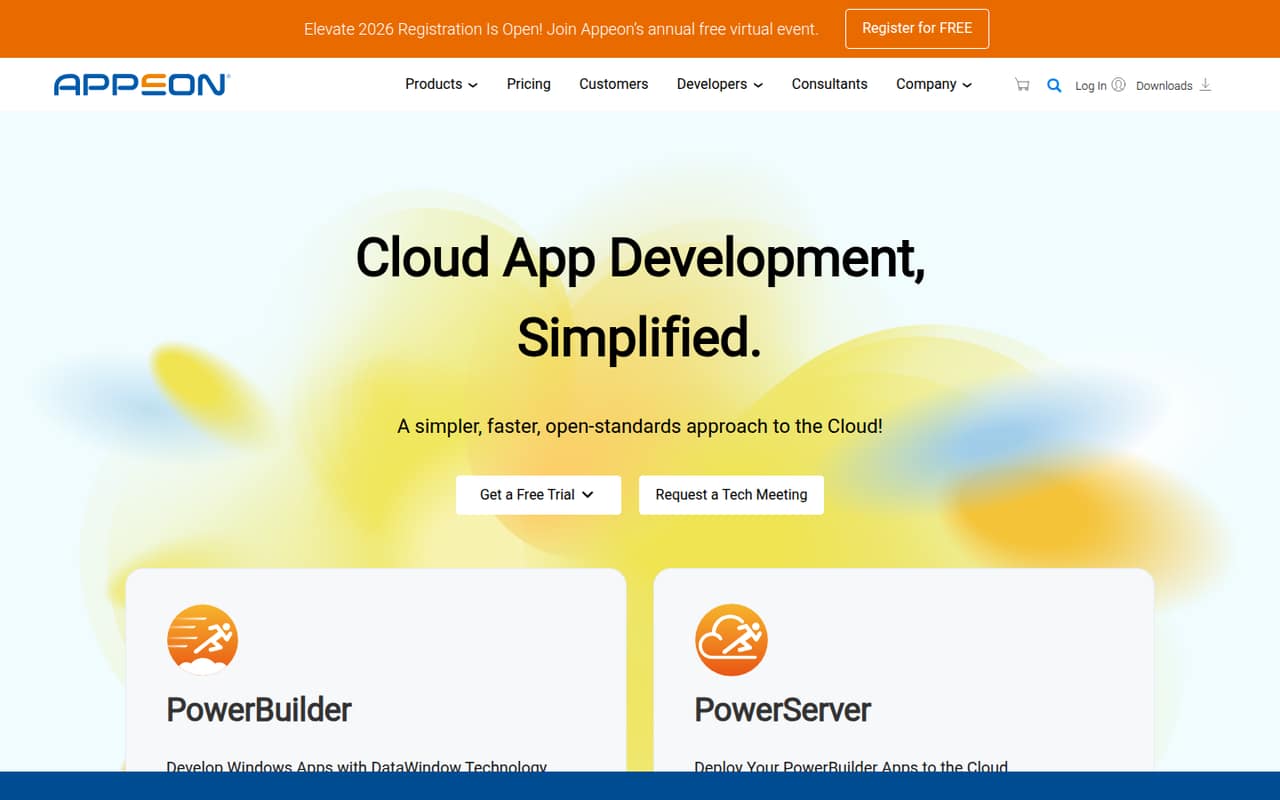
PowerBuilder is Appeon's development environment for Windows applications built with DataWindow technology. Its related PowerServer product can deploy PowerBuilder apps to the cloud, and pricing includes Web API development as well as client/server work. The homepage offers a 30-day trial of Appeon products without limitation.
Professional starts at $74.58 per developer per month, billed annually. CloudPro adds PowerServer development tools and a five-user development-server session limit; production PowerServer licenses are separate, starting at $291.67 per month when billed annually for 150 sessions. Budget for both development seats and production capacity.
Good fit if
- Teams maintaining Windows business applications
- DataWindow-based application developers
- Teams planning PowerServer cloud deployment
Skip it if
- Teams seeking an API-first development platform
- Projects requiring a free ongoing plan
- Teams needing published SDK details
ScoresHow it rates
What works
- DataWindow technology for Windows application development
- Web API development included in Professional
- PowerServer automates PowerBuilder cloud deployment
- 30-day trial without limitation
- Production tiers list session capacities and prices
What doesn't
- No free plan is listed
- PowerServer production licensing costs extra
- CloudPro's development server is limited to five user sessions
- Unlimited production sessions are subject to fair usage
- SDKs and supported languages need confirmation
01What PowerBuilder is, technically
PowerBuilder is Appeon's development environment for building Windows applications with DataWindow technology. In a stack, it sits on the application-development side: developers build client/server applications and Web APIs, then can use the related PowerServer product to deploy PowerBuilder apps to the cloud. It is not presented as a hosted API or a general-purpose cloud service.
PowerServer is the deployment component, while PowerBuilder is where the application is developed. The CloudPro bundle includes a PowerServer development server with a five-user session limit and a PowerServer Toolkit. Production deployment requires a separate PowerServer production license, with tiers based on user sessions. This split matters architecturally and financially: buying developer tooling does not by itself cover production capacity. The product is aimed at teams creating or maintaining Windows business software and extending those applications to cloud deployment, rather than teams looking for a framework-agnostic web stack.
02PowerBuilder API, SDKs and docs
The homepage frames PowerBuilder around Windows app development with DataWindow technology and PowerServer cloud deployment. The Professional bundle includes client/server and Web API development; CloudPro adds installable cloud app development, a PowerServer development server, and the PowerServer Toolkit. The vendor describes automatic cloud deployment, but does not name an API protocol or provide SDK names in the homepage text. The integration surface named in the bundles is Web API development; confirm supported languages, SDKs, and API details in Appeon's documentation before choosing it for a new service.
The homepage offers a 30-day trial of Appeon products and self-paced learning through Appeon-U. It also links to product-roadmap information and consulting partners for upgrades, cloud deployment, UI modernization, database migration, training, and staff augmentation. Bundles list a new code editor, automated builds, and codeless UI modernization features including themes and DPI-aware support. The homepage does not describe a CLI or plugin workflow, so teams relying on those tools should verify their options in the vendor's documentation.
03PowerBuilder pricing for developers
There is no free plan listed; Appeon offers a 30-day trial of its products without limitation. PowerBuilder Professional costs $74.58 per developer per month, billed annually, or about $895 per year. It includes client/server and Web API development, PBL and plain-text source compilation, 64-bit executables, standard support, and updates. CloudPro costs $132.92 per developer per month, billed annually, and adds installable cloud app development, the PowerServer Toolkit, and a development server limited to five user sessions.
Production PowerServer licenses are sold separately. Annual-billed monthly rates start at $291.67 for 150 sessions, then rise to $458.33 for 300, $708.33 for 600, and $875 for 1,200 sessions. The unlimited tier is $2,083.33 per month, billed annually, subject to fair usage. Perpetual production licenses are available by quote. The pricing page lists a 10% volume discount for purchases of 10 or more subscriptions of the same product. Account for development seats and production sessions as separate costs.
04PowerBuilder: open source, self-hosting and lock-in
Appeon sells PowerBuilder and PowerServer subscriptions, but the vendor doesn't publish a source licence or describe an open-source release on the vendor's site. The products are not presented as a hosted-only service: PowerBuilder is a development environment, and PowerServer production licensing is sold by session tier or as a perpetual license. However, the pricing details do not establish where a production deployment must be hosted, so confirm supported hosting arrangements with Appeon before committing.
The pricing page includes PBL and plain-text source compilation, but does not describe an application-data export process. Migration effort will depend on how much of the application relies on PowerBuilder and DataWindow technology, plus its database and deployment setup. Before adoption, ask how source, application data, and deployment configuration can be extracted and what would need rewriting in a different stack.
05PowerBuilder in production
The clearest published production constraint is PowerServer session capacity: subscription tiers cover 150, 300, 600, or 1,200 sessions, while the unlimited tier is subject to fair usage. CloudPro's included PowerServer development server has a five-user session limit; it is not the production license. Teams should model expected concurrent use against the right production tier and confirm how Appeon counts sessions and handles growth beyond a purchased tier.
Before relying on PowerServer for a production workload, confirm deployment topology, backup and recovery responsibilities, security controls, and applicable compliance requirements with Appeon. The vendor does not publish an SLA in the homepage and pricing details provided, so request availability commitments and support-response terms. PowerBuilder bundles include standard support and updates, but the listed pricing does not define response times. Production cost can rise with capacity, and the unlimited option remains subject to fair usage.
Questions people ask
What does PowerBuilder do?
PowerBuilder is Appeon's development environment for building Windows applications with DataWindow technology. Its bundles include client/server and Web API development. PowerServer is a related product that can deploy PowerBuilder applications to the cloud, with production licenses priced separately by session capacity.
How does PowerServer work with PowerBuilder?
PowerServer is Appeon's cloud-deployment product for PowerBuilder apps. CloudPro includes a PowerServer development server with a five-user session limit and the PowerServer Toolkit. Production deployment requires a separate PowerServer production license, with subscription tiers for specific session capacities and a perpetual option available by quote.
How much does PowerBuilder cost?
PowerBuilder Professional costs $74.58 per developer per month, billed annually. CloudPro costs $132.92 per developer per month, billed annually. PowerServer production licensing is separate: the 150-session tier is $291.67 per month billed annually, with higher tiers available. A 30-day trial is offered, but no free plan is listed.
Does PowerBuilder have a free trial?
Yes. Appeon offers a 30-day trial of its products without limitation, according to the homepage. The pricing information does not list an ongoing free plan, so teams should plan to move to a paid PowerBuilder bundle and, for production cloud deployment, a separate PowerServer production license.
What languages and SDKs does PowerBuilder support?
The homepage and pricing details identify client/server and Web API development, but do not name supported programming languages, SDKs, or API protocols. Appeon's materials also point developers to self-paced learning on Appeon-U. Confirm language, SDK, and integration requirements in the vendor's documentation before selecting PowerBuilder for a project.