
We may earn a commission if you buy through links on this page. It never changes a score or a ranking. How we make money
The bottom line
A managed deployment platform for teams that want apps running in their own cloud accounts.
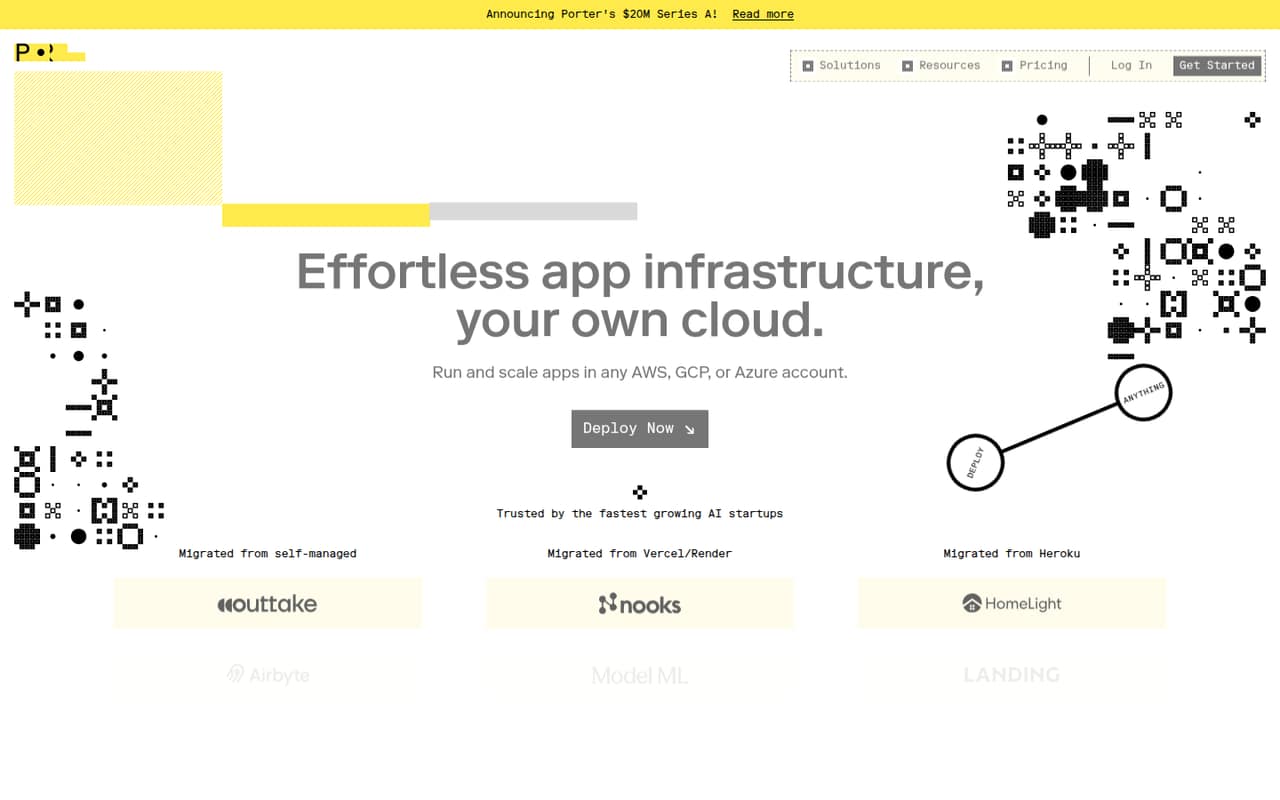
Porter is a managed app platform that provisions and operates infrastructure inside your AWS, GCP or Azure account. Deploy from Git or Docker, then use Porter for CI/CD, preview environments, autoscaling and infrastructure management.
Standard starts at $6 per GB of RAM per month and $13 per vCPU per month. Your cloud provider’s charges are separate, so budget for both Porter and the underlying infrastructure.
Good fit if
- Teams standardizing app deployments
- Startups moving from shared PaaS hosting
- Companies requiring their own cloud account
Skip it if
- Teams seeking a free ongoing plan
- Projects needing published SDK details
- Teams wanting Porter to cover cloud costs
ScoresHow it rates
What works
- Runs workloads in your AWS, GCP or Azure account
- Deploys from Git or Docker
- Automates builds and deploys on every push
- Creates preview environments for pull requests
- Standard includes autoscaling and unlimited applications
What doesn't
- Cloud-provider charges are billed separately
- No ongoing free plan is listed
- Enterprise pricing is custom
- SDK and API details need confirmation with Porter
- Open-source licensing and data export details are unpublished
01What Porter is, technically
Porter is a managed app deployment and operations platform that provisions infrastructure in a customer’s AWS, GCP or Azure account. It sits between your application source and your cloud environment: connect a repository or deploy a Docker image, and Porter handles cluster setup, builds, deployment and ongoing infrastructure tasks.
That makes it closer to a managed PaaS control plane than a library, CLI or cloud provider. The workloads run in your account, while Porter provides the deployment and management layer. Its homepage lists Git and Docker deployments, automated CI/CD, preview environments, autoscaling, monitoring, infrastructure upgrades and CVE patches. It also lists support for frontends, backends, workers, cron jobs, Go services and Postgres databases.
The main architectural trade-off is responsibility split. Porter manages app infrastructure, but AWS, GCP or Azure still supplies the underlying resources and bills you for them. Porter also says it can deploy into a customer’s VPC and support migration across the three clouds.
02Porter API, SDKs and docs
The integration path described by Porter is to connect a Git repository or deploy from Docker. The homepage says every push builds and deploys automatically, and that each pull request can get a preview environment. It names frameworks and workloads including Next.js, FastAPI, Temporal workers, cron jobs, Go services and Postgres, and says it supports any framework through Git or Docker.
Porter’s homepage links to its docs, but does not name a programming-language SDK, a public API protocol, a CLI or webhook integration. If your workflow depends on programmatic account management, custom deployment automation or a specific SDK, confirm those interfaces and their support status in Porter’s docs before adopting it. The stated integration surface is Git and Docker, not a language-specific library.
For teams using common source-control and container workflows, the described path is direct: connect a cloud account, point Porter at a repo, then deploy. Confirm how your existing CI, secrets, networking and release approvals fit before moving production services.
03Porter pricing for developers
Porter’s Standard plan is metered monthly at $6 per GB of RAM per month, listed as $0.009 per hour, and $13 per vCPU per month, listed as $0.019 per hour. It includes unlimited applications, preview environments and autoscaling. The pricing information lists no ongoing free plan or annual billing. Porter’s homepage advertises six months free for startups; check eligibility and offer terms with Porter before counting it in a budget.
The bill grows with the RAM and vCPU allocated to workloads. The price is not an all-in hosting rate: AWS, Azure or GCP charges are additional. Porter lists volume discounts for Enterprise contracts above 40 vCPU or 80 GB of RAM, but does not publish those rates. Enterprise also includes premium support, advanced RBAC, SAML-based SSO and an on-prem installation, with custom pricing. Estimate Porter’s usage charges alongside cloud costs, then confirm how resource measurement and any startup offer apply to your deployment.
04Porter: open source, self-hosting and lock-in
Porter’s product is a management layer for apps deployed in your cloud account; that is not the same as self-hosting Porter’s control plane. The vendor does not publish an open-source license or source-availability terms on its homepage. Enterprise lists an on-prem installation, but the pricing information does not state its terms or technical requirements. Ask Porter what is included and how it is licensed.
Porter also does not publish data-export details on the vendor's site. Before committing, ask how to export deployment configuration, environment settings, logs and operational history. Your app source can remain in Git, and Porter says it supports Docker deployments and migration across AWS, GCP and Azure. That offers portability for application code, but does not establish that Porter-specific configuration or infrastructure changes transfer unchanged. Review those dependencies in a migration plan.
05Porter in production
Porter lists automated builds, zero-downtime deployments, preview environments, autoscaling, monitoring and logging. It also says it handles version upgrades and CVE patches, and that Karpenter bin-packs workloads. These features address common operating tasks, but the homepage does not publish service-level objectives, availability history, rate limits or resource ceilings. Ask for those details, along with backup and recovery procedures, before depending on Porter for critical services.
The vendor says it offers built-in SOC 2 and HIPAA compliance in your cloud account and one-click options for both. Confirm the scope, shared responsibilities and evidence available for your compliance review; a platform feature does not by itself establish that your application meets a standard. GPUs are listed for training and inference, but specific instance availability and pricing are not published in the pricing information. Finally, budget for both Porter’s RAM and vCPU charges and the cloud provider’s separate bill.
Porter in the news
Questions people ask
What is Porter?
Porter is a managed app deployment and operations platform. It provisions infrastructure in your AWS, GCP or Azure account and supports deployments from Git or Docker. Porter lists automated CI/CD, preview environments, autoscaling, monitoring and infrastructure management among its features.
Does Porter run apps in my cloud account?
Yes. Porter says it deploys to your AWS, GCP or Azure account, and also describes deployment into a customer’s VPC. Your cloud provider supplies the underlying resources and bills for them separately from Porter’s platform charges.
Can I deploy with Porter from Docker?
Yes. Porter lists Docker as a deployment option alongside Git and says it works with any framework. The homepage also names Next.js, FastAPI, Temporal workers, cron jobs, Go services and Postgres as supported workloads.
Does Porter have a free plan?
The pricing information lists no ongoing free plan or free trial. Porter’s homepage advertises six months free for startups, but the offer’s eligibility and limits are not stated there. Confirm the terms with Porter before relying on the offer.
What does Porter cost for production?
Standard is listed at $6 per GB of RAM per month and $13 per vCPU per month, with hourly rates also shown. AWS, Azure or GCP charges are extra. Enterprise pricing is custom, with volume discounts listed above 40 vCPU or 80 GB of RAM.