
We may earn a commission if you buy through links on this page. It never changes a score or a ranking. How we make money
The bottom line
Managed open-source app hosting with hourly billing and easy data export, but limited platform-level control.
PikaPods runs open-source apps in managed, isolated environments and handles setup, updates, backups and monitoring. You pay hourly from prepaid credit, rather than managing a server or committing to a subscription.
It suits people who want a supported app instance without operating the underlying host. It is not a general-purpose cloud platform: the homepage describes a management interface, app pods and SFTP access, not a documented API, SDK or CLI.
Good fit if
- Small teams hosting supported open-source apps
- Users who want managed updates and backups
- Projects that need hourly, cancellable billing
Skip it if
- Teams needing root or server-level access
- Apps requiring custom infrastructure components
- Developers seeking a documented hosting API
ScoresHow it rates
What works
- Hourly billing from prepaid credit, with no subscription
- Managed setup, operating system and app updates
- Isolated environments with enforced resource limits
- SFTP access for downloading or migrating data
- EU and US hosting locations are available
What doesn't
- Not a general-purpose VPS or server-level environment
- API, SDK and CLI support are not documented on the homepage
- Costs rise with allocated CPU, memory and storage
- Stopped pods can still incur storage charges
- App-specific resource needs can change after updates
01What PikaPods is, technically
PikaPods is a managed hosting service for open-source applications, not a library, SDK or general-purpose cloud API. You choose an available app and run it as a pod: a group of containers for that app, which can include databases or supporting services. PikaPods handles setup and operating system and app updates, and says it provides backups and monitoring.
The service sits between a one-click app host and running your own server. Each app gets an isolated environment with enforced CPU, memory and disk I/O limits. You can adjust resources and configure a custom domain through PikaPods’ interface. The homepage lists EU and US locations.
This model reduces routine server administration, but it also limits what you control. You are not being offered an entire virtual server to configure. PikaPods is better understood as managed hosting for supported apps than as infrastructure for building arbitrary services or deploying custom server stacks.
02PikaPods API, SDKs and docs
PikaPods’ described integration surface is its web interface for selecting and managing apps, adjusting resources and setting a custom domain. For data operations, you can enable SFTP to download, migrate, edit or delete files. The homepage does not describe a REST API, webhooks, CLI, plugins or language-specific SDKs, so do not assume you can provision or administer pods from application code.
The app you host may expose its own APIs and integrations; those belong to that application, not to PikaPods’ hosting layer. The homepage highlights n8n’s integrations, for example, but does not present them as PikaPods integrations.
For infrastructure automation or a custom deployment workflow, confirm API and SDK support directly in PikaPods’ docs before committing. The listed user flow is a managed app catalog and control interface, not a developer platform with a stated protocol or SDK matrix. SFTP is the clearest documented route for moving data out.
03PikaPods pricing for developers
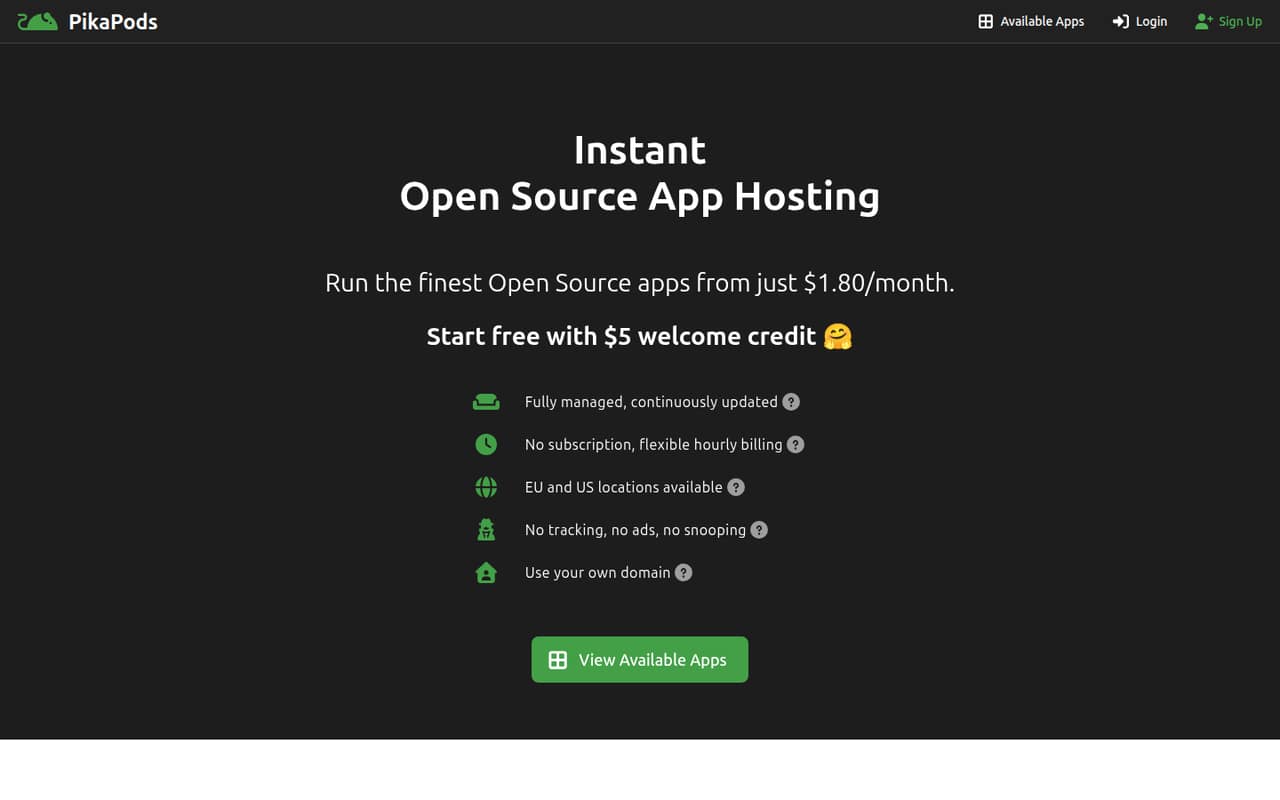
PikaPods has no free plan, but the homepage advertises a $5 welcome credit. The Prepaid resource-based plan lists running pods from $1.80 per month. The bill is drawn hourly from prepaid credit, rounded up to full hours; there is no subscription or annual billing. The pricing page lists a minimum of $1 per pod per month regardless of state, while stopped-pod storage starts at $1 per month.
Your cost depends on pod resources and runtime, not API requests or seats. PikaPods lists configurations up to 6 CPU cores, 16 GB of memory and 1,000 GB of storage per pod. After the initial credit top-up, the pricing details list up to 10 pods and 2 TB of storage. Increasing resources or running more pods increases the bill; optional automatic credit top-ups can keep pods running, but their price is not published.
Prices are in USD and exclude VAT; European consumers have VAT added at checkout. Confirm the current resource configuration and minimum charge before budgeting for a production workload.
04PikaPods: open source, self-hosting and lock-in
PikaPods hosts open-source apps, but that does not establish that PikaPods’ own hosting software is open source. The vendor does not publish the service’s license or self-hosting instructions on its homepage. App licenses vary, so check the license for the specific software you deploy.
This is managed hosting, not self-hosting on infrastructure you control. A Reddit thread’s founder described it as “managed self-hosting,” while another commenter pointed out that customers do not have access to the underlying server. That distinction matters if you need to install arbitrary system packages or change the host configuration.
PikaPods says you can enable SFTP to download, migrate, edit or delete your data, which gives you a documented export route. App-level exports and compatibility still depend on the application. Before relying on a migration path, confirm which files and database data SFTP exposes and what steps the app requires to restore on another host.
05PikaPods in production
PikaPods says it uses isolated environments, enforced CPU, memory and disk I/O limits, encrypted connections and a built-in firewall. It also lists backups and monitoring among its managed services. EU and US locations are available. The homepage does not publish an uptime SLA, API rate limits or compliance certifications; ask the vendor about availability commitments, backup retention and recovery procedures before making it a production dependency.
Resource sizing is an operational concern. In an r/actualbudgeting thread, users reported pods restarting after an app update increased memory use. PikaPods’ founder said the team temporarily raised the minimum memory for affected pods, and an app maintainer later traced the issue to a Node update and infrastructure setup. That exchange shows how app changes can affect resource needs and billing, even when the host handles updates.
App-specific constraints matter too. In an r/Ghost discussion, users described limits around customizing the base installation and adding infrastructure required by newer features. Test your app’s needed extensions, data restore path and resource use before depending on the managed setup.
From the threadsWhat users say
Reddit sentiment is mostly favorable toward the reduced maintenance and low entry cost, with users also noting that managed containers provide less control than a VPS. A discussion of an Actual Budget update illustrates that app changes can trigger resource and memory issues.
Pika is far cheaper, and much less work
Not really, you don't have access to the underlying server instance and you're locked into this "ecosystem
We noticed that Actual now needs more memory during startup, which triggered out-of-memory emails and automatic increases for some users
With this we were able to fix it on our side
Questions people ask
Does PikaPods have a free plan?
No free plan is listed. The homepage advertises a $5 welcome credit, which you can use to run pods before adding more prepaid credit. Pods are billed hourly from your balance, rounded up to full hours. Check the current account and billing terms to confirm how the welcome credit applies to the apps and resources you select.
Can I use my own domain with a PikaPod?
Yes. PikaPods says you can configure your own domain for an app through its management interface. The homepage does not describe DNS requirements or certificate setup steps, so check the app’s setup instructions and PikaPods’ current documentation before planning a migration or production launch.
Can I download my data and leave PikaPods?
PikaPods says you can enable SFTP access to download, migrate, edit or delete your data. The exact export and restore steps depend on the hosted app and its data layout. Confirm that you can retrieve both application files and the data you need, then check how the app imports them on another host.
Can I install custom software or change the server?
PikaPods provides managed app pods rather than access to an entire virtual server. The homepage describes resource controls and app management, not root access or arbitrary host configuration. If an app needs extra system packages, custom infrastructure or changes to its base installation, ask PikaPods whether that setup is supported.
What happens if an app needs more memory?
You can adjust a pod’s CPU and memory limits in its settings. Users on Reddit reported an Actual Budget update that triggered memory-related restarts; PikaPods’ founder said the team raised the minimum memory for affected pods while investigating. More allocated resources can increase your hourly bill, so monitor app updates and pod usage.
Sources
- PikaPods homepage
- PikaPods pricing, compiled via web search from tecmint.com, pikapods.com, medium.com, danian.co, bytesized-hosting.com
- Reddit: PikaPods - Instant Open Source App Hosting
- Reddit: Pikapods vs Digital Ocean - owning the platform
- Reddit: PikaPods restarted because it ran out of memory
- Reddit: Actual Budget poor Pikapods performance