
We may earn a commission if you buy through links on this page. It never changes a score or a ranking. How we make money
The bottom line
A capable bare-metal API platform, but verify operational safeguards and location-specific limits.
phoenixNAP Bare Metal Cloud provisions single-tenant dedicated servers through a web interface, REST API, CLI and infrastructure-as-code tools. Its 50+ configurations cover Intel, AMD and Arm systems, with hourly or reserved billing and 15 TB of bandwidth in most locations.
The $0.08/hour listed entry price is attractive for short-lived workloads, but instance rates vary widely and reserved pricing is not listed. Reddit reports include a serious Phoenix facility cooling incident that also affected support access, so check the relevant site’s resilience and support arrangements before production use.
Good fit if
- Dedicated compute managed with Terraform
- Short-lived bare-metal workloads
- Teams needing single-tenant servers
Skip it if
- Buyers requiring a free tier
- Teams needing published API rate limits
- Workloads requiring self-hosted infrastructure
ScoresHow it rates
What works
- 50+ preconfigured dedicated server configurations
- REST API, CLI and IaC management
- Hourly billing on most listed instances
- 15 TB bandwidth in most locations
- Shared network file storage by location
What doesn't
- No free plan or free trial listed
- Singapore bandwidth allowance is 5 TB
- Reserved rates are not listed
- API rate limits are not listed
- Reddit users report a serious facility incident
01What phoenixNAP is, technically
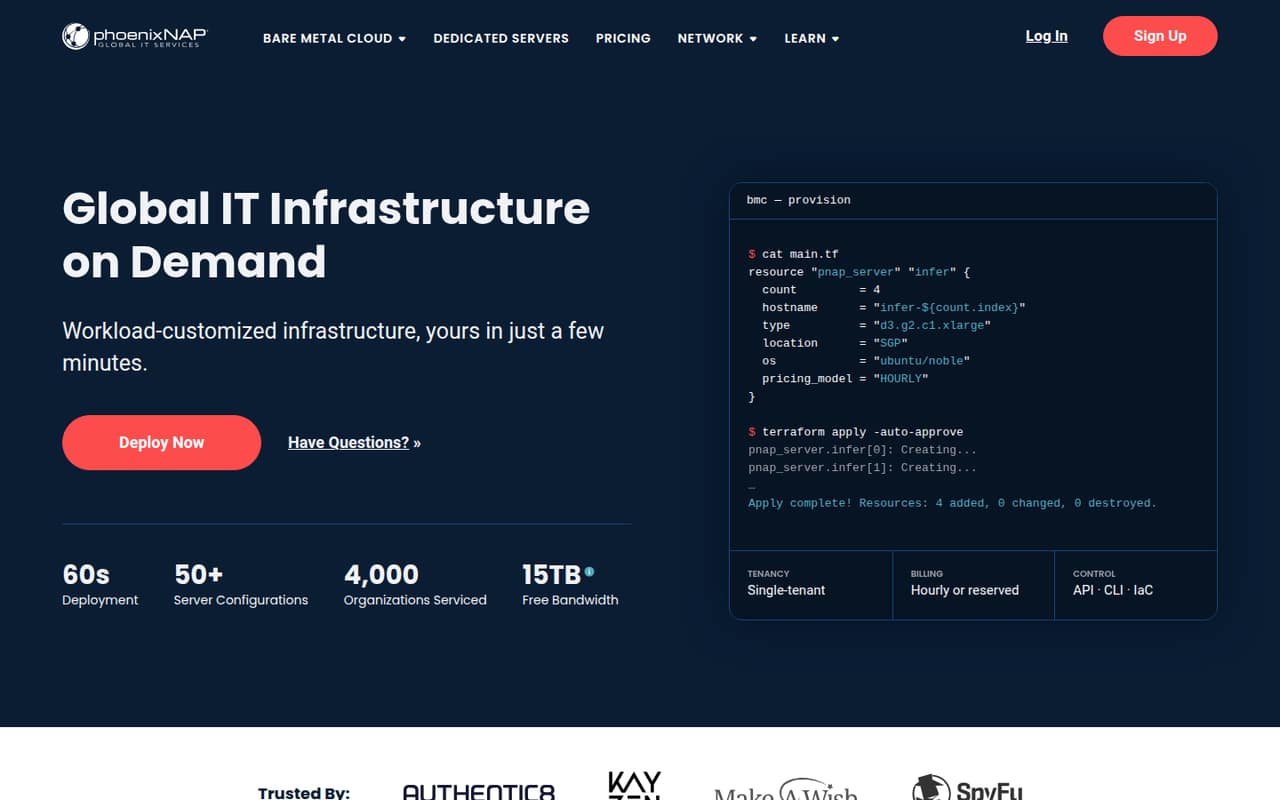
phoenixNAP Bare Metal Cloud (BMC) is a hosted infrastructure platform for provisioning single-tenant physical servers, storage and networking. It sits below your application and orchestration layer: choose a server configuration and location, then manage the machine through the web interface, API, CLI or infrastructure-as-code tools. The vendor lists more than 50 server configurations and says deployments can take about 60 seconds.
This is not a virtual-machine library or software you run on your own servers. It supplies dedicated hardware on demand, with hourly or reserved billing. The stack can include shared network file storage for BMC instances in the same location, plus private networking. phoenixNAP also lists S3-compatible object storage and connectivity to third-party cloud providers through Megaport Cloud Router. For teams that need direct hardware tenancy but want API-driven provisioning, BMC is an infrastructure layer to evaluate alongside virtualized cloud services.
02phoenixNAP API, SDKs and docs
The integration surface includes a REST API, the pnapctl CLI, a web interface and infrastructure-as-code tools. The homepage shows a server-creation request to https://api.phoenixnap.com/bmc/v1/servers, with fields for hostname, operating system, server type, location and SSH keys. It also shows Terraform resources such as pnap_server and an Ansible collection named phoenixnap.bmc.
The vendor lists Terraform, Ansible, Pulumi and Chef, plus Docker, Kubernetes and SUSE Rancher for containerization and orchestration. It also names Apigee and Postman for API management. The homepage names a REST API, not language-specific SDKs; confirm SDK support in the vendor’s docs before choosing a client library. The examples use Terraform configuration, YAML for Ansible and CLI configuration, and a curl request for REST. They show credential-based access, but the API rate limits and language SDK support should be checked in the documentation.
03phoenixNAP pricing for developers
The pricing page lists no free plan or free trial. The lowest listed instance starts at $0.08 per hour: the s0.d1.small has an Intel E-1240v3, 16 GB RAM and two 240 GB SSDs. A more current single-socket option, the s2.c1.small, is listed at $0.17 per hour. Higher-spec configurations cost more; for example, the dual Xeon d3.g2.c1.xlarge is $2.49 per hour.
Most listed configurations are billed hourly. Two AmpereOne configurations have monthly prices: $616.25 for a2.c9.large and $650.02 for a2.c9.xlarge. The vendor says billing can be hourly or reserved, but reserved rates are not listed. At continuous use, hourly costs accumulate for every hour the server is provisioned, so estimate the expected runtime rather than treating the entry rate as a monthly price.
The page lists 15 TB of free bandwidth in most locations and 5 TB in Singapore. Additional bandwidth charges and storage prices are not listed. Ask phoenixNAP for those rates and any reserved terms before forecasting production spend.
04phoenixNAP: open source, self-hosting and lock-in
BMC is a hosted infrastructure service, not a server platform you install and operate on your own hardware. The homepage does not publish an open-source license for the service or its control plane; ask phoenixNAP about the licensing of any client tools you plan to depend on. Terraform, Ansible and other listed integrations let you describe or automate infrastructure, but they do not make the underlying service self-hostable.
The vendor’s examples expose infrastructure through a REST API and configuration tools, which can make server provisioning easier to reproduce elsewhere. However, the homepage does not describe a data-export feature or a migration service. Workload data still needs a migration plan, and API resources, storage and networking may need replacement when leaving. Keep application data in portable formats and treat provider-specific Terraform resources as an integration dependency.
05phoenixNAP in production
BMC’s listed features include single-tenant servers, multiple locations, hourly provisioning and a bandwidth allowance that varies by site. Before depending on it, confirm which locations offer the exact server and storage configuration you need. Ask the vendor for API rate limits, service-level commitments, incident procedures, security controls and compliance documentation; these details are not listed on the homepage. Check how bandwidth beyond the included allowance is charged, too.
One Reddit thread about a Phoenix facility reported cooling problems, offline routers and support services that users could not reach during the incident. A commenter said their equipment remained above normal temperatures and another described servers as inaccessible locally. These are user reports about a specific event, not a measure of service-wide reliability, but they are relevant when assessing geographic risk and escalation paths. For production, plan backups outside the site, test recovery procedures and confirm how to contact support during a facility or portal outage.
From the threadsWhat users say
The Reddit discussion is mixed and sparse: one thread reports a disruptive Phoenix facility incident and support-access problems, while another raises a price concern. These accounts are useful operational signals, not a representative measure of customer sentiment.
Their own support services went offline. So you can't even submit tickets
Our stuff is still above normal temps, but finally getting below alerting thresholds
Seems a bit pricey, I'd probably look at SoYouStart/OVH instead
Questions people ask
How much does phoenixNAP Bare Metal Cloud cost?
The lowest listed configuration is the s0.d1.small at $0.08 per hour. Most configurations have hourly rates, while two AmpereOne systems are listed at $616.25 and $650.02 per month. The vendor also offers reserved billing, but reserved rates are not listed. Check storage and bandwidth charges before estimating a full deployment.
Does phoenixNAP offer a free tier or trial?
The pricing information lists no free plan or free trial. It does include a bandwidth allowance: 15 TB in most locations and 5 TB in Singapore. That allowance is not a free compute tier, and charges for bandwidth beyond it are not listed. Ask the vendor for applicable overage rates before deploying.
How do I provision phoenixNAP servers from code?
The vendor lists a REST API, pnapctl CLI, Terraform, Ansible, Pulumi and Chef integrations. Its examples show Terraform creating a pnap_server, Ansible using the phoenixnap.bmc collection, and REST requests sent to the BMC API. Check the vendor’s docs for current setup instructions, credentials and language SDK support.
Where can I deploy phoenixNAP Bare Metal Cloud servers?
The homepage lists BMC locations in Phoenix, Ashburn, Chicago, Seattle, Amsterdam and Singapore. It also lists network nodes in other cities, including Atlanta, Los Angeles, Frankfurt and Sydney; a network node is not necessarily a BMC server location. Confirm that your chosen server configuration is available at the required BMC site.
Is phoenixNAP suitable for production workloads?
It can fit workloads that need dedicated single-tenant servers and API-driven provisioning, but production readiness depends on your location and requirements. Confirm availability commitments, API rate limits, security and compliance details, support escalation and extra bandwidth costs with the vendor. Plan backups and recovery outside the facility where your workload runs.