
We may earn a commission if you buy through links on this page. It never changes a score or a ranking. How we make money
The bottom line
OpenStack supplies a broad infrastructure control plane; your team supplies the deployment and operations work.
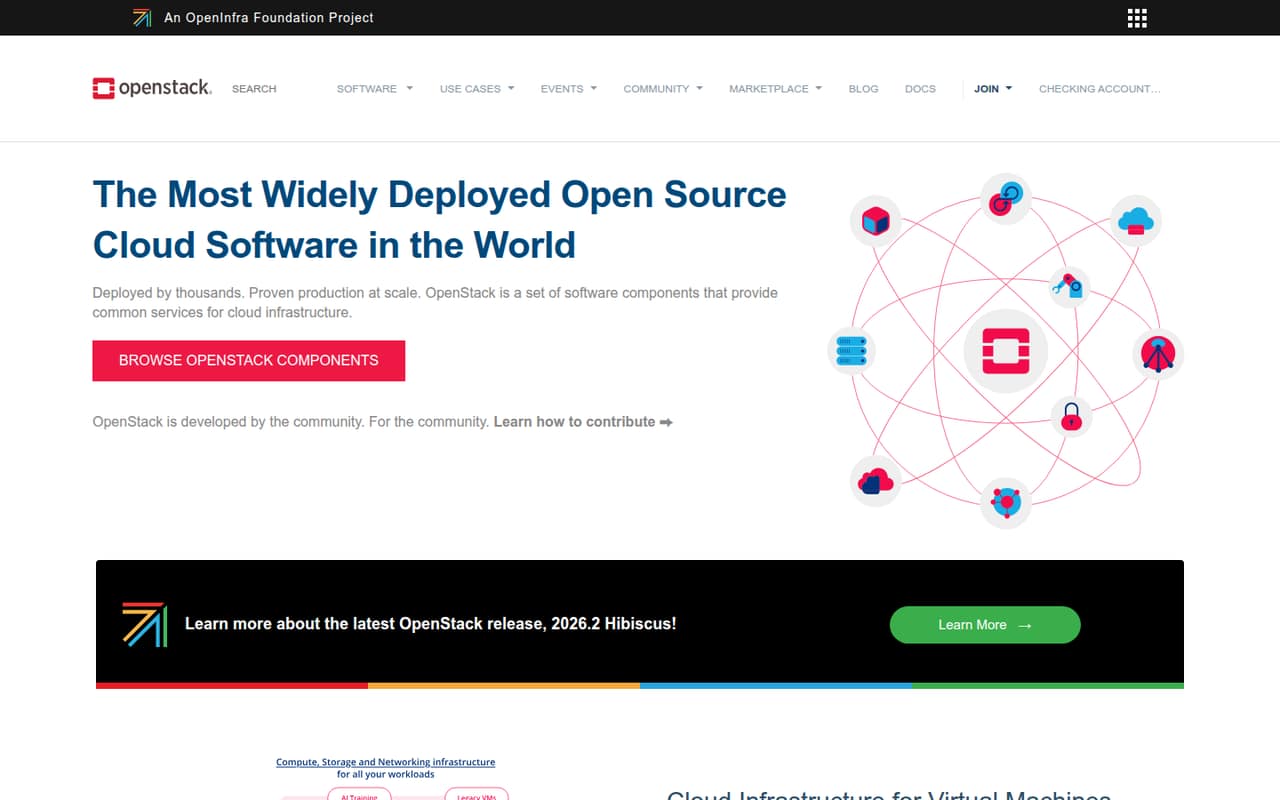
OpenStack is a set of open-source components for managing compute, storage and networking through APIs or a dashboard. It can run on-premises, in public clouds or at the edge, and additional components handle orchestration and other cloud services.
The core software is free to download and self-host, but that is not the same as a low-cost managed service. Reddit users describe a steep learning curve and ongoing debugging, while others say complexity depends on the deployment and team.
Good fit if
- Teams building private clouds
- Infrastructure providers managing cloud resources
- Organizations needing on-premises or edge infrastructure
Skip it if
- Teams that only need a database
- Small operations without cloud staffing
- Projects seeking a managed control plane
ScoresHow it rates
What works
- Manages compute, storage and networking resources
- Provides APIs and a dashboard
- Supports on-premises, public cloud and edge deployments
- Core software is free to download and self-host
- Additional components extend beyond standard IaaS
What doesn't
- Deployment and ongoing operations require expertise
- Core software price excludes infrastructure and staffing
- SDKs and supported languages need verification
- License details should be checked for selected components
- Reddit users report debugging and maintenance demands
01What OpenStack is, technically
OpenStack is a set of software components for managing cloud infrastructure, not a hosted SaaS control plane or a single library. It sits below application platforms in the stack: it pools compute, storage and networking resources, then exposes those resources through APIs or a dashboard. Teams use it to build infrastructure services for virtual machines, bare metal and containers.
The core problem it addresses is operating cloud infrastructure as a shared, programmable platform. Additional components can provide orchestration, fault management and service management beyond standard infrastructure-as-a-service functionality. OpenStack can run on-premises, in public clouds or at the edge; the deployment model depends on who operates the underlying infrastructure. The homepage also points to public cloud data centers powered by OpenStack, so using OpenStack does not necessarily mean hosting every component yourself. In either model, it is infrastructure software, not a substitute for the applications or databases deployed on top of it.
02OpenStack API, SDKs and docs
The homepage names APIs and a dashboard as the ways to manage compute, storage and networking resources. That gives developers a programmatic control surface as well as a graphical one, but the homepage does not name an API protocol, SDKs, supported languages or a CLI. Confirm those details in the documentation for the components and release you plan to deploy before choosing client libraries or building automation around them.
OpenStack is a component-based project, so integrations depend on which services a deployment includes. The homepage links to a component browser and release information, and describes additional components for orchestration, fault management and service management. Treat those components as separate integration decisions rather than assuming every deployment exposes the same capabilities. Before implementation, check API compatibility, authentication, client-library maintenance and upgrade guidance for your selected release. The dashboard can cover interactive administration, while the APIs are the relevant surface for application and infrastructure automation.
03OpenStack pricing for developers
The core OpenStack software is free to download and self-host; the pricing information lists no monthly or annual software price. That is a free software option, not a hosted tier with included compute. You supply or pay for the servers, storage, networking, facilities and staff needed to run the cloud. The total cost therefore grows with the infrastructure you provision and the effort required to deploy, maintain and upgrade it.
There is no published starting price for a managed OpenStack deployment in the pricing information. Public cloud providers powered by OpenStack set their own prices, so compare their rates and service terms directly. The homepage points to an OpenStack Marketplace for partners, but does not give partner pricing. Before production, budget separately for hardware or provider usage, operations, support and any commercial services you choose. The vendor does not publish a software usage meter, request-based bill or overage schedule for the self-hosted core. Ask any prospective provider how its compute, storage, network and support charges change with usage.
04OpenStack: open source, self-hosting and lock-in
OpenStack is open-source software, and its homepage describes the project as community-developed. The homepage does not name a specific license, so check the license terms for the components and releases you intend to deploy rather than assuming every component has identical terms. Self-hosting is a supported model: OpenStack can run on-premises, and the project also supports public cloud and edge deployments.
Running the software yourself gives your team control of the infrastructure and its operating environment, but it also makes your team responsible for keeping the deployment working. The homepage describes API-based resource management; it does not establish a standard data-export process or a one-step migration path. Plan how to export images, configuration and workload data, and test moving them to another platform. Using OpenStack-specific APIs and services can increase migration work even when the underlying software is open source.
05OpenStack in production
OpenStack is intended to manage large pools of infrastructure, and the homepage says it is used across on-premises, public cloud and edge deployments. Those claims do not replace workload-specific checks. Before committing, validate service availability, upgrade paths, API compatibility, security controls, compliance requirements and provider quotas for your chosen release and deployment. Confirm how faults in the control plane affect running workloads, and define monitoring, backup and recovery procedures.
Reddit reports on operating effort are mixed. One thread says, “All your time will be sucked away debugging it in the long run.” Another commenter argues that OpenStack does not always require a large engineering team, while also noting that deployments can become complex. A separate discussion calls it overkill when the goal is only to manage a database or a small set of servers. Treat staffing as an architectural input: OpenStack can underpin a cloud platform, but the team must be prepared to deploy, maintain and troubleshoot that platform.
From the threadsWhat users say
Reddit sentiment is mixed: users value OpenStack as infrastructure for private clouds, but several warn that deployment and support can consume substantial engineering time. Commenters also stress that it is excessive for narrower needs.
All your time will be sucked away debugging it in the long run
Can it get very complex, for sure. Is it necessary to have that kind of complexity? Not at all
Unless you're starting a cloud provider service, OpenStack is overkill
OpenStack works as an IaaS, Infrastructure as a Service, at the bottom it acts like an extended hypervisor, like vmvare with vcenter
Questions people ask
What is OpenStack used for?
OpenStack manages pools of compute, storage and networking resources for cloud infrastructure. Teams can manage those resources through APIs or a dashboard. Additional components provide services such as orchestration, fault management and service management. It can support infrastructure for virtual machines, bare metal and containers.
Can OpenStack run on-premises?
Yes. OpenStack supports on-premises deployments, as well as public cloud and edge deployments. With an on-premises installation, your organization operates the infrastructure and the OpenStack deployment. Plan for the hardware, networking, deployment work and ongoing operations required to run it.
How much does OpenStack cost?
The core software is free to download and self-host, and the pricing information lists no monthly or annual software price. That does not include the hardware, facilities, operations or support needed for a production deployment. OpenStack-powered public cloud providers set their own rates, so check their prices directly.
Does OpenStack provide APIs and SDKs?
OpenStack provides APIs and a dashboard for managing infrastructure resources. The homepage does not name SDKs, supported programming languages or an API protocol. Check the documentation for the specific components and release you plan to use, and verify client-library availability and compatibility before building integrations.
Is OpenStack difficult to operate in production?
It can be. Reddit users report debugging and maintenance demands, while other commenters say the effort depends on the deployment and team. OpenStack is a broad infrastructure platform, so assess staffing, deployment expertise, upgrade procedures and incident response before relying on it for production workloads.