
We may earn a commission if you buy through links on this page. It never changes a score or a ranking. How we make money
The bottom line
A broad hosted observability platform; watch ingest and user costs as you scale.
New Relic brings APM, infrastructure, logs, security, digital experience and AI monitoring into one hosted observability platform. Its free plan offers 100 GB of ingest per month, but production bills can grow with data volume, paid users and add-ons.
We see a strong fit for teams that want connected monitoring without operating the observability stack themselves. The trade-off is cost and migration risk: Reddit users describe both expensive bills and incident-response gains that can justify the spend.
Good fit if
- Teams consolidating observability tools
- Incident response across application and infrastructure
- Teams starting within the free ingest allowance
Skip it if
- Teams needing a self-hosted observability stack
- Projects with unpredictable, high-volume ingest
- Buyers requiring confirmed PCI compliance
ScoresHow it rates
What works
- APM, logs, infrastructure and security in one platform
- Free plan includes 100 GB monthly data ingest
- OpenTelemetry is highlighted as a standard
- AI monitoring covers model and agent interactions
- Enterprise offers priority routing and a critical-response SLA
What doesn't
- Standard adds $99 monthly for each additional full-platform user
- Ingest beyond 100 GB is billed per GB
- Pro's lower price requires an annual commitment
- Self-hosting and source licence details need vendor confirmation
- Data export and migration paths need confirmation before adoption
01What New Relic is, technically
New Relic is a hosted observability platform: teams send telemetry from their software systems to a central service for monitoring and investigation. It sits alongside applications and infrastructure, collecting signals that help engineers find issues and connect application performance to user experience and business outcomes.
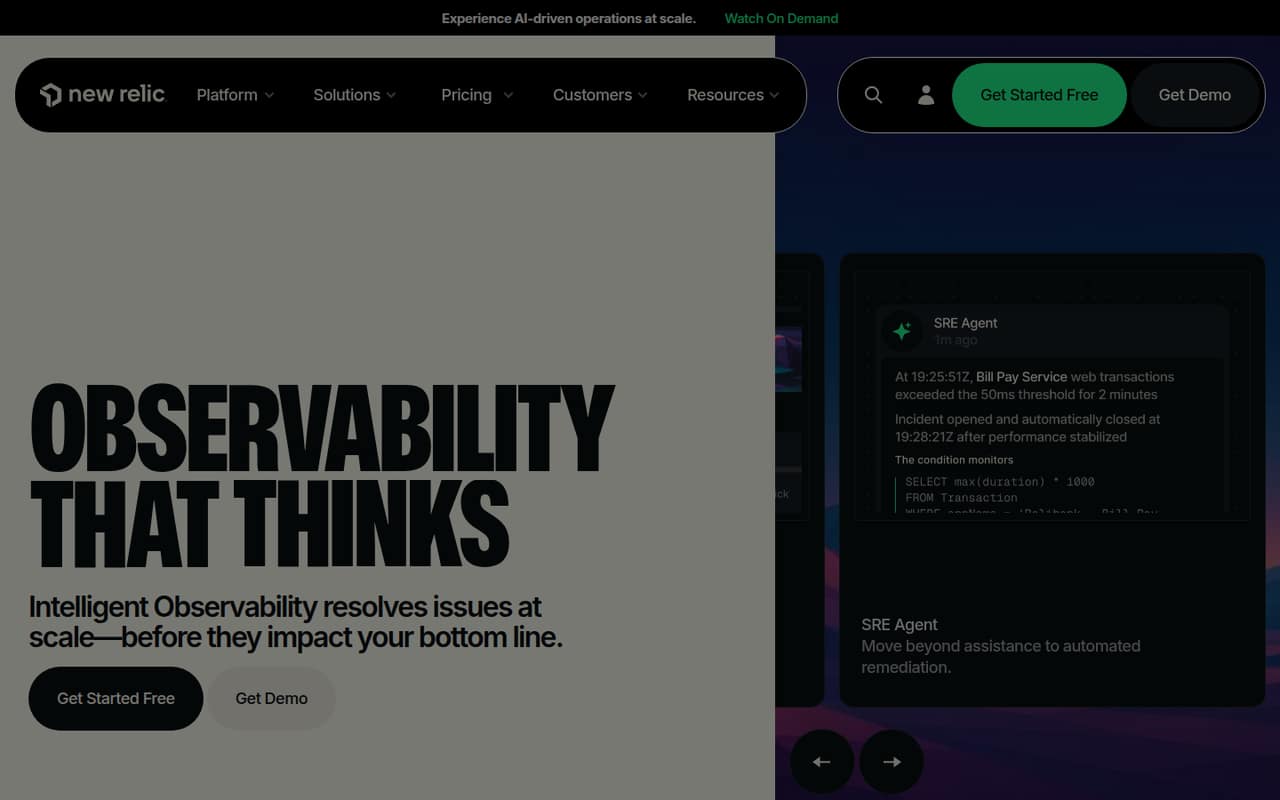
The platform covers application performance monitoring (APM), infrastructure, logs, security, digital experience, and AI and agent monitoring. That breadth is useful when an incident crosses service boundaries: engineers can investigate application behavior alongside infrastructure health and log data in one platform. The homepage also promotes session replay with AI, an SRE Agent for automated remediation, and visibility into multi-cloud and Kubernetes costs.
New Relic is not just a code-level profiler or a metrics dashboard. It is a wider monitoring service with data ingest, users, retention, and optional capabilities affecting the bill. Teams evaluating it should map required signals and users to the pricing model before sending production telemetry.
02New Relic API, SDKs and docs
The homepage highlights OpenTelemetry as an open standard for every signal and positions New Relic as an observability destination for application, infrastructure, log, security, user-experience, and AI data. It also describes an Agentic Platform that delivers observability insights to AI agents where engineers work, plus an SRE Agent aimed at automated remediation.
Those are integration directions, not a full implementation guide. The homepage does not name specific SDKs, programming languages, API styles, CLI tools, or plugins. Before choosing an instrumentation path, confirm supported languages, agent installation steps, API coverage, and documentation for your deployment in New Relic’s docs. Also verify how OpenTelemetry data maps to the signals and features your team needs.
For a codebase review, check whether existing instrumentation can send the telemetry you need and how much configuration is required per service. New Relic’s broad feature set can reduce tool switching, but the integration effort depends on your stack and the signals you plan to collect.
03New Relic pricing for developers
Free costs $0 and includes 100 GB of data ingest per month, one full-platform user, unlimited basic users, 500 synthetic checks, and at least eight days of retention. It is a useful starting point, but extra ingest, synthetic checks, and extended retention can be billable.
Standard starts at $10 per month for its first full-platform user. Each additional full-platform user costs $99 per month, up to five; Core users cost $49 each. Ingest beyond 100 GB costs $0.40/GB, and the plan lists a two-business-day support response SLA.
Pro costs $349 per user per month with an annual commitment or $418.80 month to month. It includes unlimited full-platform users and a two-hour critical support response SLA. Enterprise is custom-priced. Data Plus ingest costs $0.60/GB beyond 100 GB; an EU data center adds $0.05/GB/month. Advanced Compute is usage-based, with rates not published. Model ingest, seats, retention, and add-ons before rolling the service out.
04New Relic: open source, self-hosting and lock-in
New Relic is presented as a hosted platform, not a self-hosted server. The vendor’s homepage and pricing information do not publish a source licence or a self-hosting option; teams that require either should confirm directly with New Relic before adopting it. OpenTelemetry is highlighted as an open standard, which can help keep instrumentation less tied to one vendor, but it does not by itself establish that dashboards, alerts, or stored data can move unchanged.
The vendor does not publish a data-export or migration path in the information available for this review. Ask about export formats, retention after cancellation, and whether alert rules and dashboards can be recreated outside the service. A Reddit commenter recommends OpenTelemetry as a way to make future migrations easier. Another notes that migration, training, and operating data stores can offset open-source savings. Treat portability as an implementation requirement, not an assumption.
05New Relic in production
New Relic’s free allowance and paid-user tiers make ingest volume and access design important production decisions. Free includes 100 GB monthly ingest and at least eight days of retention; beyond that, ingest, retention, and synthetic checks can add charges. Standard caps full-platform users at five, while Pro lists unlimited full-platform users. Check the support response SLA against your incident requirements: Standard lists two business days, Pro two hours for critical issues, and Enterprise one hour for critical issues.
For regulated workloads, Enterprise lists FedRAMP Moderate and HIPAA eligibility with Data Plus. Eligibility is not a blanket compliance guarantee; confirm scope, configuration, and contractual requirements with the vendor. The published pricing information does not establish an availability SLA, so ask about service commitments before making New Relic part of critical response workflows.
Reddit reports are mixed. Some users call the platform expensive; another says faster incident response justified the cost. One commenter suggests sampling instrumentation to manage spend. Validate that any sampling strategy still captures the failures your team needs to diagnose.
From the threadsWhat users say
Reddit sentiment is mixed: developers cite the cost and consider alternatives, while some say the incident-response benefits justify paying for a hosted tool. Migration effort and keeping instrumentation portable also come up.
New Relic and Datadog are fantastic but you really do pay the price
it made our incident response so much more effective that we were still saving a shit ton of money because our outages were shorter and easier to resolve
I'd start by looking at Open Telemetry and tools that work with that
Shouldn't cost a kidney
Questions people ask
What is New Relic used for?
New Relic is used to monitor software systems and investigate issues across applications, infrastructure, logs, security, and digital experience. The platform also offers monitoring for AI models and agents. Its aim is to give teams connected signals for finding and resolving problems.
Does New Relic have a free plan?
Yes. The Free plan costs $0 and includes 100 GB of data ingest per month, one full-platform user, unlimited basic users, 500 synthetic checks, and at least eight days of data retention. Extra ingest and some add-ons can be billable.
How much does New Relic cost?
Standard starts at $10 per month for its first full-platform user, with additional users and ingest charged separately. Pro costs $349 per user per month with an annual commitment or $418.80 month to month. Enterprise uses custom pricing.
Can New Relic be self-hosted?
New Relic is presented as a hosted observability platform. Its homepage and pricing information do not publish a self-hosted option or source licence. If self-hosting is a requirement, confirm deployment options directly with the vendor before adopting it.
Is New Relic suitable for regulated workloads?
The Enterprise plan lists FedRAMP Moderate and HIPAA eligibility with Data Plus. That is not a blanket compliance guarantee. Confirm the service’s scope, configuration requirements, and contractual terms with New Relic for your specific workload.