
We may earn a commission if you buy through links on this page. It never changes a score or a ranking. How we make money
The bottom line
Koyeb makes container and GPU deployment straightforward, but usage costs and portability need scrutiny.
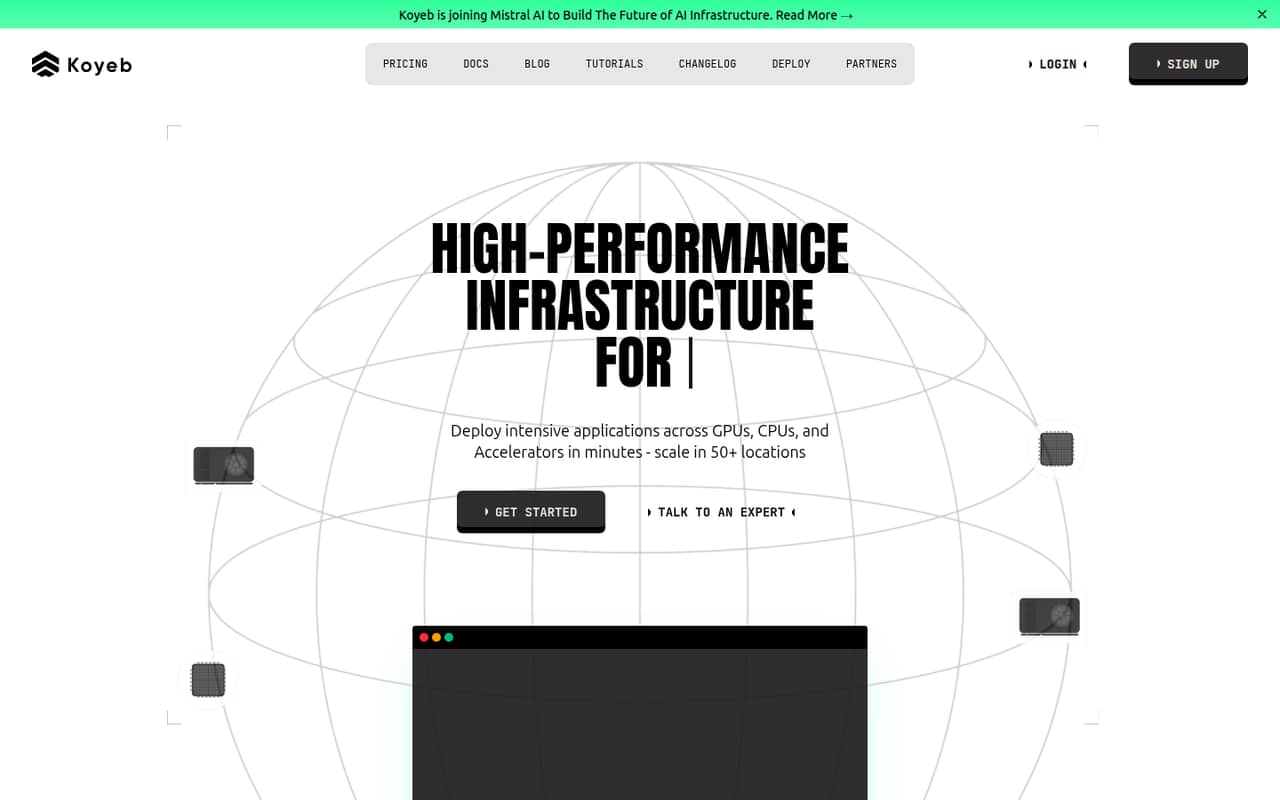
Koyeb is hosted cloud infrastructure for deploying containers, apps and models on CPUs, GPUs and accelerators. Git push and CLI deployments, autoscaling and managed Serverless Postgres make it a practical fit for teams that want to run AI workloads without managing servers.
The main trade-offs are usage-based compute costs, limited public detail on SDK and API options, and questions to settle about data export and self-hosting. Reddit reports include both an account-review problem that was later resolved and an app exceeding free-tier limits.
Good fit if
- Teams deploying containerized AI workloads
- Apps that need GPU autoscaling
- Developers wanting managed Postgres
Skip it if
- Teams requiring self-hosted infrastructure
- Projects needing predictable flat compute bills
- Buyers requiring documented export guarantees
ScoresHow it rates
What works
- Deploy containers with Git push or CLI
- Autoscaling can scale from zero
- GPU options include AMD, Intel and Nvidia hardware
- Managed Postgres supports pgvector
- Health checks support zero-downtime deployments
What doesn't
- Compute is metered and billed by usage
- A general free platform plan is not listed
- SDK and API details need confirmation
- Self-hosting and data export details need confirmation
- Reddit users report account and free-tier problems
01What Koyeb is, technically
Koyeb is a hosted cloud platform and deployment control plane, not an application library or a server you install in your own environment. It runs containerized applications on managed CPU, GPU and accelerator infrastructure, with autoscaling and deployment across locations. The platform sits between your source code or container image and the compute that serves your application.
You can deploy code, containers or models with a Git push or CLI call. Koyeb handles the runtime and scaling, including scaling containers down to zero and back up as demand changes. Its managed Serverless Postgres product can sit alongside an application and supports pgvector for embedding storage and search. The homepage advertises availability in more than 50 locations. That makes Koyeb relevant to teams building APIs, inference endpoints, distributed systems and other workloads that need managed infrastructure. It is a hosted service: teams should assess its usage costs and portability alongside the reduction in server operations.
02Koyeb API, SDKs and docs
Koyeb's homepage describes native support for popular languages and Docker containers, but the concrete deployment surfaces it names are Git push and CLI call. Teams can connect a Git workflow for continuous deployment or use the CLI to deploy code, containers and models. The homepage does not name specific languages or SDKs, so confirm language-specific SDK and API support in Koyeb's documentation before choosing an integration.
The platform also provides real-time logs and direct instance access for troubleshooting. Its deployment workflow includes automatic health checks, and the homepage lists native HTTP/2, WebSocket and gRPC support. These are runtime and networking capabilities, not evidence of a particular client SDK or API protocol for managing Koyeb itself. Koyeb says it supports popular languages and Docker without modification; teams with custom build pipelines should confirm supported build and deployment steps in the docs. Git and CLI deployment are the clearest integration paths described.
03Koyeb pricing for developers
Koyeb has no free platform plan listed. The Postgres Free 5h option includes five free hours with 0.25 vCPU, 1 GB RAM and 1 GB storage, so it is for brief database testing rather than a continuously running production database. The Pro plan is $29 per month and includes $10 of compute; Scale is $299 per month and includes $100 of compute. Both include 1 TB of bandwidth per month.
Compute is metered by usage, billed per second and charged at the end of the calendar month. Additional services start at $0.000006 per second. Listed GPU instances range from $0.50 per hour for RTX-4000-SFF-ADA to $24 per hour for 8x H200, with N300s requiring access. Postgres storage costs $0.50 per GB per month. Bandwidth beyond the included amount costs $0.02 per GB in the EU and US or $0.04 per GB in Asia. Pro and Scale are monthly prices; no annual billing is listed.
04Koyeb: open source, self-hosting and lock-in
Koyeb is presented as a hosted cloud platform. The vendor does not publish an open-source licence or self-hosted edition on the vendor's site available here, so teams that require either should confirm directly with Koyeb before adopting it. The same applies to data export: ask what can be exported, in which formats, and whether database backups can be moved without assistance.
Containers and Git-based deployment provide some application portability: teams can build and deploy containerized workloads on other infrastructure. That does not remove the work of replacing Koyeb-specific deployment, autoscaling and managed-service configuration. Managed Postgres with pgvector is based on Postgres, which gives teams a familiar database, but they should verify backup and restore options and test a migration path. Treat portability as something to design and confirm, not an automatic property of container deployment.
05Koyeb in production
Koyeb advertises autoscaling from zero to hundreds of servers, health checks for deployments, and support for HTTP/2, WebSocket and gRPC. Those features address scaling and rollout mechanics, but production teams should check their expected concurrency, cold-start behavior and service limits against current documentation. Pro and Scale include 1 TB of monthly bandwidth; overage rates differ by region. Scale lists a 99.9% uptime SLA, while Enterprise lists 99.99%; confirm which services and regions each SLA covers. Enterprise also lists SSO, RBAC and an audit trail.
One Reddit thread reports an account flagged for suspicious activity; the account holder later confirmed it worked after Koyeb staff intervened. In another thread, an application owner said a Koyeb instance crashed after exceeding free-tier usage limits. These are individual reports, not reliability measurements, but they make account review and usage thresholds worth checking. Ask Koyeb about rate limits, incident response, compliance coverage and data recovery before making a critical workload dependent on the service.
From the threadsWhat users say
The available Reddit comments show mixed sentiment: one account-access complaint was later resolved, while another developer reported an app outage after exceeding free-tier limits. These are isolated reports, not a broad measure of reliability.
sign in with github tells me that I've done suspicious activity and will not let me log in
i don't think so, but I'm staying away from this platform by the looks of it
Thank you. I can confirm it works now
Our Koyeb instance has crashed due to exceeding the free tier usage limits
Questions people ask
Is Koyeb free?
Koyeb does not list a free platform plan. It does list Postgres Free 5h, which includes five free hours with 0.25 vCPU, 1 GB RAM and 1 GB storage. That is a limited database option, not a free tier for continuously running applications. Check current plan terms before deploying.
How does Koyeb charge for compute?
Compute is metered by usage, billed per second and charged at the end of the calendar month. Pro costs $29 per month and includes $10 of compute; Scale costs $299 and includes $100. Additional services start at $0.000006 per second, so the final bill depends on deployed resources and usage.
Can I deploy a Docker container to Koyeb?
Yes. Koyeb's homepage says it has native support for Docker containers and lets you deploy containers with a Git push or CLI call. It also advertises autoscaling, including scaling to zero. Check the vendor's documentation for the deployment steps and any current runtime requirements.
Does Koyeb offer managed Postgres?
Yes. Koyeb offers managed Serverless Postgres with pgvector for storing and searching embeddings. Plans range from Postgres Free 5h to Postgres 3XLarge. Listed storage costs $0.50 per GB per month; confirm how storage and backups apply to the database plan you choose.
Can I run GPU workloads on Koyeb?
Yes. Koyeb lists GPU infrastructure alongside CPU and accelerator options, including hardware from AMD, Intel and Nvidia. Listed GPU prices range from $0.50 per hour for RTX-4000-SFF-ADA to $24 per hour for 8x H200. N300s instances require access, so confirm availability and costs before planning capacity.