
We may earn a commission if you buy through links on this page. It never changes a score or a ranking. How we make money
The bottom line
Kissflow fits governed business apps better than developer-led, API-first projects.
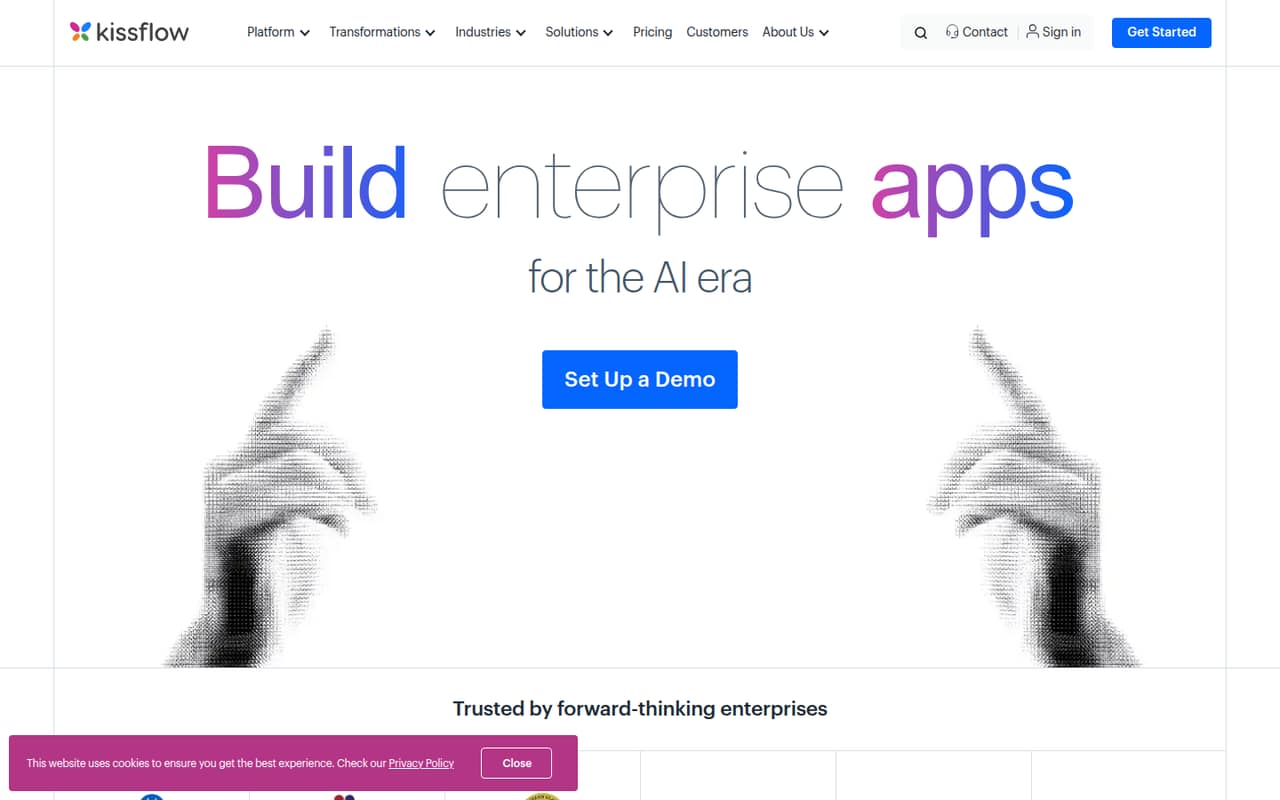
Kissflow is a hosted no-code and low-code platform for building enterprise apps and workflows. AI generation, forms, reports, approvals, ready-made applications, and governance tools target business teams and IT organizations managing internal processes.
The platform could reduce custom development for visual, workflow-heavy apps, but developers should verify its API and integration options before making it a core system. Basic is listed at $2,500 per month, while Enterprise requires a custom quote; there is no listed free plan.
Good fit if
- Enterprise workflow and approval apps
- IT teams governing citizen development
- Teams adapting prebuilt business applications
Skip it if
- API-first application development
- Small teams with tight budgets
- Projects requiring open-source self-hosting
ScoresHow it rates
What works
- Build workflows with approvals and notifications
- Generate complete apps or building blocks with AI
- Includes forms, reports, portals, and boards
- Governance tools target organization-wide deployments
- Prebuilt apps cover several enterprise use cases
What doesn't
- Basic is listed at $2,500 per month
- Enterprise pricing requires a custom quote
- Public API and SDK details are limited
- Private cloud or cluster hosting requires a request
- A Reddit user criticizes the mobile apps
01What Kissflow is, technically
Kissflow is a hosted no-code and low-code platform for building enterprise applications and workflow automations. It sits above business systems as an application and process layer: teams use it to assemble apps, forms, reports, portals, and approval flows rather than build each interface and process from scratch. The platform also offers ready-made applications, including loan origination, fleet management, and claims processing.
Its AI features generate complete apps or building blocks, while governance modules give IT and transformation teams controls for managing solutions across an organization. That makes Kissflow relevant when business teams need to build operational tools but IT needs oversight. It is not presented as a developer library, CLI, or self-managed application server. Teams evaluating it for a larger stack should treat it as a vendor platform and check how its integrations, data access, and deployment options fit existing systems before committing.
02Kissflow API, SDKs and docs
The homepage presents Integrations as one of Kissflow’s platform building blocks, alongside workflows, apps, forms, reports, portals, and boards. It also describes workflows with approvals and notifications. That points to a visual app-building and integration experience, rather than a developer-first SDK or CLI workflow.
The vendor doesn’t publish the API style, named SDKs, supported programming languages, CLI, or integration protocols on its homepage. The named integration surface is the platform’s Integrations capability. Before adopting Kissflow as a system that other services depend on, confirm in the vendor’s docs whether your required systems and authentication methods are supported, whether events can be sent or received, and what API access is available. Confirm SDK support in the vendor’s docs as well. The homepage describes governance tools and AI-generated apps, but those do not answer implementation questions such as version control, testing environments, or deployment automation.
03Kissflow pricing for developers
Kissflow has no listed free plan, and a free trial is not published. The pricing page lists Basic at $2,500 per month for teams needing core workflow automation. It includes unlimited workflows, unlimited applications, and Silver-level support. Some listings cite $1,500 per month instead, so confirm the current quote and billing terms with Kissflow. Annual Basic pricing is not published.
Enterprise uses a custom quote for organizations needing enterprise-scale automation. It includes unlimited applications, unlimited integrations, and 25+ AI-powered automation features, with user-based and transaction tiers. That means the Enterprise bill depends on the agreed tier and contract; the vendor doesn’t publish a public rate card for those variables. The pricing information says there are no AI or API usage surcharges, but it does not give per-user or per-transaction rates. Additional services and private cloud or cluster hosting are available on request. Ask for the complete quote, including support and hosting terms, before estimating production costs.
04Kissflow: open source, self-hosting and lock-in
Kissflow is sold as a vendor platform, not as an open-source project. The vendor doesn’t publish an open-source licence or source-code access terms, so teams should not plan to fork or maintain the platform themselves. Private cloud or cluster hosting is available on request; that is a quoted option, not a standard self-hosting package with published deployment instructions.
The vendor also doesn’t publish data-export formats or a migration path. Before building critical processes on Kissflow, ask how to export application definitions, records, attachments, and workflow history, and whether those exports remain usable outside the platform. Apps built with visual components and proprietary workflow logic can create migration work even when underlying business data is exportable. Get export rights and exit assistance into the contract, and test a representative data export before relying on the platform for long-lived processes.
05Kissflow in production
Kissflow’s governance modules are aimed at IT and transformation teams managing applications across an organization. The vendor also offers Enterprise with user-based and transaction tiers. Before production, ask for the limits and terms that matter to your workload: transaction thresholds, concurrency, API access, uptime commitments, backup and recovery, audit controls, and security and compliance documentation. The pricing information lists unlimited integrations for Enterprise, but that does not establish unlimited throughput or requests.
Kissflow positions its platform for complex enterprise solutions, but teams should validate how its workflows behave under their own data volume and approval patterns. A Reddit user looking for a BPM-style task tool says Kissflow and another product have “terrible mobile apps,” a concern for processes used by staff in the field. Another Reddit thread about workflow documentation ended with the poster choosing a diagramming tool, a reminder that Kissflow’s app platform may not fit every process-mapping need. These are individual comments, not reliability data. Get service commitments and test mobile workflows with intended users.
From the threadsWhat users say
The small amount of Reddit discussion is mixed and limited. One user complains about the mobile apps, while another discussion shifts toward a diagramming tool for workflow documentation.
KissFlow and Canny both have terrible mobile apps
I think LucidChart is what we're looking for
sometimes some tasks should be done in the right sequence by different people
I've been looking at workflow automation tools like Cflow, Kissflow, and Pipefy
Questions people ask
What is Kissflow used for?
Kissflow is used to build enterprise applications and automate business workflows. Teams can create apps, forms, reports, and approval processes, or adapt ready-made applications for use cases such as loan origination, fleet management, and claims processing.
How much does Kissflow cost?
Basic is listed at $2,500 per month and includes unlimited workflows, unlimited applications, and Silver-level support. Enterprise pricing is custom and uses user-based and transaction tiers. Some listings cite a lower Basic price, so confirm the current quote with the vendor.
Is Kissflow free?
Kissflow has no listed free plan, and a free trial is not published. Teams should request a demo or a direct quote to assess the platform and confirm current purchase terms.
Is Kissflow open source or self-hosted?
Kissflow is not presented as an open-source product. Private cloud or cluster hosting is available on request, but the vendor does not publish it as a standard self-hosting package. Ask about data export and migration terms before adopting it.
Does Kissflow offer an API or SDK?
The homepage identifies Integrations as a platform capability but does not name API protocols, SDKs, programming languages, or a CLI. Confirm the available interfaces and supported systems in the vendor’s docs before planning a custom integration.
Sources
- Kissflow homepage
- Kissflow pricing, compiled via web search from zenphi.com, saaspricehub.io, rework.com, kissflow.com, thedigitalprojectmanager.com, softwareadvice.co.uk, procurer.io, capterra.com
- Reddit: Kissflow vs LucidChart?
- Reddit: Is there a way to manage tasks in a BPM manner like in KissFlow or Canny?
- Reddit: Top 7 Kissflow alternatives: Features and prices compared in 2026
- Reddit: Cflow vs Kissflow vs Pipefy: Which one do you guys think offers the best balance of automation, AI, and document processing?