
We may earn a commission if you buy through links on this page. It never changes a score or a ranking. How we make money
The bottom line
Helicone unifies LLM routing and observability, but weigh reported maintenance-mode risk before adopting.
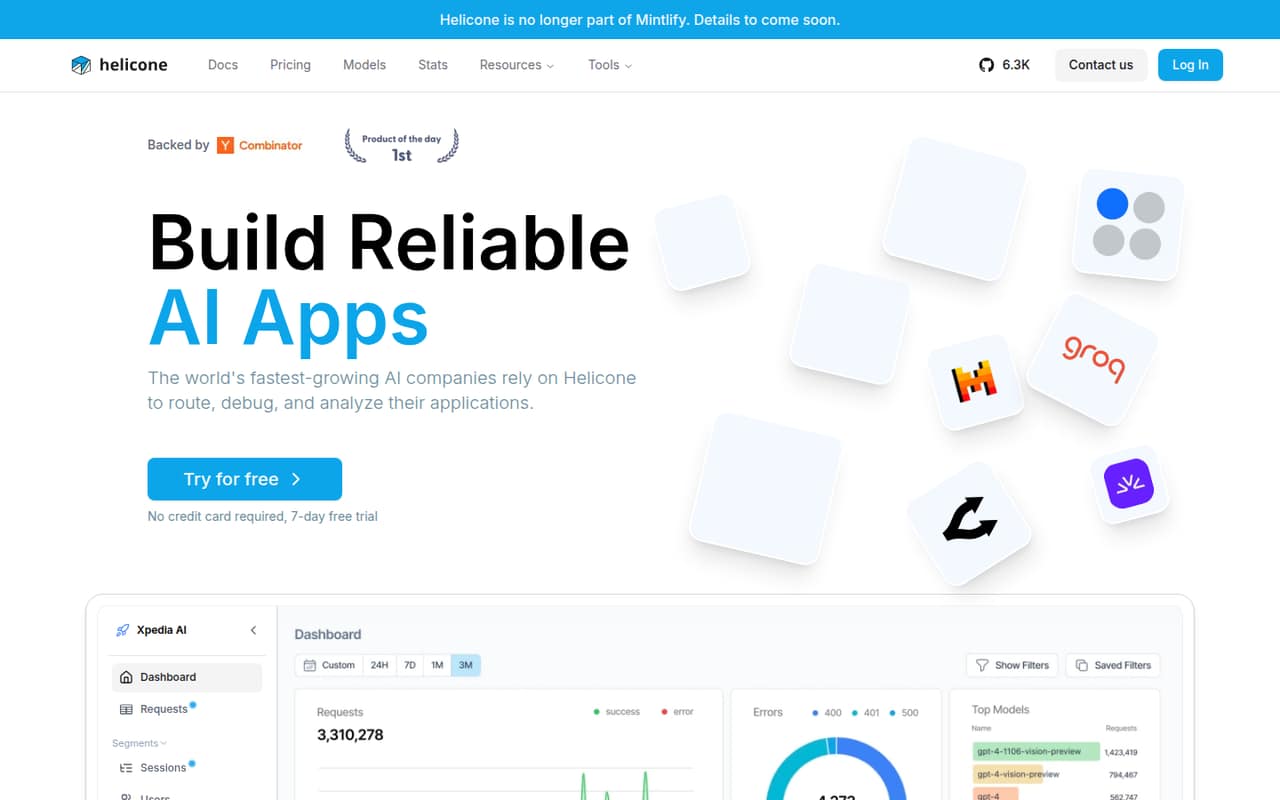
Helicone is an open-source gateway and observability platform that sits between an application and model providers, or collects data through asynchronous logging. Its OpenAI-compatible proxy, model routing, tracing and prompt tools cover several production needs in one layer.
The Hobby plan includes 10,000 free requests, while paid plans add higher ingestion limits and longer retention. A Reddit thread reports that Helicone was acquired by Mintlify and may be moving into maintenance mode; teams should verify the project's current development and support status before committing.
Good fit if
- Teams routing across model providers
- Apps needing request-level cost visibility
- Organizations that can self-host
Skip it if
- Teams needing confirmed active development
- Projects requiring published overage rates
- Stacks that avoid gateway dependencies
ScoresHow it rates
What works
- OpenAI-compatible proxy and asynchronous logging
- One API key for access to 100+ models
- Tracks latency, tokens, errors and costs
- Apache 2.0 license with Docker Compose and Helm options
- Hobby tier includes 10,000 free requests
What doesn't
- Reddit users report a move toward maintenance mode
- Usage and storage overage rates are not published
- Hobby ingestion is limited to 10 logs per minute
- Vendor does not publish data-export details
- Enterprise pricing is custom
01What Helicone is, technically
Helicone is a hosted AI gateway and LLM observability service, with a self-hosted server option. In a typical architecture, an application sends model traffic through Helicone's OpenAI-compatible proxy, or logs requests asynchronously. The gateway sits between application code and inference providers; the observability layer records request and response data for analysis.
The gateway provides access to more than 100 models through one API key, with routing strategies based on latency, cost or weights, automatic failover, and unified billing. The observability app tracks latency, token use, time to first token, errors and costs, with filters for model, user ID, session and custom properties. Helicone also offers agent tracing, prompt versioning and deployment, caching, and configurable rate limits. That makes it an infrastructure layer for applications already calling LLMs, rather than a model, client library or command-line tool.
02Helicone API, SDKs and docs
The main integration surface is an OpenAI-compatible proxy: applications send model requests through Helicone, which captures request and response data. Teams can instead use asynchronous logging. The vendor describes a unified proxy endpoint and one API key for more than 100 models, plus direct integrations with OpenAI, Anthropic, Google Gemini, AWS Bedrock, Groq, DeepSeek, Together AI, Mistral and OpenRouter.
Framework and workflow integrations include LangChain, LlamaIndex, LangGraph, Vercel AI SDK, CrewAI, DSPy, Semantic Kernel, PostHog, n8n and Zapier. Prompt versions can be deployed through the gateway without changing application code, and the playground supports prompt, session and trace testing. The vendor does not name programming languages or a CLI in its integration details. Confirm SDK availability and language-specific setup in Helicone's docs before choosing an integration path. Its advertised surface is broad, but teams should validate that their existing request flow and framework fit the proxy or asynchronous logging model.
03Helicone pricing for developers
Hobby is free and includes 10,000 requests, 1 GB of storage, one seat, one organization, seven-day retention and ingestion of 10 logs per minute. That can cover a small project, but the low ingestion ceiling and short retention are constraints for production traffic.
Pro costs $79 per month and includes 10,000 free requests, then usage-based billing, unlimited seats, one organization, 1 GB of storage before usage-based charges, one-month retention and ingestion of 1,000 logs per minute. Team costs $799 per month with the same request and storage allowance structure, five organizations, three-month retention and 15,000 logs per minute. Both include a seven-day free trial. Enterprise has custom pricing, unlimited seats and organizations, forever retention, 30,000 logs per minute and on-prem deployment.
Usage-based request and storage rates are not published, and annual prices are not published. Ask Helicone for a cost estimate using expected traffic, storage and retention before routing production workloads through a paid plan.
04Helicone: open source, self-hosting and lock-in
Helicone is open source under the Apache 2.0 license. The vendor offers self-hosting with Docker Compose for local environments and production Helm charts for Kubernetes. Self-hosting gives organizations an option for greater data ownership, but it also means operating the required infrastructure; the vendor does not publish a data-export process, so confirm export formats and procedures before relying on the hosted service.
The OpenAI-compatible proxy and asynchronous logging provide integration surfaces that may be easier to replace than application-specific model calls. However, prompt versions, traces, dashboards and stored request data can create migration work. Teams should establish how to retrieve those records and map prompts and metadata to a replacement system. The license permits use of the source under Apache 2.0, but it does not eliminate the operational work of running or migrating the platform.
05Helicone in production
The managed service is described as SOC 2 and GDPR compliant and built on edge infrastructure with a Rust-based proxy. Those are useful deployment and compliance signals, not substitutes for checking the controls and contractual terms your organization requires. Match your expected volume against each plan's ingestion limit: Hobby lists 10 logs per minute, Pro 1,000, Team 15,000 and Enterprise 30,000. Confirm how request handling behaves at those limits and what happens during provider outages or gateway degradation.
Helicone advertises automatic failover, latency- and cost-based routing, caching backed by Redis or S3, and rate limits by request count, token use or dollar budget. The pricing page lists usage-based requests and storage beyond allowances, but not their rates. A Reddit thread reports that Helicone was acquired by Mintlify and that the project may be moving into maintenance mode, with security updates continuing but active feature development likely done. Treat that as a report to verify directly, especially if your production roadmap depends on new features or timely fixes.
From the threadsWhat users say
The Reddit discussion raises a concrete concern about ownership and future development, rather than providing broad feedback on day-to-day use. The available sentiment is limited and should be treated as a signal to check Helicone's current roadmap and support commitments.
Helicone just got acquired by Mintlify
the project is reportedly moving into maintenance mode
security updates will continue
active feature development is likely done
Questions people ask
How does Helicone integrate with an LLM application?
Helicone supports an OpenAI-compatible proxy that routes model requests and captures request and response data. Applications can also use asynchronous logging. The vendor lists integrations with model providers and frameworks including LangChain, LlamaIndex, LangGraph and Vercel AI SDK; check its docs for setup instructions for your stack.
Can Helicone run without sending traffic through its proxy?
Yes. The vendor describes asynchronous logging as an alternative to the OpenAI-compatible proxy. That lets an application log request data without using Helicone as its model-routing endpoint. Confirm the implementation details and supported integrations in the docs.
Can we self-host Helicone?
Yes. Helicone is available under the Apache 2.0 license, with Docker Compose for local environments and production Helm charts for Kubernetes deployments. Self-hosting shifts infrastructure operations to your team; confirm the required resources and deployment procedures before planning capacity.
What does Helicone track?
Helicone tracks request latency, token consumption, time to first token, error rates and costs. Teams can segment metrics by model, user ID, session and custom properties. Its tracing features are designed to inspect multi-step workflows, chains and stateful agent interactions.
Is Helicone still actively developed?
A Reddit thread reports that Helicone was acquired by Mintlify and may be moving into maintenance mode, with security updates continuing and active feature development likely done. That is a community report; ask Helicone directly about current maintenance, support and roadmap commitments before adopting it.