
We may earn a commission if you buy through links on this page. It never changes a score or a ranking. How we make money
The bottom line
A broad customer-messaging platform, but developers should verify its APIs and limits before building around it.
Gupshup is a conversational platform for messaging, voice, AI agents, campaigns and human support. Its channel coverage and pay-as-you-go entry point suit teams building customer conversations across WhatsApp, Instagram, SMS, RCS and Voice.
The developer trade-off is limited public detail on API and SDK support, rate limits, data export and self-hosting. The listed $0 monthly platform subscription is not a free plan: usage charges and Meta or WhatsApp fees still apply.
Good fit if
- Teams building WhatsApp customer journeys
- Organizations using several messaging channels
- Support teams combining AI and human agents
Skip it if
- Developers seeking a documented SDK stack
- Projects requiring self-hosted messaging infrastructure
- Small teams needing simple WhatsApp automation
ScoresHow it rates
What works
- Supports WhatsApp, Instagram, SMS, RCS and Voice
- AI agents can escalate complex cases to human teams
- Campaigns can trigger from events and messaging signals
- AI Co-Pilot offers suggested responses and summaries
- Self-Serve has no monthly platform subscription fee
What doesn't
- Homepage does not name SDKs, languages or API protocols
- Enterprise seat and usage limits are unpublished
- Meta and WhatsApp fees are charged separately
- Traditional overage costs are unpublished
- Reddit users question whether it suits smaller requirements
01What Gupshup is, technically
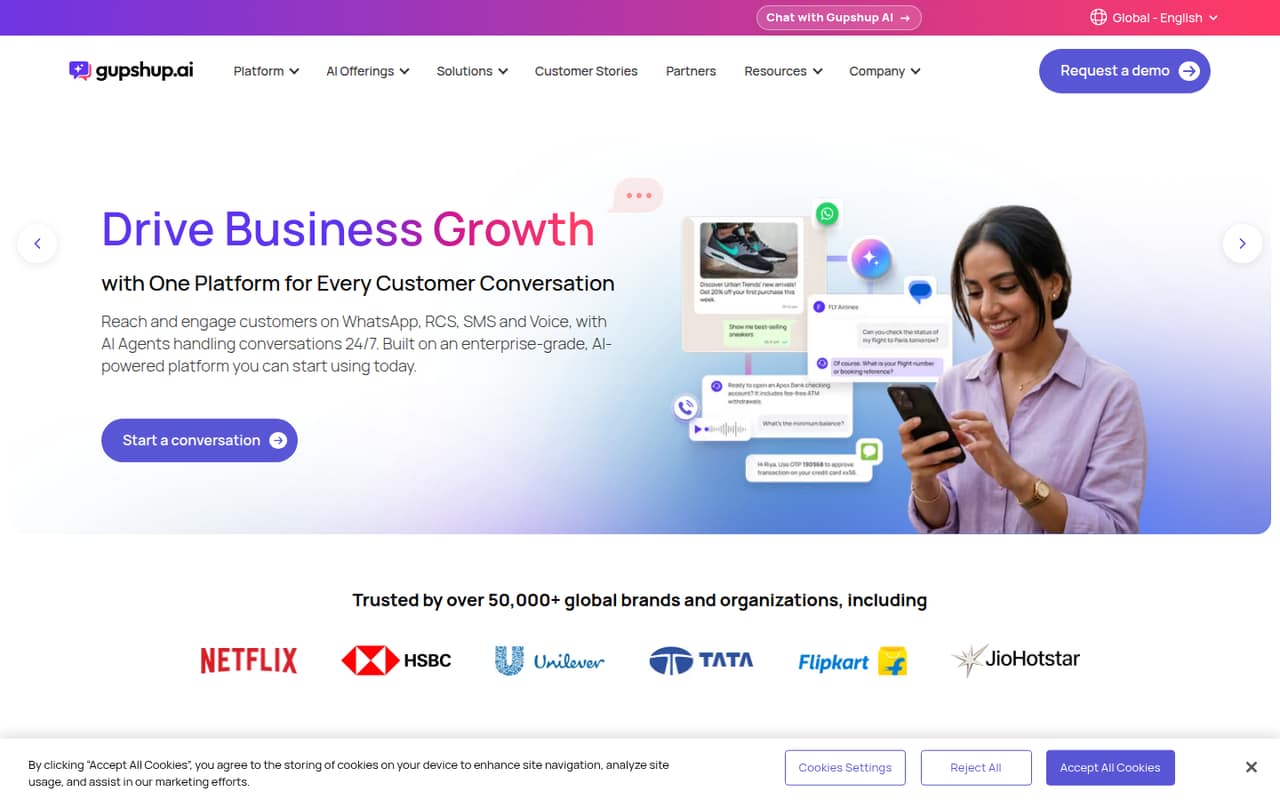
Gupshup is a conversational platform for customer messaging, voice, campaign automation and AI-assisted support. It sits between your customer-facing applications and messaging channels such as WhatsApp, Instagram, SMS and RCS, with Voice also part of its platform positioning. Its tools cover automated conversations, campaign journeys and human-agent support.
The product is presented as an enterprise-grade platform rather than a library, CLI or self-hosted server. Teams can use AI agents for routine interactions, escalate complex cases to human support and use AI Co-Pilot for suggested replies and conversation summaries. Campaigns can trigger from third-party events or signals such as message reads, clicks and journey progression. Gupshup also describes ACE LLM as a fine-tuned model for personalized conversations. The homepage promotes an Avatar Agent for websites that can go live with one line of code. For an engineering team, the key evaluation is how Gupshup connects to existing customer data, event systems and support workflows.
02Gupshup API, SDKs and docs
Gupshup's homepage describes a platform that orchestrates customer conversations across messaging channels, but it does not name an API protocol, SDK, programming language or CLI. The concrete integration surfaces it describes are channel conversations, campaign triggers from third-party events and messaging signals, and a website Avatar Agent that the homepage says can go live with one line of code.
That is not enough detail to choose an implementation path. Before building, confirm in Gupshup's developer documentation which APIs, event-delivery mechanisms, SDKs and languages are supported for your channels and use cases. Ask how authentication, retries, webhook delivery, error handling and version changes work, and whether those details differ by channel. The product also includes campaign automation, AI agents and human escalation, so confirm which parts can be configured in the platform and which require application-side integration. The homepage's product overview does not establish a CLI, plugin ecosystem or specific framework integrations.
03Gupshup pricing for developers
Self-Serve (Pay-as-you-go) lists a $0 monthly platform subscription fee, but Gupshup does not list a free plan. The pricing information lists a $10 minimum prepaid-wallet top-up, then $0.001 per template message and $0.001 per session message. Those platform charges are not the whole bill: Meta or WhatsApp message fees are billed at actuals in addition to Gupshup's fees.
Voice calls are listed at $0.0001 per second. Media files above 64 KB have no Gupshup platform fee, though that statement does not remove the separately billed Meta or WhatsApp fees where applicable. Enterprise pricing is a custom quote with volume-based pricing; seat and usage limits are not published. Traditional overage costs are also not published, so ask how usage is counted, what happens when prepaid funds run out and whether any channel-specific charges apply. Annual pricing and a free trial are not listed.
04Gupshup: open source, self-hosting and lock-in
Gupshup is presented as a platform service, not as an open-source library or self-hosted server. Its homepage does not publish a source license or a self-hosting option. Teams that require on-premises deployment or control over the platform's underlying code should ask Gupshup directly whether those options are available.
Data export terms are not published on the homepage. Before committing, ask what conversation records, campaign definitions, customer attributes and agent configurations can be exported, in what formats, and whether exports remain available after cancellation. Migration effort will depend on how much of the application relies on Gupshup-specific campaign logic, AI agents and channel workflows. A move to another provider may require rebuilding those flows and revalidating channel integrations; plan for that work rather than assuming a portable configuration.
05Gupshup in production
The pricing information does not publish rate limits, service-level commitments, seat limits for Self-Serve or usage limits for Enterprise. It also does not list traditional overage costs. Before launch, confirm throughput by channel, message and API limits, retry behavior, outage handling, support response commitments, data retention and security or compliance documentation for your deployment.
The platform spans multiple channels and combines automated campaigns, AI agents and human escalation. That breadth makes it important to test failure paths in your own integration: delayed or repeated event delivery, unavailable channels, exhausted wallet balance and handoff to a human queue. These are checks to take to the vendor, not documented Gupshup limits. In a Reddit discussion about choosing a WhatsApp API provider, one commenter called Gupshup overkill for limited requirements; another said they were still looking for a provider with affordable pricing and good support. Those comments are anecdotal, but they point to a practical concern: validate support and fit for your scale before moving production workflows.
From the threadsWhat users say
The Reddit discussion is limited and does not establish broad user sentiment. Comments raise concerns about fit, affordability and support, with one commenter saying Gupshup may be excessive for a small use case.
I’m currently evaluating WhatsApp API platforms for my company and I’m torn between **Gupshup** and **WATI**
Both are BSP. ask them if they can provide coexistence
I am yet to find one which is affordable in price and provides good support
Gupchup would be an overkill for your limited requirements
Questions people ask
What is Gupshup used for?
Gupshup provides tools for customer conversations across messaging channels and voice. Its offerings include AI agents, automated campaigns, human support tools, AI-assisted replies and escalation from automated conversations to human teams.
Which messaging channels does Gupshup support?
The homepage lists WhatsApp, Instagram, SMS and RCS for omnichannel conversations, and also promotes Voice. Confirm channel availability and feature coverage for your account and use case with Gupshup before implementation.
Does Gupshup offer an API or SDK?
Gupshup's homepage describes its platform and integrations but does not name an API protocol, SDK or programming language. Check the vendor's developer documentation for current API, SDK and event-delivery support for the channels you need.
Does Gupshup have a free plan?
The pricing information lists no free plan or free trial. Self-Serve (Pay-as-you-go) has a $0 monthly platform subscription fee, but it requires a $10 minimum prepaid-wallet top-up and charges for message usage.
Can Gupshup escalate an AI conversation to a person?
Yes. Gupshup describes escalation of complex cases from AI agents to human support teams. Confirm how routing, agent availability and conversation context work in the specific channel and support workflow you plan to use.