
We may earn a commission if you buy through links on this page. It never changes a score or a ranking. How we make money
The bottom line
A low-friction way to build hosted apps through AI chat, with real limits on control and portability.
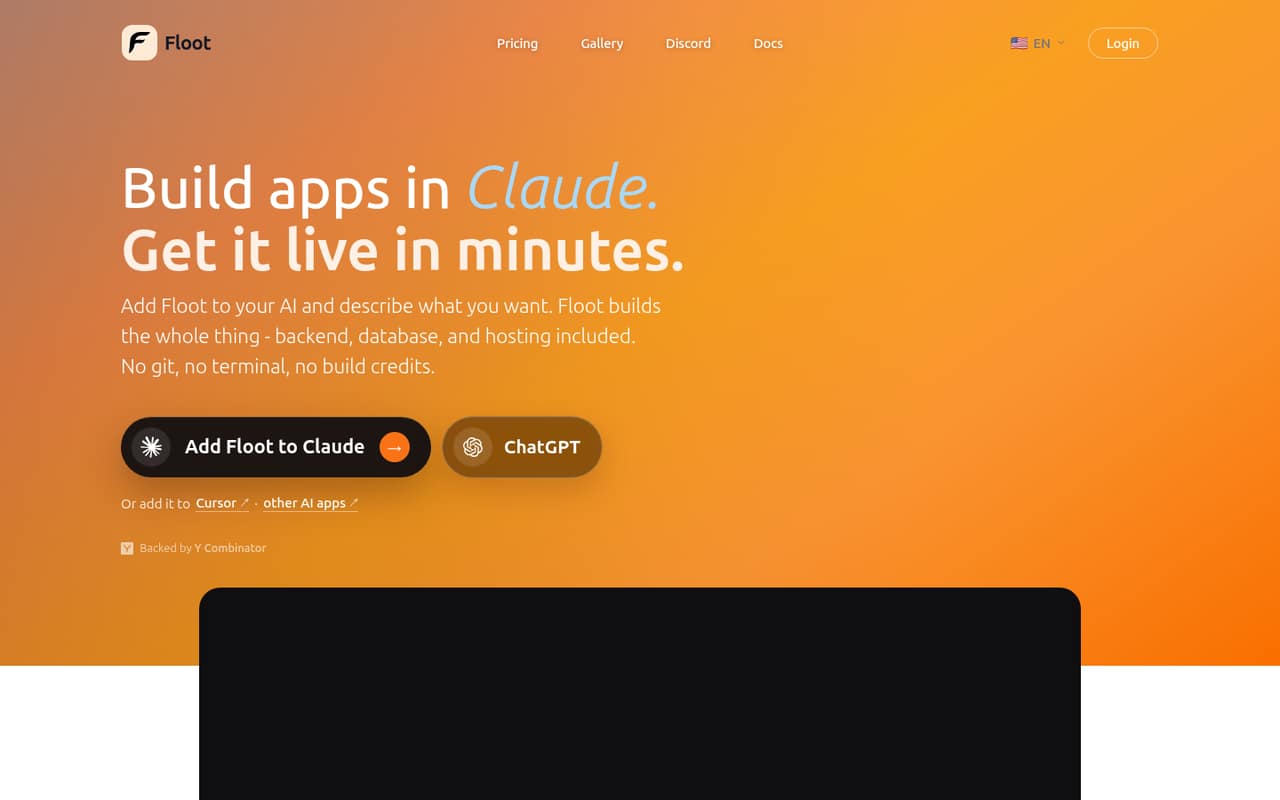
Floot is a hosted app builder that connects to AI clients such as Claude, ChatGPT and Cursor. You describe an app in chat; Floot handles its backend, database and hosting, with web and mobile publishing presented as part of the platform.
The workflow may suit nontechnical builders and prototypes, but developers should verify code and data export, reliability commitments and usage caps before making Floot a production dependency. Paid plans start at $20.83 per month with annual billing, or $25 month to month.
Good fit if
- Nontechnical app builders
- Chat-first prototypes
- Small apps needing managed hosting
Skip it if
- Teams needing self-hosting
- Developers requiring documented APIs
- Projects with strict portability needs
ScoresHow it rates
What works
- Build and refine apps through AI chat
- Backend, database and hosting are included
- Supports web and app-store publishing
- Accounts and recurring tasks are built in
- Free plan includes 100 daily building actions
What doesn't
- Free plan includes no hosting or AI credits
- No published SDK, language or CLI details
- Source code and self-hosting terms are unclear
- Export and migration options are not published
- Uptime, security and compliance details need confirmation
01What Floot is, technically
Floot is a hosted app-building platform that uses an MCP connector to connect an AI client to its app-generation workflow. It is not presented as a library, CLI or self-hosted server. You describe an app in Claude, ChatGPT, Cursor or another AI app; Floot builds the app and provides its backend, database and hosting.
That puts Floot between a conversational AI client and a managed application platform. The intended result is a live app with a database, user accounts and recurring tasks, without setting up those services yourself. The homepage also says apps can publish to the web and app stores, and that you can add features by continuing the conversation. Emails, notifications and SEO essentials are included in the platform offering. This trades direct control over infrastructure for a shorter path from prompt to deployed app. Floot's public pitch does not position it as a code framework you install into an existing stack.
02Floot API, SDKs and docs
The stated integration surface is a Floot connector for Claude, ChatGPT, Cursor and other AI apps. The homepage calls out an MCP walkthrough and describes connecting Floot, prompting the AI to build a project, refining it in chat and publishing it. It also says there is no need for Git or a terminal in that workflow.
For integrations inside an app, Floot lists Stripe payments, Google login, Zapier and other services, with setup guided step by step. The homepage does not name programming languages, SDKs, a CLI, or a REST API or webhook interface. Developers who need those surfaces should confirm SDK and API support in Floot's docs before committing to the platform. The homepage links to a walkthrough, but does not establish the depth of reference documentation, examples or versioning guidance. Treat this as a chat-first managed workflow rather than a documented developer API until the vendor confirms otherwise.
03Floot pricing for developers
Floot has a free plan with 100 building actions per day and two website-to-mobile app builds per month. It includes no hosting and no AI credits, so it is useful for trying the workflow rather than running a hosted production app.
Pro costs $25 per month, or $250 per year ($20.83 per month billed annually). It includes 1,000 daily building actions, 12 website-to-mobile builds per month, $10 of hosting per month, 5,000 AI credits per month, custom domains and one free IONOS domain. Power costs $100 monthly or $1,000 annually ($83.33 per month billed annually); it raises those limits to 5,000 daily actions, unlimited website-to-mobile builds, $25 hosting and 15,000 AI credits per month, with the same domain benefits.
The pricing notes say credits apply only to the optional Floot agent and AI image generation. The pricing page does not publish overage rates or what happens when a plan's allowances run out. Ask Floot about hosting charges and usage behavior before estimating a production bill.
04Floot: open source, self-hosting and lock-in
Floot is presented as a hosted service that manages the app backend, database and hosting. The vendor does not publish a source-code licence or self-hosting option on its homepage, so teams should not assume they can run Floot's platform on their own infrastructure.
The homepage also does not publish app source-code or data export procedures. That leaves migration risk: if an app depends on Floot's managed backend, accounts, recurring tasks or publishing workflow, moving it may require rebuilding those pieces elsewhere. Before using Floot for a business-critical app, ask the vendor what code and data can be exported, in which formats, and whether the generated app can run without Floot's services. Confirm ownership and deletion terms as well. Without those answers, treat portability as an open procurement question, not a supported feature.
05Floot in production
The published plans set daily building-action limits, monthly website-to-mobile build allowances, hosting amounts and AI-credit allowances. Those figures are not service-level guarantees. The vendor does not publish uptime targets, rate limits for a running app, backup and restore details, security certifications or compliance commitments on the homepage. Confirm those points, along with hosting charges beyond the included amount, before depending on Floot for production traffic or sensitive data.
Reddit reports provide examples, not reliability evidence. One r/aigamedev poster said they built a playable dungeon-crawler game despite having no development experience. In an r/floot thread, a user said they launched an app on Apple's App Store; another commenter said its mobile layout required turning the phone sideways to use comfortably. That is a useful reminder to inspect the app on target devices. Ask Floot about monitoring, incident response, data backups and failure handling for recurring tasks before launch.
From the threadsWhat users say
The small Reddit sample leans positive on accessibility and getting projects built or launched. It also includes a practical mobile-layout complaint, so it does not establish production quality or broad user satisfaction.
I am not particularly technical and love how these coding platforms enable me to turn an idea into something functional
I've been using Floot pretty religiously to vibe-code little apps here and there for myself
Quick update. I launched RiffRaff on the Apple App Store today!
Yeah at the moment you have to turn your phone sideways to get any sense of it but you know how it is there's always work to do
Questions people ask
Is Floot free?
Floot has a free plan with 100 building actions per day and two website-to-mobile app builds per month. The plan includes no hosting and no AI credits, so it does not cover a hosted app on its own. Pro starts at $25 per month, or $20.83 per month with annual billing.
How much does Floot cost?
Floot lists Pro at $25 monthly or $250 annually, equivalent to $20.83 per month when billed annually. Power is $100 monthly or $1,000 annually, equivalent to $83.33 per month annually. A free plan is also listed. Check the current pricing page for terms before purchasing.
Can Floot publish apps to app stores?
Floot's homepage says apps can publish to the web and app stores, and its plans specify monthly allowances for website-to-mobile app builds. A user in an r/floot thread reported launching an app built with Floot on Apple's App Store. Confirm the publishing steps and any platform-specific requirements with Floot.
Does Floot have an API or SDK?
Floot describes connecting to AI clients through a connector and provides a walkthrough for Floot MCP. Its homepage lists integrations such as Stripe, Google login and Zapier, but does not name programming-language SDKs or a REST API. Check Floot's docs or ask the vendor to confirm support for the interfaces your project needs.
Can I self-host a Floot app or export its data?
Floot presents itself as a hosted platform, and its homepage does not publish a self-hosting option, source-code licence or data-export procedure. Ask the vendor what application code and data you can export, in what formats, and whether your app can run without Floot's backend and hosting before building a production dependency.
Sources
- Floot homepage
- Floot pricing, compiled via web search from floot.com, tooljunction.io
- Reddit: I Created a Dungeon Crawler RPG - 100% vibe-coded, no dev experience
- Reddit: Just launched Floot on product hunt!
- Reddit: First Floot App - Like twitter but anonymous and for just your neighborhood
- Reddit: Base 44 vs. Floot vs. Lovable vs. GPT-5 vs. WP AI Builder (Perplexity comparison