
We may earn a commission if you buy through links on this page. It never changes a score or a ranking. How we make money
The bottom line
Broad incident lifecycle coverage and 350+ API endpoints, with pricing and production limits to verify.
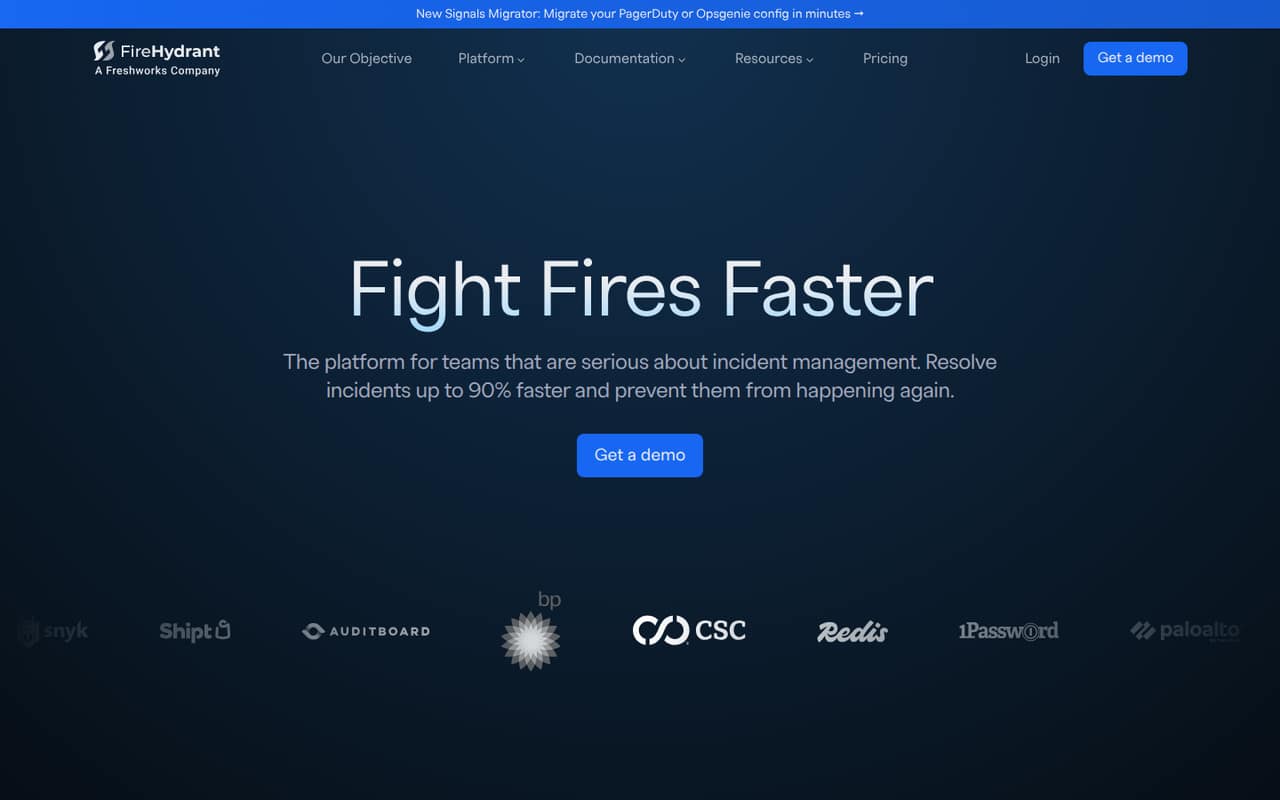
FireHydrant is an incident-management platform for planning, coordinating and reviewing incidents. It combines on-call and alerting, runbooks, a service catalog, collaboration in Slack or Teams, AI features, status pages and analytics. The vendor lists 350+ API endpoints, Terraform support and SDKs.
The main fit is teams that want incident workflows and reliability follow-up in one product. Pricing starts with a free plan, while Pro is $25 per responder per month billed annually. Reddit feedback is mixed: users praise flexibility, while others report API issues and concerns about Signals.
Good fit if
- Teams standardizing incident response
- Slack- or Teams-based operations
- Organizations automating incident workflows
Skip it if
- Teams requiring verified self-hosting
- Buyers needing published API limits
- Organizations avoiding responder-based pricing
ScoresHow it rates
What works
- Covers preparation, response and retrospectives
- 350+ API endpoints, per the vendor
- Terraform support and SDKs
- Incident collaboration in Slack or Teams
- Free plan includes up to 10 responders
What doesn't
- SDK languages are not named on the homepage
- Pro monthly-billing price is not published
- Signals alert rates are not published
- API rate limits need confirmation
- Reddit users report API and Signals concerns
01What FireHydrant is, technically
FireHydrant is an incident-management platform presented as a service for preparing for, coordinating and reviewing production incidents. It sits alongside the operational tooling that detects failures: on-call and alerting identify who should respond, while runbooks, incident collaboration and status pages coordinate the work. A service catalog records service ownership and dependencies; retrospectives and analytics support follow-up.
The product combines incident workflows with reliability features rather than serving as an observability backend. Its homepage describes AI-generated incident summaries, updates, transcripts and retrospectives, plus Slack and Teams collaboration. The vendor also lists 350+ API endpoints, Terraform support and SDKs, positioning FireHydrant as a configurable system that can connect to existing infrastructure and workflows. The homepage does not describe a self-hosted deployment option, so teams should confirm deployment and data-residency requirements with the vendor before treating it as part of a regulated or tightly controlled stack.
02FireHydrant API, SDKs and docs
The vendor says FireHydrant has 350+ API endpoints, Terraform support and SDKs. It does not name SDK languages or describe the API protocol on its homepage. Check the vendor’s documentation for supported languages, authentication, endpoint behavior, pagination and rate limits before building automation; do not assume a particular SDK or protocol.
The product surface named by the vendor includes incident workflows, runbooks, service catalog, status pages and analytics. Teams can manage incidents in Slack or Microsoft Teams, and the AI features include live video transcriptions for Zoom and Google Meet. FireHydrant also advertises a Signals Migrator for PagerDuty or Opsgenie configurations. These are useful integration points, but buyers should confirm exactly which data and settings migrate and what each integration supports. For infrastructure-as-code, check the Terraform provider’s coverage against the resources your team needs. Ask the vendor for current API limits and a supported integration path for any workflow that must create or update incidents automatically.
03FireHydrant pricing for developers
FireHydrant has a free plan for up to 10 responders, with two runbooks, one public status page and three integrations. Pro costs $25 per responder per month when billed annually; the vendor does not publish a monthly-billing price. Pro includes five runbooks, one retrospective template, unlimited public status pages, 10 custom fields and five integrations. Enterprise pricing is custom, with unlimited runbooks, retrospective templates, custom fields and integrations, plus premium support.
The main usage dimension is responders on Pro, so the subscription grows as more responders need access. Signals on-call and alerting charges are based on alerts sent, but rates are not published. SMS and voice notifications are also paid add-ons with unpublished prices. Ask for a quote using expected responder and alert volumes, and clarify whether a 14-day trial applies to the plan you are evaluating. The free plan is a useful starting point, but its runbook and integration caps may constrain production workflows.
04FireHydrant: open source, self-hosting and lock-in
The vendor does not publish a source-availability or open-source licence statement in its product description, and it does not describe a self-hosting option there. Treat FireHydrant as a vendor-operated platform unless the vendor confirms otherwise; teams that require an on-premises deployment should get that answer before committing.
The homepage mentions 350+ API endpoints and Terraform support, but does not describe data-export formats, export coverage or a migration path away from the service. That leaves important lock-in questions open: can you export incidents, service catalog records, runbooks, retrospectives and audit history in usable formats, and can automation recreate those records elsewhere? Ask for a sample export and contract terms covering data access and deletion. The vendor advertises a Signals Migrator for PagerDuty or Opsgenie configurations, but that is an inbound migration tool, not evidence of a complete outbound export.
05FireHydrant in production
FireHydrant advertises SOC 2 compliance, SSO, RBAC, audit logs and SCIM for enterprise use. Before production rollout, confirm which plan includes each control, how incident data is retained, and what uptime and support commitments apply. The homepage does not publish API rate limits, so validate expected request volume and throttling behavior with the vendor, particularly if Signals or custom automation will create incidents at scale.
Reddit reports are mixed. One r/sre poster said a team-creation request returned HTTP 200 without creating a team, and reported account-level rather than token-level rate limiting. A commenter on another r/sre thread said they had noticed API abnormalities with Signals after the Freshworks acquisition. These are individual reports, not a reliability measurement, but they make API verification important: test failure handling, inspect resulting records and confirm escalation paths before depending on automation. Ask about current issue status and support response commitments.
Questions people ask
What does FireHydrant do?
FireHydrant helps teams prepare for, coordinate and review incidents. Its features include runbooks, on-call and alerting, a service catalog, incident collaboration in Slack or Teams, status pages, AI-generated summaries and retrospectives, and analytics for tracking MTTx and patterns.
Does FireHydrant have an API and SDKs?
The vendor says FireHydrant has 350+ API endpoints, Terraform support and SDKs. Its homepage does not name SDK languages or the API protocol. Check the vendor’s documentation for supported languages, authentication details, current rate limits and endpoint coverage before building an integration.
How much does FireHydrant cost?
FireHydrant offers a free plan with up to 10 responders. Pro costs $25 per responder per month when billed annually; the vendor does not publish a monthly-billing price. Enterprise pricing is custom. SMS and voice are paid add-ons, and Signals charges based on alerts sent, with rates not published.
Can FireHydrant migrate PagerDuty or Opsgenie configurations?
FireHydrant advertises a Signals Migrator for PagerDuty or Opsgenie configurations. Confirm with the vendor which configuration elements it imports, whether it migrates historical data, and what manual work remains. The migration announcement does not establish that all settings or records transfer.
Can we self-host FireHydrant or export our data?
The vendor’s product description does not publish a self-hosting option, open-source licence or data-export specification. Ask FireHydrant about deployment choices, export formats and coverage, retention, deletion terms, and whether incidents, runbooks, service catalog data and audit history can be moved out.