
We may earn a commission if you buy through links on this page. It never changes a score or a ranking. How we make money
The bottom line
Daytona gives AI agents isolated, stateful sandboxes, billed by compute usage.
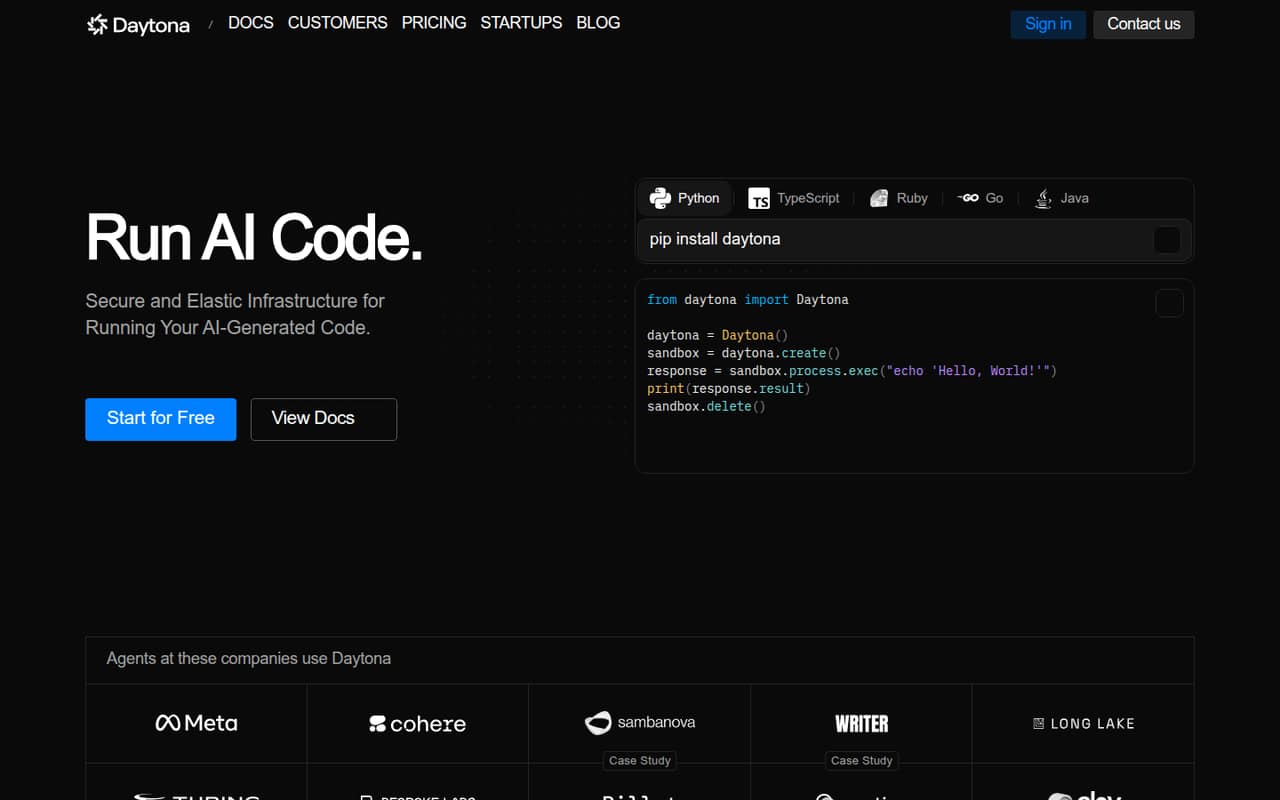
Daytona is hosted infrastructure for creating isolated environments to execute AI-generated code and agent workflows. Its API covers process execution, files, Git and language-server operations, with SDKs named for Python, TypeScript, Ruby, Go and Java. The homepage claims sandbox creation in under 90ms.
The $200 free compute credit makes it possible to start without a subscription, while production costs depend on resources and runtime. Per-second billing and published hourly rates help estimate compute spend, but teams should confirm limits, reliability commitments and self-hosting options before building a production dependency.
Good fit if
- AI agents that execute generated code
- Parallel code evaluation workflows
- Teams needing stateful sandboxes
Skip it if
- Teams requiring verified self-hosting
- Workloads needing published rate limits
- Projects with fixed monthly compute budgets
ScoresHow it rates
What works
- Sandbox creation claimed in under 90ms
- SDKs named for five programming languages
- Process, file, Git and LSP operations
- $200 in free compute to start
- Per-second billing with published resource rates
What doesn't
- Free compute is a credit, not unlimited usage
- No subscription price is listed
- Vendor does not publish sandbox rate limits
- Licence and self-hosting options are unpublished
- Production reliability commitments need confirmation
01What Daytona is, technically
Daytona is hosted infrastructure that creates isolated, stateful sandboxes for executing AI-generated code and agent workflows. It sits between an application or agent runtime and the code it needs to run: your software calls Daytona to create a sandbox, execute commands, manage files or work with Git, then removes the sandbox when finished.
The target problem is running generated or untrusted code away from the application’s own infrastructure. Daytona also positions sandboxes as environments for parallel agent workflows, evaluations, code interpretation and data analysis. Its homepage claims creation in under 90ms and describes real-time output for code execution. Those are vendor claims, not a substitute for checking behavior against your own workload. The architecture is useful when agents need isolated execution and state between operations; it is less compelling if your application only needs to launch a short-lived local process or already operates its own sandbox layer.
02Daytona API, SDKs and docs
The homepage names Python, TypeScript, Ruby, Go and Java, and shows a Python SDK installation with pip install daytona. Its Python example creates a Daytona client, creates a sandbox, runs a process command and removes the sandbox. A second example uses CreateSandboxParams to select Python, then calls sandbox.process.code_run and sandbox.process.exec.
The integration surface includes process execution, file-system CRUD with granular permissions, native Git operations with secure credential handling, and built-in language-server features. Daytona also describes a RESTful API for coding-agent workflows. The homepage links to documentation, but the shown examples and feature list are not a complete API reference; check the vendor docs for method coverage, authentication, versioning and error handling before choosing an SDK. A CLI is not named on the homepage, so confirm CLI support in the vendor docs if it is part of your deployment workflow.
03Daytona pricing for developers
Daytona lists Free compute at $0 per month with $200 in compute credit; the free trial requires no credit card. The credit is a spending allowance, not an unlimited sandbox tier. Pay-as-you-go includes another $200 in free compute and bills usage per second. The pricing page lists no monthly or annual subscription price, and says volume discounts apply as usage scales.
Published hourly rates are $0.0504 per vCPU and $0.0162 per GiB of memory. Storage costs $0.000108 per GiB per hour after the first 5 GiB. Windows costs $0.0858 per vCPU per hour. GPU rates vary by model and availability: for example, an RTX 4090 is $0.57 per hour preemptible or $0.99 on demand; an H100 is $2.27 preemptible or $3.95 on demand. Enterprise has custom pricing and lists larger limits, SSO, audit logs and BYOC. Estimate costs from sandbox size and active time, then confirm how the free credit applies to your workload.
04Daytona: open source, self-hosting and lock-in
Daytona presents its sandbox infrastructure as a service accessed through APIs and SDKs. The vendor does not publish the software licence, source availability, self-hosting instructions or a data-export process on its homepage and pricing details. Enterprise lists BYOC, but that should not be treated as confirmation that the full platform can be self-hosted; ask Daytona what BYOC includes and which components remain vendor-operated.
The shown Python integration has a Daytona client create and remove sandboxes, while the product exposes process, file, Git and LSP operations. An application built around those interfaces will need changes if it moves to a different execution provider or an in-house sandbox system. Keep agent state and durable application data outside the sandbox unless Daytona confirms export and persistence behavior for your plan. Before committing, ask for the licence, deployment architecture, data-retention rules and a tested migration path.
05Daytona in production
Daytona’s isolation, stateful environments and parallel execution address useful production requirements for agent systems. The homepage also claims sub-90ms sandbox creation, but a team should validate startup time, concurrency and real-time output under its own workload before relying on those figures. Ask the vendor for service-level commitments, regional availability, recovery behavior and support response terms.
The pricing page lists Enterprise features including larger limits, SSO, audit logs and BYOC. It does not give numeric limits for the other plans, so confirm concurrency, sandbox lifetime, resource ceilings and API rate limits before sizing a deployment. Model costs with the published per-second billing and hourly resource rates, including storage and any GPU or Windows use. Review how sandbox state, Git credentials and untrusted code are isolated, and confirm retention and access controls with the vendor. Those details matter more as agent workflows handle sensitive data or run at scale.
Questions people ask
What does Daytona do?
Daytona provides isolated, stateful sandboxes for running AI-generated code and agent workflows. Its API and SDKs let applications create sandboxes and operate on processes, files, Git repositories and language-server features. The product is aimed at code execution, agent workflows, evaluations and related tasks that need separated runtime environments.
Which programming languages does Daytona support?
The Daytona homepage names Python, TypeScript, Ruby, Go and Java. It shows a Python SDK installation using pip install daytona and Python examples for creating sandboxes and executing code or commands. Check the vendor docs for the current SDK coverage and supported language options for sandbox execution.
Does Daytona have a free plan?
Daytona lists a Free compute plan at $0 per month with $200 in free compute. The pricing information also says the free trial requires no credit card. The credit is finite; usage beyond the included allowance should be budgeted under Daytona’s usage-based rates.
Can Daytona run untrusted code safely?
Daytona describes isolated sandboxes for AI-generated and untrusted code. It also lists process execution, file operations and secure Git credential handling. Isolation is a product feature, not a substitute for reviewing your threat model: ask Daytona about boundaries, permissions, network access and data handling before running sensitive workloads.
Can we self-host Daytona?
The vendor does not publish self-hosting instructions or a licence on its homepage. Enterprise lists BYOC, but the scope of that option needs confirmation with Daytona. Ask whether the control plane and sandbox runtime can run in your environment, what components remain hosted, and how data can be exported if you migrate.