
We may earn a commission if you buy through links on this page. It never changes a score or a ranking. How we make money
The bottom line
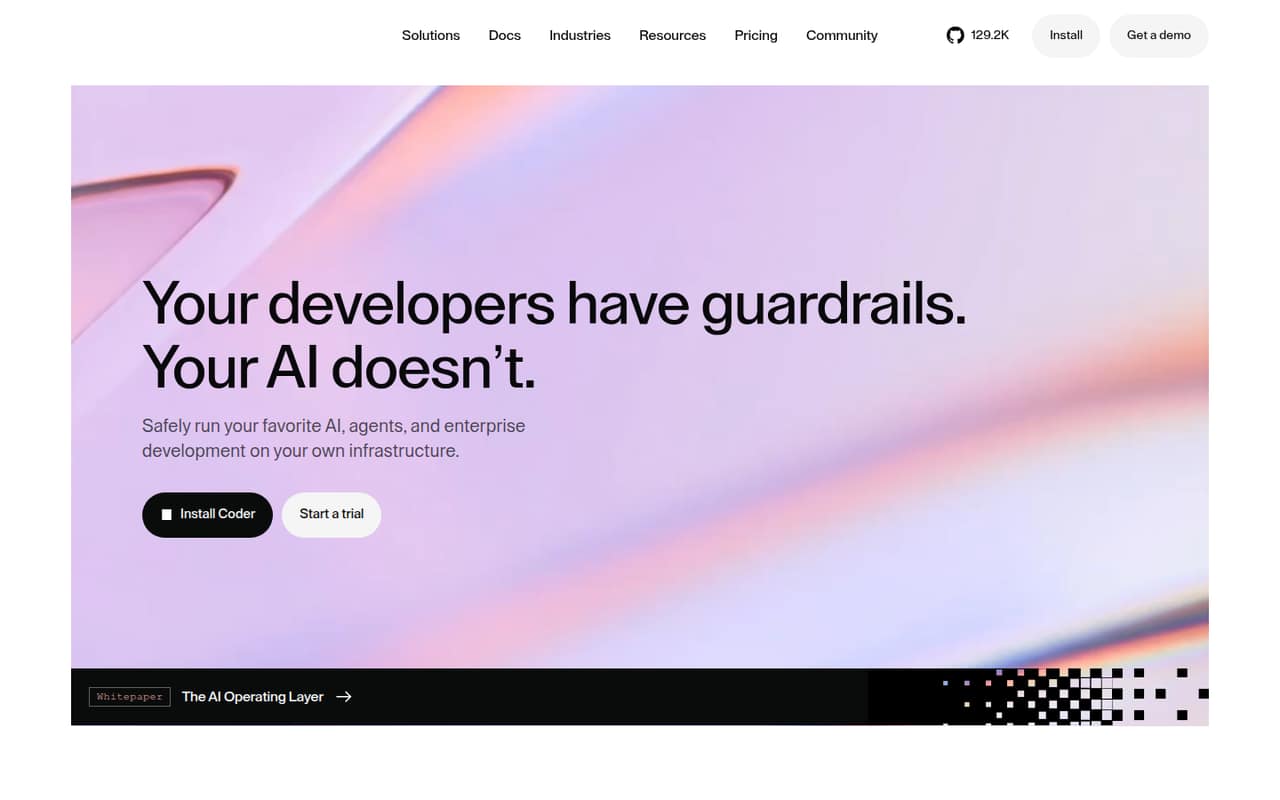
Coder puts development workspaces and AI agents on infrastructure your organization controls.
Coder is self-hosted infrastructure for standardized developer workspaces, native AI coding agents and centralized AI governance. Teams can use models and agents of their choosing while keeping environments on infrastructure they control.
Community is free and includes unlimited self-hosted workspaces, up to five concurrent Coder Agents and unlimited Agent Hours. Premium and AI Premium require custom pricing. Before adopting it, confirm the integration interfaces, licence, export options and production support terms with Coder.
Good fit if
- Teams standardizing self-hosted workspaces
- Enterprises governing AI agent use
- Organizations choosing their own infrastructure
Skip it if
- Teams seeking a hosted IDE service
- Developers requiring a documented SDK
- Buyers needing published fixed enterprise prices
ScoresHow it rates
What works
- Self-hosted workspaces run on infrastructure you control
- Community includes unlimited self-hosted workspaces
- Community includes unlimited Agent Hours
- Use any AI model or agent
- Centralized governance offers visibility and auditability
What doesn't
- Premium and AI Premium prices require a custom quote
- Community seat limit is not published
- Agent concurrency is capped at five on Community and Premium
- Licence and source availability are not published
- Homepage does not name API or SDK interfaces
01What Coder is, technically
Coder is self-hosted development infrastructure, not a hosted IDE or a model API. It provides standardized workspaces for developers and agents, plus native AI coding agents and centralized governance. Organizations run it on infrastructure they control, positioning Coder between developer tooling and the compute environments where code and agents run.
The platform addresses environment consistency and AI oversight. Workspaces give developers and agents a shared, controlled development environment; governance centralizes model access and provides visibility, observability and auditability across AI usage. Teams can choose their AI models and agents rather than being tied to one model provider, according to Coder's homepage.
That architecture suits organizations that need to set policies around development environments and AI use. It also means the buyer is responsible for planning the infrastructure Coder runs on. The homepage does not describe a hosted service that removes that operational responsibility, so teams should account for deployment and ongoing environment management in their stack.
02Coder API, SDKs and docs
Coder's integration surface, as described on its homepage, is its self-hosted workspaces, native AI agents and centralized model access. The homepage describes using any AI model or agent, with policy-controlled environments and oversight across AI usage. It does not name an API style, SDK, programming language, CLI, webhook or plugin interface. Treat Coder as infrastructure to deploy and govern, not as a documented SDK integration based on the homepage alone.
Before building automation around Coder, confirm supported interfaces, authentication, workspace provisioning and agent configuration in the vendor's documentation. Ask which SDKs and languages are supported, whether integrations use a REST API or other interface, and what versioning and compatibility guarantees apply. Coder's homepage links to product information for Workspaces, Agents and AI Governance, but does not establish a specific integration contract. That leaves implementation effort difficult to estimate from the homepage; teams should validate the required workflows before making it part of a production toolchain.
03Coder pricing for developers
Community is free and includes unlimited self-hosted workspaces, up to five concurrent Coder Agents and unlimited Agent Hours. Its seat limit is not published, so confirm whether your intended team size fits before rolling it out. The free plan does not remove the need to provide infrastructure for self-hosted environments.
Premium is billed annually per user at a custom quote. It supports thousands of developers worldwide and includes up to five concurrent Coder Agents and unlimited Agent Hours. AI Premium is also custom-priced, with unlimited concurrent Coder Agents; those agents draw from allotted Agent Hours, but the allocation is not published. Monthly prices are not published, and no add-ons or overage rates are listed.
The bill therefore depends on the quoted plan and, for self-hosting, the infrastructure your organization supplies. Ask Coder how Premium seat counts, AI Premium Agent Hours, additional usage and any support or service terms affect the quote. Do not assume unlimited Agent Hours on Community or Premium means unlimited infrastructure capacity.
04Coder: open source, self-hosting and lock-in
Coder supports self-hosted infrastructure, so organizations can run development environments on infrastructure they control. That is a deployment option, not proof that the software is open source. The vendor does not publish the licence or source availability on its homepage; ask Coder what rights apply to the edition you plan to deploy and modify.
The homepage also does not describe data export or migration procedures. Before adoption, confirm how workspace configuration, policies, agent settings and audit records can be exported, and what formats are available. Coder's model choice can reduce dependence on a single AI model provider, but it does not by itself establish that workspace definitions or governance policies are portable to another platform. Build a migration and data-retention plan into procurement rather than assuming self-hosting eliminates product lock-in.
05Coder in production
Coder's self-hosted model gives organizations control over the infrastructure running development environments, while its governance features are intended to centralize model access and provide visibility, observability and auditability across AI use. Those controls are relevant to enterprise deployments, but buyers should validate how they map to their security and compliance requirements before relying on them.
Capacity depends on the plan: Community and Premium list up to five concurrent Coder Agents, while AI Premium lists unlimited concurrency subject to allotted Agent Hours. The vendor does not publish the Agent Hours allocation or a seat limit for these plans. Ask about concurrency behavior, usage accounting, scaling requirements and what happens when an allowance is exhausted.
The homepage does not publish reliability targets or support response terms. Confirm deployment prerequisites, upgrade and recovery procedures, security documentation and production support in the sales process. Also check infrastructure sizing and the limits of audit data retention before making Coder part of a critical development workflow.
Questions people ask
Is Coder a hosted IDE?
Coder describes itself as self-hosted development infrastructure. Its Workspaces provide standardized development environments on infrastructure an organization controls. The homepage does not describe Coder as a hosted IDE service, so teams should plan for the infrastructure and operational work required to run their deployment.
Can Coder use different AI models and agents?
Yes. Coder says developers can use any AI model or agent, and describes native AI coding agents with a model of your choosing. Its AI Governance features centralize model access and policy-controlled environments. Confirm which specific models and agents are supported for your deployment with Coder.
What is included in Coder Community?
Community is free and includes unlimited self-hosted workspaces, up to five concurrent Coder Agents and unlimited Agent Hours. The seat limit is not published. Because the workspaces are self-hosted, confirm the infrastructure requirements and whether the plan's seat limit fits your team.
Does Coder provide an API or SDK?
Coder's homepage describes Workspaces, Agents and AI Governance, but does not name an API style, SDK, programming language or CLI. Ask Coder which interfaces and SDKs are supported for your required workflows, and check its documentation for authentication, versioning and compatibility details.
Can we export data or move away from Coder?
The homepage does not describe data export or migration procedures. Before adopting Coder, ask how to export workspace configuration, policies, agent settings and audit records, including the available formats. Also confirm which configurations can be reused outside Coder and what data-retention terms apply.