
We may earn a commission if you buy through links on this page. It never changes a score or a ranking. How we make money
The bottom line
Good fit for Meta-first chat sales; verify developer limits and portability before building around it.
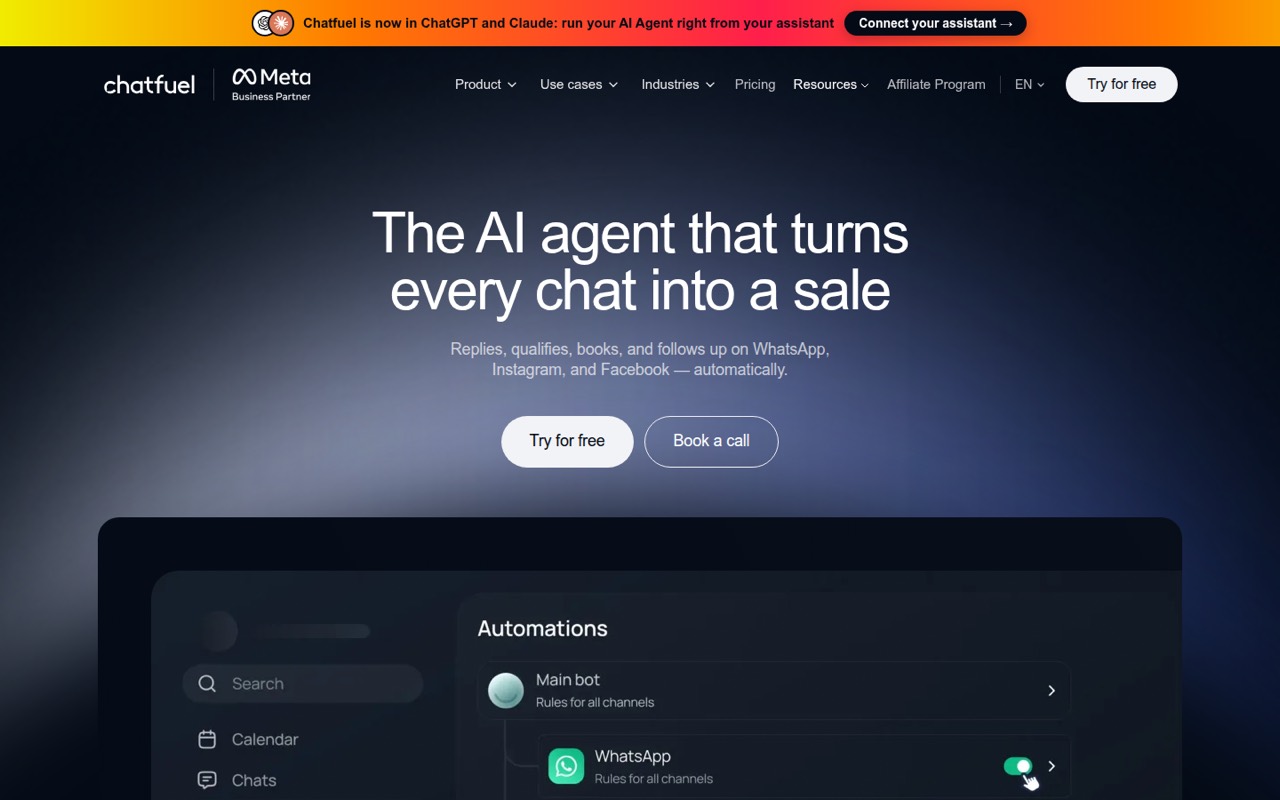
Chatfuel is a hosted platform for automating sales conversations on WhatsApp, Instagram and Facebook. It combines replies, lead qualification, bookings, payment links and a lead pipeline, with no-code setup and an SDK and API for custom work.
It is strongest when a business wants to sell through Meta messaging without building its own bot infrastructure. The vendor’s annual plans start at $18 per month equivalent, but are paid yearly; monthly-billed prices and key developer details such as API rate limits are not published.
Good fit if
- Businesses selling through Meta messaging
- Agencies managing client chat automation
- Developers building branded chat experiences
Skip it if
- Teams needing published API limits
- Projects requiring self-hosted infrastructure
- Multilingual flows needing proven segmentation
ScoresHow it rates
What works
- Automates replies across WhatsApp, Instagram and Facebook
- Combines qualification, bookings and follow-ups
- Payment links and order confirmation stay in chat
- Lead cards provide a built-in sales pipeline
- Offers an SDK and API for custom builds
What doesn't
- No ongoing free plan is listed
- Monthly-billed plan prices are not published
- SDK languages and API limits need confirmation
- Source availability, self-hosting and export options are unclear
- Reddit users report gaps in language logic and segmentation
01What Chatfuel is, technically
Chatfuel is a hosted messaging-automation platform, not a self-hosted bot server or a standalone library. Businesses configure chat flows in its platform, connect WhatsApp, Instagram or Facebook, and use it to handle replies, lead qualification, bookings, follow-ups and sales handoffs. The platform also turns conversations into lead cards and provides creative-level ad reporting in its automation dashboard.
In a typical stack, Chatfuel sits between a customer’s messaging channel and a business’s sales process. It can answer questions, ask qualification questions, send a payment link, confirm an order and schedule a booking without a separate CRM subscription, according to the vendor. The homepage also positions its SDK and API as a way to build AI-powered experiences into products or create a white-label agent platform. That makes Chatfuel both a no-code business tool and a potential integration component, though the vendor’s public homepage gives more detail about the no-code product than the developer surface.
02Chatfuel API, SDKs and docs
The vendor names a Chatfuel SDK and API for developers, including a path to build a white-label agent platform. Its homepage describes a one-command setup for that platform and says the SDK can integrate AI-powered experiences into products. It also offers step-by-step docs for setting up an agency, connecting a client, building a qualification bot and running ads.
The homepage does not name SDK languages, API endpoints, authentication methods, request formats, webhooks or a CLI. Before writing an adapter or committing to a production integration, confirm supported languages, API style, versioning, error behavior and rate limits in Chatfuel’s developer docs. The business product’s named channel integrations are WhatsApp, Instagram and Facebook; it is built on the official WhatsApp Business API, according to the vendor. That channel support does not by itself establish which functions are exposed to developers. Plan for a proof of integration against the specific operations your product needs, especially if you require custom data sync or handoff to another system.
03Chatfuel pricing for developers
Chatfuel’s pricing page lists no free plan, although the homepage has a “Try for free” call to action. The listed prices are annual-billing monthly equivalents: Business S is $18 per month for $20 in AI credits, one bot and about 330 chats; Business M is $40.50 for $50 in credits and about 826 chats. Higher Business plans run from Business L at $81 to Business XXL at $366.67 per month equivalent, with estimated chat volume rising to about 8,260.
Agencies start at Agency S for $90 per month equivalent, with three companies and about 1,652 chats. Agency M through Agency XXL range from $202.50 to $1,845, with unlimited companies and estimated volume up to about 41,301 chats. Annual billing is paid for the year; monthly-billed prices are not published. Chat estimates are the page’s estimates, not a guaranteed request allowance. Credit packs and auto-reload are available, but pack prices are not published. Other listed charges include $10 per bot for coworker setup, $0.020 per lead event sent to Meta, and WhatsApp templates at Meta’s rate plus 10%.
04Chatfuel: open source, self-hosting and lock-in
Chatfuel is presented as a hosted business platform with an SDK and API; the vendor doesn’t publish its source availability, licence, self-hosting options or data-export process on the homepage. Don’t assume that access to an SDK means you can run the platform yourself or take its underlying code with you.
That leaves portability as a procurement question. Ask whether you can export contacts, conversation histories, lead cards, automation logic and channel configuration in usable formats, and whether those exports include identifiers needed to reconnect records elsewhere. Also ask what happens to data and channel connections if an account closes. A migration would likely involve rebuilding flows and reconnecting messaging channels in the replacement platform; how much work that entails depends on what Chatfuel lets you export and what your business has built. Get those answers before using the lead pipeline as your only system of record.
05Chatfuel in production
Chatfuel’s production fit depends on channel access, usage and how much of the sales process you put in its pipeline. The vendor says it is built on the official WhatsApp Business API and is Meta-approved; confirm the account setup, applicable messaging rules and template charges for your deployment. The pricing page lists AI-credit allowances and estimated chat volumes, but the vendor doesn’t publish API rate limits. Ask about request throttling, retry behavior, uptime commitments, incident handling and what happens when credits run out before routing critical work through it.
A Reddit review describes setup as fast and reports it played well with Meta’s ecosystem, but also flags scaling across platforms and multiple languages. Other Reddit users report weaker multi-language logic and segmentation than they wanted; one commenter said a Chatfuel flow had lower conversion than the same flow on ManyChat, while noting it could have been coincidence. Treat these as individual reports, not controlled comparisons. Validate language handling, segmentation, handoff and recovery behavior with your own requirements before scaling.
From the threadsWhat users say
Reddit sentiment is mixed. Users praise the quick Meta-focused setup, while some report limitations in multilingual logic, segmentation and comparative conversion results.
It’s fast to set up, plays nice with Meta’s ecosystem, and doesn’t require coding
AI" is only 25% of the puzzle. And automation is the other 75%
We ran the same flow on Chatfuel and ManyChat — conversion rates were 20–30% higher on ManyChat
We tested Chatfuel vs. ManyChat and found Chatfuel lacking in multi-language logic and segmentation
Questions people ask
What is Chatfuel used for?
Chatfuel automates business conversations on WhatsApp, Instagram and Facebook. It can reply to messages and comments, qualify leads, send payment links, confirm orders, manage bookings and follow up. It also turns chats into lead cards and includes creative-level ad reporting in its automation dashboard.
Does Chatfuel have an API and SDK?
Yes. Chatfuel’s homepage offers an SDK and API for building AI-powered experiences into products and creating a white-label agent platform. The homepage doesn’t name SDK languages, API endpoints or rate limits, so confirm those details in the developer docs before planning an integration.
Is Chatfuel free?
The pricing page lists no free plan, though the homepage has a “Try for free” call to action. Check with Chatfuel what that offer includes and whether it is a trial or another limited-access option. The listed paid plans use annual billing, with monthly equivalents starting at $18.
Can Chatfuel take payments and bookings in chat?
The vendor says Chatfuel can send a payment link in a conversation and confirm an order after payment. It also supports chat-based slot selection, booking confirmations, reminders and calendar syncing. Check which payment and calendar connections are supported for your channels and region before relying on them.
Can I self-host Chatfuel or export my data?
Chatfuel is presented as a hosted platform, but the vendor doesn’t publish its self-hosting or data-export options on the homepage. Ask about exporting contacts, conversation history, lead records and flow configuration before making it the only place you store sales data.