
We may earn a commission if you buy through links on this page. It never changes a score or a ranking. How we make money
The bottom line
A free GPL desktop editor for code and websites, not an API-driven development platform.
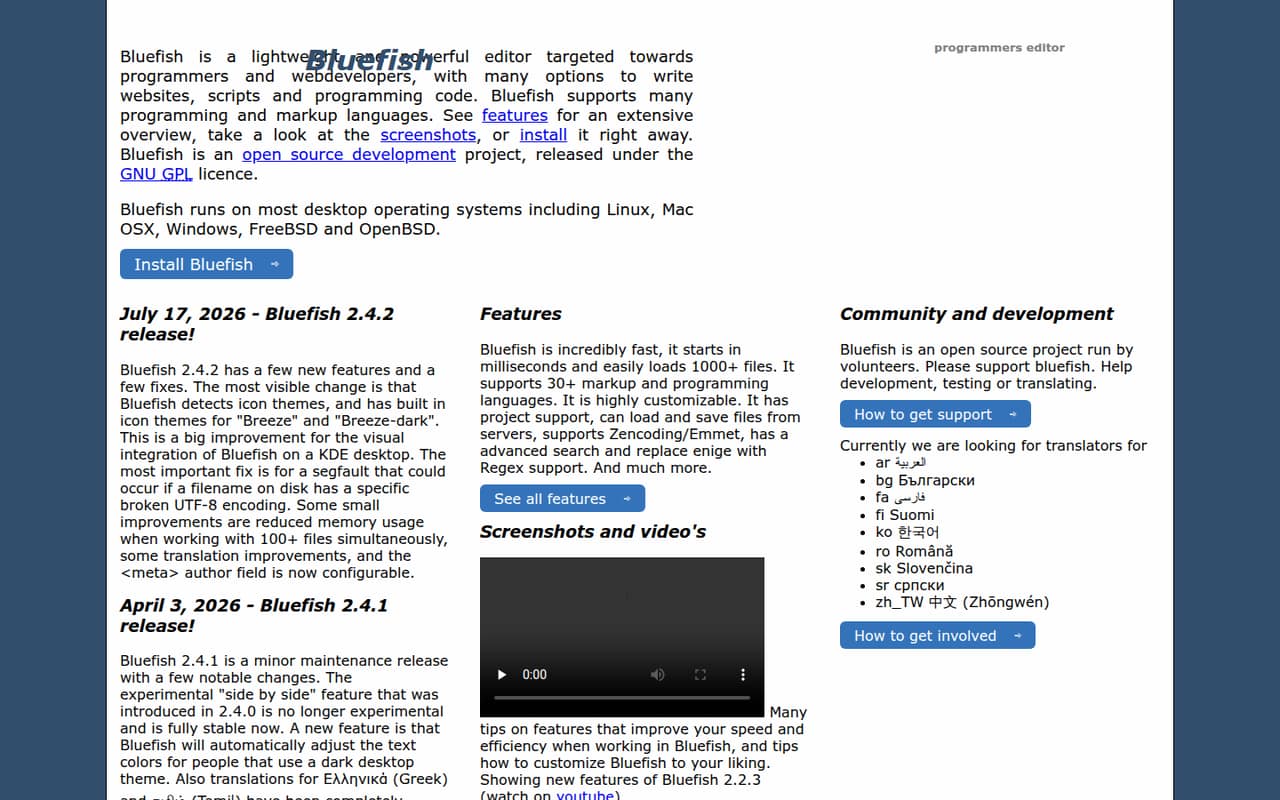
Bluefish is a lightweight desktop editor for websites, scripts, and programming code. It supports 30+ markup and programming languages, project support, regex search and replace, Zencoding/Emmet, and loading and saving files from servers. The vendor says it can load 1,000+ files.
Bluefish is free and open source under the GNU GPL, and runs on Linux, Mac OS X, Windows, FreeBSD, and OpenBSD. It is a local editing tool, not a hosted IDE or developer API. The vendor does not publish usage-based pricing, seat limits, or service-level commitments.
Good fit if
- Developers who want a free desktop editor
- Web developers editing server-side files
- Projects needing broad markup-language support
Skip it if
- Teams requiring a hosted collaborative IDE
- Developers building around editor APIs or SDKs
- Organizations needing a published support SLA
ScoresHow it rates
What works
- Free and open source under the GNU GPL
- Runs on Linux, Mac OS X, Windows, FreeBSD, and OpenBSD
- Supports 30+ markup and programming languages
- Can load and save files from servers
- Includes regex search, projects, and Zencoding/Emmet
What doesn't
- No published API, SDK, or CLI
- Language names and server protocols are not listed on the homepage
- No published seat, usage, or rate limits
- Volunteer-run project, with no published service-level commitment
- Pricing page lists no monthly or annual price
01What Bluefish is, technically
Bluefish is a desktop code editor installed on a developer’s computer, not a hosted IDE, API, library, or self-hosted server. It sits in the editing layer of a development stack: developers use it to write and modify website files, scripts, and programming code, then use their existing build, test, and deployment tools to run or ship that code.
The vendor describes it as lightweight and aimed at programmers and web developers. Its feature list includes support for 30+ markup and programming languages, project support, regex search and replace, and Zencoding/Emmet. Bluefish can load and save files from servers, so it can fit workflows that edit remote files as well as local ones. The vendor says it can load 1,000+ files. It runs on Linux, Mac OS X, Windows, FreeBSD, and OpenBSD. Its latest release listed on the homepage is 2.4.2, dated July 17, 2026.
02Bluefish API, SDKs and docs
Bluefish’s published integration surface is the desktop editor: local project and file editing, plus the ability to load and save files from servers. The vendor does not publish a REST API, SDK, CLI, or language-specific bindings in its homepage text. Treat it as an editor in your toolchain, not a programmable service to call from an application or pipeline. If automation or SDK support matters, confirm those options in the project’s documentation before adopting it.
The vendor states that Bluefish supports 30+ markup and programming languages, but the homepage does not name them individually. It also lists project support, regex search and replace, and Zencoding/Emmet. Server-file support is useful, but the homepage does not name supported protocols or authentication methods; verify those against your environment. The homepage links to features, screenshots, installation, and support information. It does not describe a package ecosystem or integrations with build systems, source control, or deployment platforms.
03Bluefish pricing for developers
Bluefish is listed as free and open source under the GNU GPL. The pricing material gives no monthly or annual price, and the vendor does not publish seat or usage limits. There is no stated per-request, per-user, or compute billing model to project onto production use: Bluefish is a desktop editor, not a metered hosted API. The pricing page lists no add-ons, and no paid plan or upgrade threshold is identified.
That makes the software a low-cost option for individual developers and teams willing to install and maintain a desktop editor. It does not establish the total cost of deployment, support, or internal operations. The project is run by volunteers, and the vendor does not publish a support SLA in the vendor's homepage. Before rolling it out across a team, confirm the applicable GNU GPL obligations and decide who will handle updates and support. Seat caps, enterprise pricing, and commercial support pricing are not published.
04Bluefish: open source, self-hosting and lock-in
Bluefish is an open-source project released under the GNU GPL. It is desktop software that runs on Linux, Mac OS X, Windows, FreeBSD, and OpenBSD, rather than a hosted service that requires a vendor account. In that sense, teams install and operate the editor locally; there is no Bluefish server to self-host.
Bluefish edits websites, scripts, and programming code, and can load and save files from servers. That puts the files, rather than a hosted editor workspace, at the center of the workflow. Moving to another editor should therefore be a file-level migration, though the vendor does not publish details about project metadata portability or export tooling. Check those details before relying on project-specific features. The GNU GPL governs use and redistribution; review the licence itself for obligations relevant to your deployment.
05Bluefish in production
Bluefish is an editing tool, not an application runtime or hosted dependency, so API availability and request-rate limits are not the production concerns they would be for a cloud service. The vendor says it can load 1,000+ files and notes that version 2.4.2 reduced memory use when working with 100+ files simultaneously. Those are vendor claims, not a published performance guarantee; test your own project size and workstation setup.
Before relying on remote editing, verify the server protocols, authentication, and file-save behavior your environment requires. The homepage does not publish security certifications, a vulnerability response policy, or a support SLA. The project is volunteer-run, so teams with operational requirements should establish an internal update and escalation plan. For production code, also confirm that Bluefish’s project features fit your repository workflow and that your build, test, review, and deployment systems remain independent of the editor.
Questions people ask
Is Bluefish free?
Yes. Bluefish is released under the GNU GPL and is listed as free and open source. The pricing material does not publish a monthly or annual price, seat limits, or usage limits. Teams should review the licence for obligations that apply to their use and redistribution, and account separately for internal support and maintenance.
Is Bluefish a hosted editor?
No. Bluefish is a desktop editor that runs on Linux, Mac OS X, Windows, FreeBSD, and OpenBSD. It is not described as a hosted IDE or server product. It can load and save files from servers, but the vendor does not name the supported protocols or authentication methods on its homepage.
Which languages does Bluefish support?
The vendor says Bluefish supports 30+ markup and programming languages, but its homepage does not list the languages individually. It is positioned for writing websites, scripts, and programming code. Check the project’s feature documentation for the specific language modes and syntax support your codebase requires.
Can Bluefish edit files on a server?
Yes. Bluefish’s feature list says it can load and save files from servers. The homepage does not identify the protocols, authentication options, or server configurations supported. Confirm those details in the project documentation before making remote editing part of a deployment or production workflow.
Can Bluefish handle large projects?
The vendor says Bluefish can load 1,000+ files. Its 2.4.2 release notes also report reduced memory use when working with 100+ files simultaneously. These are vendor statements, not a performance guarantee for every project or machine. Check the editor with your own repository size and workstation configuration.