
We may earn a commission if you buy through links on this page. It never changes a score or a ranking. How we make money
The bottom line
A hosted cloud with broad infrastructure options, but incomplete public pricing and integration details.
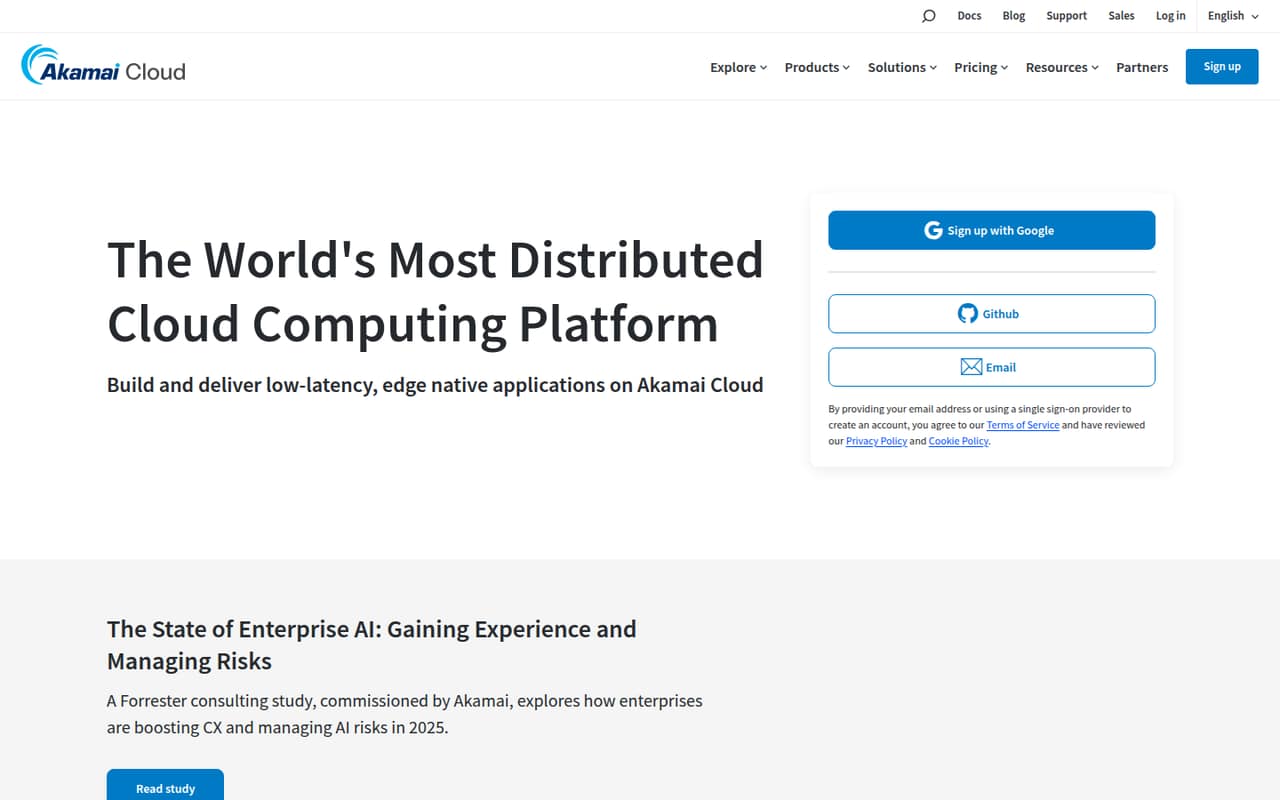
Akamai Cloud is a hosted cloud computing platform for VMs, containers, managed Kubernetes, databases, and object storage. Its distributed deployment pitch fits teams placing workloads closer to users, and the homepage points developers to documentation and endpoints.
The public details leave work for buyers: the vendor doesn't publish a starting price, named SDKs, or API protocol on its homepage. The pricing page lists a $100-per-compute-instance monthly infrastructure management add-on, but not transfer overage rates. Get a full quote and confirm integration requirements before sizing a production deployment.
Good fit if
- Teams deploying workloads across regions
- Kubernetes users needing managed orchestration
- Workloads using managed MySQL or PostgreSQL
Skip it if
- Teams requiring a published entry-level price
- Buyers needing a named SDK or language
- Projects that require self-hosted cloud software
ScoresHow it rates
What works
- Compute options include Shared CPU, Dedicated CPU, High Memory, and GPU
- Managed Kubernetes is available for containerized workloads
- Managed databases support MySQL and PostgreSQL
- CPU, transfer, storage, and RAM are bundled into a flat price
- The homepage advertises low egress fees and a free egress allowance
What doesn't
- No starting price is published
- Transfer overage rates are not published
- The homepage names no SDKs or programming languages
- No free compute plan is listed
- The $100 monthly infrastructure management add-on can raise costs
01What Akamai Cloud is, technically
Akamai Cloud is a hosted cloud computing platform: it supplies infrastructure and managed services rather than a library or a self-hosted server. It sits below an application in the stack, providing compute, storage, databases, and container orchestration for teams that build and deploy their own software.
The platform is aimed at distributed and low-latency applications. Its homepage presents VMs, containers, storage, and databases as ways to deploy workloads across a global platform. Compute choices include Shared CPU, Dedicated CPU, High Memory, and GPU. For container workloads, Akamai offers its managed Linode Kubernetes Engine and App Platform; for data, it offers managed MySQL and PostgreSQL clusters and Object Storage.
That breadth can put multiple infrastructure components under one provider. It does not, by itself, establish how many locations are available to a particular product or whether a workload can run at the edge in a specific region. Confirm product and location availability against your architecture before planning deployment.
02Akamai Cloud API, SDKs and docs
The homepage directs developers to a portal described as providing guides, documentation, and endpoints. That's the visible integration starting point for teams automating infrastructure or building against Akamai Cloud services. The homepage also presents products such as Linode Kubernetes Engine, Managed Databases, and Object Storage, but does not explain their API workflows.
The vendor doesn't publish the API protocol, SDK names, supported programming languages, CLI, or webhook details on its homepage. Confirm SDK support and endpoint behavior in the developer portal before choosing an implementation. Ask specifically about authentication, versioning, pagination, error handling, and rate limits if your deployment depends on automated provisioning or frequent API calls; those details affect retries and operational tooling.
Akamai also promotes marketplace apps and Qualified Compute Partners for low-latency deployments. Check whether a required integration is available there and whether it is supported for your chosen compute product. The public materials establish that documentation and endpoints exist, not the exact developer workflow.
03Akamai Cloud pricing for developers
Akamai's homepage says CPU, transfer, storage, and RAM are bundled into one flat price, and promotes low egress fees with a free egress allowance. The pricing page describes hourly billing, rounded up to the nearest hour, with monthly invoicing. It does not publish a starting price or annual billing option, and the listed plans provide no basis for estimating a standard production deployment.
The pricing page lists infrastructure management at $100 per compute instance per month. Transfer overage rates are not published, so ask for the applicable rates and included transfer allowance before forecasting traffic-heavy services. The homepage's free-account signup is not the same as a published free compute tier; no free plan is listed. It also advertises up to US$5,000 in cloud credits for qualifying new and existing enterprise customers, subject to promotion rules.
Model the bill against instance count, runtime, storage, transfer, and any management add-on. Get a written estimate for your selected regions and products; otherwise, the flat-price message is not enough to calculate monthly spend.
04Akamai Cloud: open source, self-hosting and lock-in
Akamai Cloud is presented as a hosted service, not as software to install on your own servers. The vendor doesn't publish a source-code license or self-hosting option on its homepage, so teams that require either should confirm availability with Akamai before adopting the platform.
The homepage pitches portability by encouraging customers to choose technologies for different workloads and avoid proprietary services. That is a useful architectural goal, but it does not define an export process. Before committing, ask how to retrieve object data, database backups, and VM images, and what formats or transfer charges apply. Also check whether your deployment depends on Akamai-specific managed-service features that would need replacement elsewhere.
Using familiar compute and container patterns may make parts of an application easier to move, but migration still requires testing the destination environment, networking, storage, and operational tooling. Treat portability as a design requirement to verify, not an automatic property of the platform.
05Akamai Cloud in production
Akamai Cloud offers compute choices, managed Kubernetes, managed databases, and object storage for production workloads. Before relying on it, confirm product availability in your target locations, service-level commitments, backup and recovery behavior, security controls, and compliance requirements. Ask Akamai for API quotas and rate limits if provisioning or operational automation will be frequent; the homepage and pricing details do not establish those limits.
A Reddit thread about a resource-heavy application reports an Akamai Cloud (formerly Linode) Shared CPU setup in the Northeast US at $768 per month, with 128 GB RAM, 24 CPUs, and 2.5 TB storage. That is one user's reported configuration and cost, not a current quote or a platform-wide price. Another commenter says Linode's prices rose after the buyout. The thread's downtime complaint is about Contabo, not Akamai, so it is not evidence of Akamai uptime.
For a production decision, request a workload-specific quote and review the applicable support and service terms. The homepage advertises expert support, but teams should verify response commitments against their own incident requirements.
From the threadsWhat users say
The small Reddit sample is mixed and centers on cost comparisons, not operational reviews of Akamai Cloud. One user reports a substantial monthly bill for a large instance; commenters debate pricing and competing providers.
Linode's prices are insane following the buyout
Hetzner's prices are hard to beat
Cost: $768/mo
It's also possible the service is better in some datacenters than others
Questions people ask
What is Akamai Cloud?
Akamai Cloud is a hosted cloud computing platform for building and delivering applications. Its product lineup includes compute, managed Kubernetes, managed MySQL and PostgreSQL databases, and Object Storage. Akamai positions it for distributed and low-latency workloads, with deployment across its global platform.
Does Akamai Cloud have a free tier?
The homepage invites users to set up a free account, but the pricing details do not list a free compute plan. Akamai also advertises up to US$5,000 in cloud credits for qualifying enterprise customers, subject to promotion rules. Confirm eligibility and what services the credits cover before budgeting.
How much does Akamai Cloud cost?
The vendor does not publish a starting price in the pricing details. The pricing page lists infrastructure management at $100 per compute instance per month, with hourly billing rounded up to the nearest hour and monthly invoicing. Transfer overage rates are not published, so request a quote for your workload.
Which databases does Akamai Cloud manage?
Akamai's Managed Databases service supports MySQL and PostgreSQL clusters. The homepage describes it as fully managed and suitable for production deployments. Confirm the available versions, backup behavior, scaling options, and service terms for your intended database before moving production data.
Can I run Kubernetes on Akamai Cloud?
Yes. Akamai offers Linode Kubernetes Engine, described as a managed Kubernetes container orchestration engine, and App Platform for deploying cloud-native applications on Kubernetes with automated infrastructure. Check the developer portal and product documentation for current configuration, API, and regional details before planning a deployment.