
We may earn a commission if you buy through links on this page. It never changes a score or a ranking. How we make money
The bottom line
A fast route from prompt to app-store builds, with production scaling and flexibility worth validating first.
Adalo is a hosted no-code app builder with an AI assistant, visual editor, hosted Postgres and publishing for iOS, Android and web. It can shorten the route from an idea to a working app, especially for forms, lists and other straightforward workflows.
The trade-off is control: the published integration surface centers on REST APIs and custom actions, and Reddit users report bugs, performance limits and friction as apps grow. We’d validate complex data relationships, custom logic and expected traffic before choosing it for a production system.
Good fit if
- Prototyping app ideas quickly
- Small apps built around forms
- Teams wanting app-store publishing
Skip it if
- Apps with complex custom logic
- Teams needing a named SDK
- High-traffic apps without validation
ScoresHow it rates
What works
- Ada creates screens, a database and logic from a prompt
- Visual editing works alongside AI-assisted changes
- Publishes native iOS, Android and web apps
- Hosted Postgres is included with every project
- Full source export provides an exit path
What doesn't
- Free and Builder plans cap apps at 500 records each
- SDKs, programming languages and a CLI are not named
- Paid add-on prices are not published
- Reddit users report performance and stability problems
- Custom logic and growing data relationships may be limiting
01What Adalo is, technically
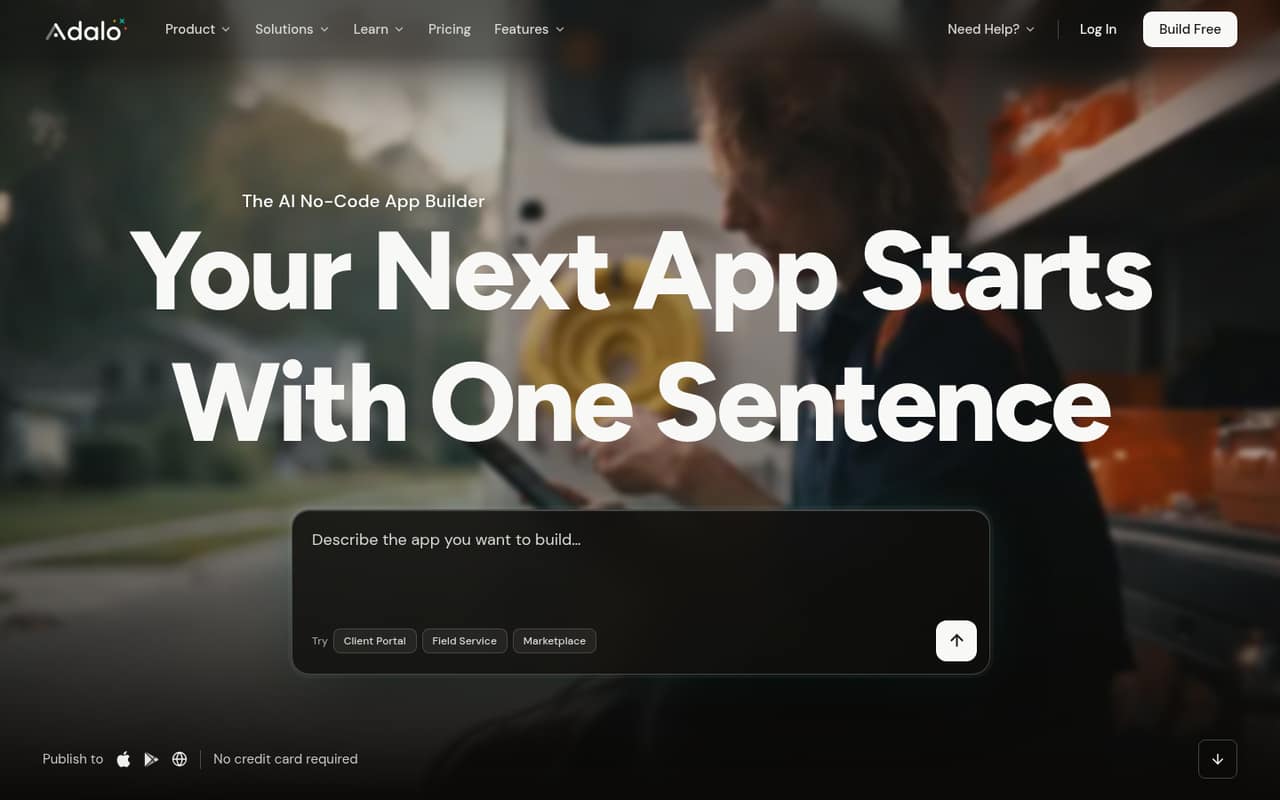
Adalo is a hosted SaaS app builder, not a client library or a self-hosted development framework. You describe an app to Ada, its AI builder, which creates screens, a database and logic; then you edit the result visually or with further prompts. The platform handles app hosting and publishing, including native iOS and Android builds and web apps.
In a typical stack, Adalo sits above a data layer and the services your app connects to. Every project includes hosted Postgres, and you can instead connect a database your team runs. Built-in integrations include Stripe, Google Maps, Firebase, and Google and Apple sign-in. The homepage also names REST API connections and custom actions for other services. Native features listed include push notifications, geolocation and camera access.
Adalo is aimed at building and shipping apps without assembling a conventional front-end and backend stack. It also offers full source export and, on Adalo Blue, on-premise deployment. That makes it more than a hosted prototype canvas, though deployment and runtime details still need checking against your requirements.
02Adalo API, SDKs and docs
The main workflow is prompt-driven app generation followed by visual editing. Ada builds screens, database structure and logic from a sentence; you can then request changes or make them in the editor. That keeps the initial build approachable, but developers should map data relationships and custom logic before committing to a larger app.
Adalo's homepage names a REST API integration surface and custom actions. Built-in services include Stripe, Google Maps, Firebase, Google and Apple sign-in, and Google Sheets. It also supports hosted Postgres or connecting an external database. The homepage does not name a language-specific SDK or CLI; confirm SDK support in the vendor's docs before planning a code-first integration. It likewise does not identify webhooks or plugins as integration surfaces, so don't assume they are part of the workflow.
A Reddit commenter describes an easy initial learning curve and video courses in Adalo's App Academy, while warning that advanced data work is less intuitive. Check the vendor's docs for the exact API operations, authentication model and supported integration behavior your app needs.
03Adalo pricing for developers
Adalo has a Free plan at $0 per month for building and testing: it includes five Ada prompts per month, one free app build, unlimited test apps, one app editor and 500 records per app. Builder costs $65 monthly or an effective $52 per month with annual billing. It includes two published apps, five editors, one instant update per month, no prompt limit and the same 500-record-per-app allowance.
Business is $200 monthly or $160 per month annually. It raises the allowances to five published apps and 10 editors, adds unlimited instant updates, Collections API and external databases. Adalo Blue is for custom deployments, but its price is not published. Plans can be billed quarterly at 10% off or yearly at 20% off; Builder's $30 first-month offer applies to monthly billing.
The listed plan differences make the bill grow with published apps, editors and required capabilities, rather than a published per-request meter. Localization, crash monitoring and analytics are paid Builder add-ons with unpublished prices. Extra AI credits are also available at an unpublished price. Budget separately for Apple Developer ($99/year) and Google Play Developer ($25 one-time) accounts.
04Adalo: open source, self-hosting and lock-in
Adalo does not present itself as an open-source platform, and the vendor does not publish an open-source licence for the builder. Its hosted service is the standard way to build and publish apps. Adalo Blue lists on-premise deployment and dedicated infrastructure, but its pricing is not published; confirm what runs on-premise and what remains dependent on Adalo before treating it as a self-hosted alternative.
The vendor says you can export the full app source and run it wherever you like. That is a useful exit route, but it is not the same as having an open-source builder or a documented migration plan. The homepage also allows teams to use their own database instead of hosted Postgres. Before adopting Adalo, ask what source export includes, how app data can be exported, and whether the exported app can be maintained without the platform. Those details determine how much of the stack can move with you.
05Adalo in production
Adalo lists native iOS and Android builds, web publishing, app-store submission and over-the-air updates; it says most updates ship without a store review. That can simplify release work, but teams should confirm which changes qualify for over-the-air delivery and what store-review steps remain. The Free and Builder plans cap each app at 500 records; check the applicable data limits and operational terms for a production plan before designing around larger datasets.
Reliability and scale deserve a proof of concept. In Reddit discussions, users report bugs, stability issues, poor runtime performance and rigidity as functionality, traffic or data relationships grow. Other comments say simple forms-and-lists apps can remain a better fit for no-code tools than apps with complex logic. These are user reports, not a guarantee of how a particular project will behave.
Before launch, validate expected traffic, data growth, integrations, backups, security controls and compliance requirements with the vendor. Adalo's public homepage does not establish specific security certifications or service-level commitments, so ask for those if your deployment depends on them.
From the threadsWhat users say
Reddit sentiment is mixed but leans cautious for production use. Users value the approachable start and quick prototypes, while several report performance, stability and flexibility problems as apps grow.
the learning curve is easy in the beginning
Advanced features aren't the most intuitive though. (like showing and working with data)
I've started running into some limitations with flexibility and occasional stability issues
The performances when running the app are really not good
Questions people ask
Is Adalo free?
Yes. The Free plan costs $0 per month and includes five Ada prompts per month, one free app build, unlimited test apps, one editor and 500 records per app. It is for building and testing, so check the paid plans if you need more editors, published apps or production features.
Can Adalo publish apps to the App Store and Google Play?
Yes. Adalo says it can publish native iOS and Android builds to the App Store and Google Play, as well as publish to the web. Apple and Google developer accounts are separate costs: the pricing information lists $99 per year for Apple and a $25 one-time fee for Google Play.
Does Adalo own the apps I build?
The vendor says you can export the full source and run it wherever you like, which provides an exit path. Before relying on that, ask what the export includes, how to export app data and whether you can maintain the app independently. The vendor does not publish an open-source licence for the builder.
Can I connect my own database to Adalo?
Yes. Adalo includes hosted Postgres, and the vendor says you can connect a database your team already runs. Business includes external databases and Collections API. Confirm the supported connection methods, data behavior and plan requirements against your use case before migrating production data.
Is Adalo suitable for production apps?
It can publish production apps, but fit depends on your data model, logic and expected traffic. Reddit users report performance, stability and flexibility issues as apps grow. We’d validate those risks with a working proof of concept and ask the vendor about data limits, security controls and service commitments.